


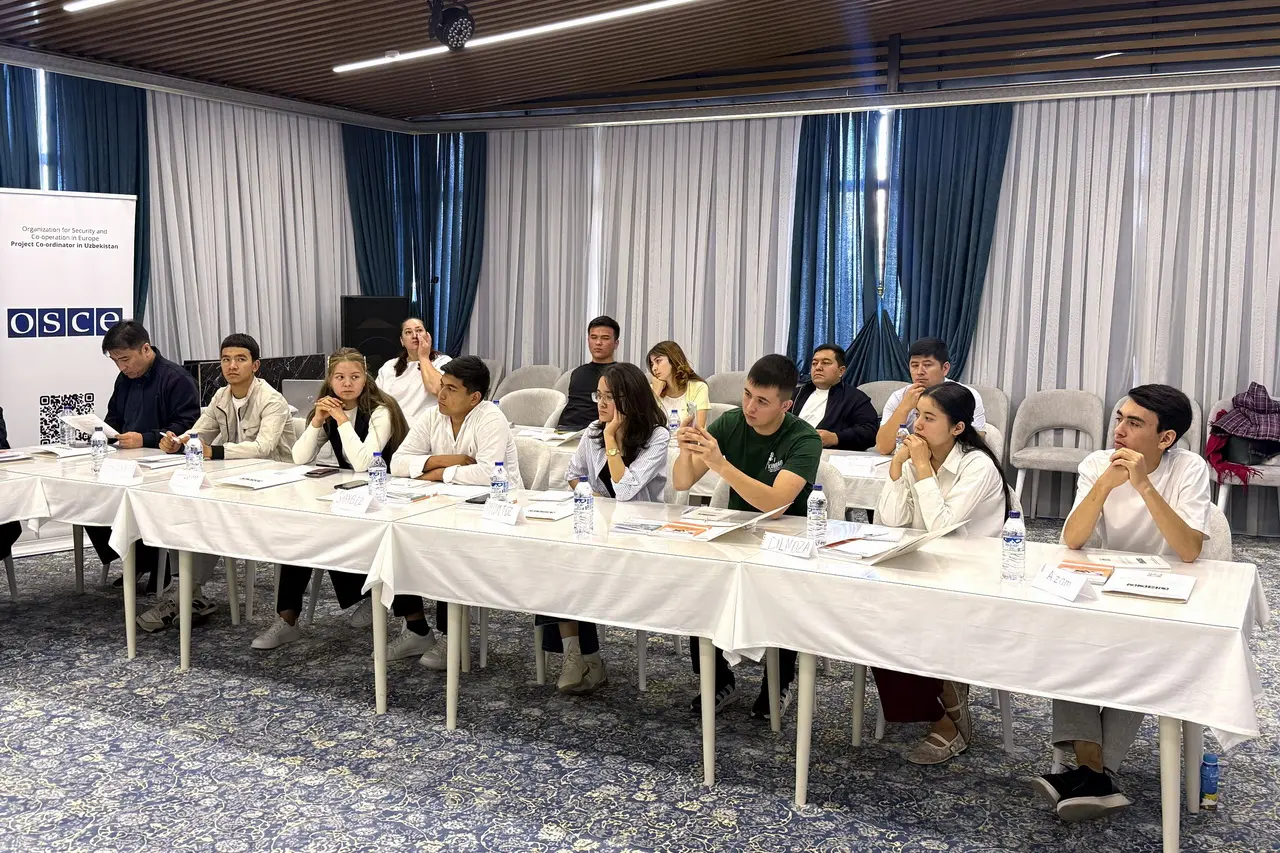
Tashkent, Uzbekistan — In an age when a single unchecked post can circle the globe within seconds, the line between genuine information and deliberate falsehood has become dangerously thin. The internet, once celebrated as the great democratizer of knowledge, now also serves as a fertile ground for manipulation, extremism, and radicalization. Recognizing this growing threat, the OSCE Project Co-ordinator in Uzbekistan, in close cooperation with the Journalist Retraining Centre, has stepped forward with a practical and forward-looking response. The two organizations jointly organized a specialized media camp in the Parkent district of the Tashkent region, bringing together thirty talented students of journalism, filmmaking, and design from leading universities across the country. The camp was not simply another training seminar; it was an immersive three-day initiative designed to build critical media literacy skills among the very people who will shape Uzbekistan’s modern visual and informational culture. The underlying message was clear: the next generation of media professionals must be equipped not only with technical skills but with the analytical judgment, ethical compass, and digital resilience necessary to navigate a landscape saturated with misinformation, disinformation, and malicious content. By focusing on the detection of fake news, rigorous fact-checking, and the creation of safe, reliable content, the program aimed to transform young creators into vigilant gatekeepers of truth. More importantly, the initiative sought to position these young talents as active participants in preventing violent extremism and radicalization that can ultimately lead to terrorism. In a world where harmful narratives often find their most receptive audiences among the young, the camp represented a strategic investment in the future. It acknowledged that media professionals, filmmakers, and designers are not mere passive producers of entertainment or news but are cultural influencers whose work can either reinforce social cohesion or unintentionally amplify division. The choice of Parkent, a scenic district outside the capital, was deliberate: it allowed participants to step away from the pressures of daily life and immerse themselves fully in a collaborative environment where creativity, critical thinking, and social responsibility were placed at the center of the learning experience.
The urgency of this mission cannot be overstated, particularly in a region where the internet has become a double-edged sword. On one hand, digital platforms provide unprecedented opportunities for education, expression, and connection. On the other, they have evolved into arenas where extremist groups and malicious actors exploit psychological vulnerabilities, spread propaganda, and recruit impressionable individuals through sophisticated online campaigns. The same algorithms that recommend harmless videos can, without intervention, lead vulnerable users down a rabbit hole of radical content. This phenomenon is not confined to any single country or culture; it is a global challenge. However, for a nation like Uzbekistan, which is undergoing rapid digital transformation and boasts one of the youngest populations in Central Asia, the stakes are particularly high. Young people are not only the most active users of social media but also the primary targets of those who seek to weaponize information. The media camp, therefore, was designed to address the root causes of this vulnerability. Rather than simply telling participants what to avoid, it empowered them to understand how propaganda works, how emotional manipulation is deployed, and how disinformation is manufactured and spread. The organizers recognized that media literacy is not a luxury but a fundamental skill for democratic citizenship and national security. Journalists and content creators, in particular, bear a special responsibility. They are the ones who decide which stories are told, which voices are amplified, and which narratives are normalized. If they lack the ability to verify facts, identify bias, and recognize harmful stereotypes, they can unwittingly become accomplices in the very processes of radicalization that society seeks to prevent. The camp sought to break this cycle by fostering a new generation of media professionals who understand that accuracy is not an obstacle to creativity but its essential foundation. Participants were encouraged to think of themselves not merely as students but as future guardians of the public trust, tasked with the difficult but crucial mission of ensuring that the information ecosystem does not become a weapon against the very communities it is meant to serve.
The three-day program was carefully structured to combine theoretical knowledge with hands-on experience, ensuring that every lesson could be immediately applied in real-world contexts. The curriculum included interactive sessions, practical case studies, and expert-led workshops on a range of critical topics. Among the most important were digital hygiene, which taught participants how to protect their own online presence and verify the authenticity of sources; the use of artificial intelligence in storytelling, a rapidly evolving field that offers both creative opportunities and new ethical dilemmas; and the creation of alternative narratives, a technique used to counter extremist propaganda by offering more compelling, tolerant, and positive stories. The sessions were not passive lectures. Instead, participants were actively engaged in analyzing real examples of disinformation, deconstructing manipulative visuals, and examining how rumors can spiral out of control on social media. They learned how to trace the origin of an image, check the credibility of a source, and assess the emotional cues that often signal manipulated content. They also explored the role of design in shaping perception, understanding that visual choices—colors, framing, typography—can carry subtle ideological messages. This focus on the visual dimension was particularly relevant given that half of the participants were journalism and design students who will go on to create the images, infographics, and visual stories that dominate modern media. The program also delved into the profound ways in which everyday digital interactions affect real-world communities. Participants examined how online hate speech can translate into offline violence, how cyberbullying can drive individuals to isolation and despair, and how seemingly harmless shares of unverified information can cause real damage to people’s reputations and mental health. Through group discussions and collaborative projects, they were encouraged to reflect on their own online behavior and to consider what it means to be an ethical digital citizen. The camp did not shy away from difficult conversations; instead, it created a safe space where young creators could confront the uncomfortable realities of the digital age without feeling overwhelmed. By the end of the three days, the participants were not only more knowledgeable but also more confident in their ability to make a positive difference in their communities.
Speaking at the event, Gulnara Babadjanova, Director of the Journalist Retraining Centre, underscored the profound responsibility that modern media professionals carry in the struggle against terrorism and extremism. “Our most important weapon in the fight against terrorism is accurate and reliable information,” she said. “The role of modern media is not to spread negative stereotypes, but to promote tolerance in society. Journalists themselves must continuously develop their knowledge and skills in order to report on complex issues professionally, while always keeping ethics and people’s safety in mind.” Her words resonated deeply with the participants, many of whom had grown up in an era of information overload and had witnessed firsthand the chaos that misinformation can cause. Babadjanova’s statement highlighted a crucial shift in how the fight against extremism is understood. For many years, the primary response to terrorism was security-based: surveillance, policing, and military action. While these measures remain necessary, there is growing recognition that the battle is also ideological and informational. Extremist groups thrive on simplification, stereotyping, and fear. They reduce complex political and social realities to dangerous caricatures, and they rely on the media to amplify these caricatures either through sensational coverage or through the careless repetition of unverified claims. By contrast, accurate and reliable information undermines the very foundations of extremism. It exposes falsehoods, complicates simplistic narratives, and humanizes the people who are often reduced to enemies in propaganda. Babadjanova’s call for continuous professional development is particularly important in a media landscape that is constantly evolving. New platforms emerge, algorithms change, and technologies such as artificial intelligence make it easier than ever to create convincing fake images, video, and audio. Journalists who stop learning soon become obsolete, and worse, they become vulnerable to manipulation. The media camp was designed to address this challenge by instilling a habit of lifelong learning in its participants. It encouraged them to approach every story with humility, to question their own assumptions, and to remember that behind every statistic, every image, and every headline there are real people whose lives and dignity must be respected. The ethical dimension emphasized by Babadjanova was woven throughout the entire program, reminding participants that their professional choices have moral consequences.
The voices of the participants themselves provided the most compelling evidence of the camp’s impact. Shamsiddin Talibboev, a student at Uzbekistan State World Languages University, offered a thoughtful reflection that captured the spirit of the entire initiative. “It is important not only to know how to use the internet, but also to critically evaluate our actions online, understand that sharing content without consent causes real harm, and avoid supporting cyberbullying,” he said. His words highlight a key insight that is often overlooked in discussions of digital safety: the problem is not simply malicious actors operating from the shadows. Ordinary users, including well-meaning young people, can contribute to a toxic online culture through careless sharing, invasive behavior, and the casual spread of harmful content. Talibboev’s emphasis on consent is particularly significant. In an era of viral challenges, meme culture, and relentless content creation, the boundaries between public and private, between acceptable commentary and harassment, are often blurred. Young creators, eager for attention and engagement, may inadvertently violate the privacy of others or amplify harmful stereotypes. The media camp sought to correct this by fostering a culture of empathy and accountability. Participants were encouraged to think about the human impact of their digital actions, to consider how a photograph taken out of context might affect someone’s life, and to recognize that a single comment can contribute to an environment of intimidation and fear. Talibboev’s reflection also underscores the importance of critical self-evaluation. Digital literacy is not just about evaluating external sources; it also requires examining our own motives, biases, and habits. Why do we share certain content? Are we seeking validation, expressing anger, or genuinely trying to inform? By asking these questions, young media professionals can move beyond passive consumption and engage with the internet more intentionally. The camp provided participants with practical tools for this kind of self-reflection, including exercises in digital journaling and collaborative feedback sessions. These activities helped students understand that their online identities are not separate from their real-world values but are, in fact, extensions of them. When they graduate and enter the professional world, they will carry this awareness with them, shaping not only their own behavior but also the editorial cultures of the organizations they join.
In the broader context of Uzbekistan’s development, the media camp marks a significant step toward a safer, more transparent information environment. It represents a growing recognition that the fight against violent extremism cannot be won solely through security measures; it must also be waged in classrooms, newsrooms, and digital studios. The investment in thirty young students is, in many ways, an investment in the entire society. These students will go on to work in television, radio, online media, film production, advertising, and design. They will create the content that will inform and entertain millions of people. They will influence public opinion, shape cultural norms, and set ethical standards for future generations of creators. The skills and values they acquired at the media camp—critical thinking, rigorous fact-checking, ethical judgment, and digital resilience—will multiply as they share their knowledge with colleagues, classmates, and audiences. The camp also sends an important signal about the role of international cooperation in addressing shared challenges. The OSCE Project Co-ordinator in Uzbekistan, working alongside the Journalist Retraining Centre, has demonstrated that effective solutions to complex problems require partnership, mutual learning, and a commitment to common values. The success of the initiative is not measured only by what happened over three days in Parkent, but by the lasting impact that these young people will have in their communities. There is no simple way to measure the prevention of radicalization; success often appears as an absence, as stories that were never told, recruits that were never enlisted, and acts of violence that were never committed. Yet every young journalist who chooses to verify a source before publishing, every filmmaker who resists the temptation to sensationalize suffering, and every designer who uses their skills to promote tolerance rather than division contributes to a defenses against extremism that is both powerful and essential. The media camp in Parkent was a modest event in scale but an ambitious one in vision. It recognized that the future of Uzbekistan, and indeed the future of the global community, depends on the ability of ordinary people to distinguish truth from falsehood, to resist the lure of easy answers, and to treat one another with dignity and respect. In the end, the most important message of the camp was a simple but profound one: in the struggle for peace and security, the pen, the camera, and the design tool are just as powerful as any weapon—and far more capable of building a world we all want to live in.