


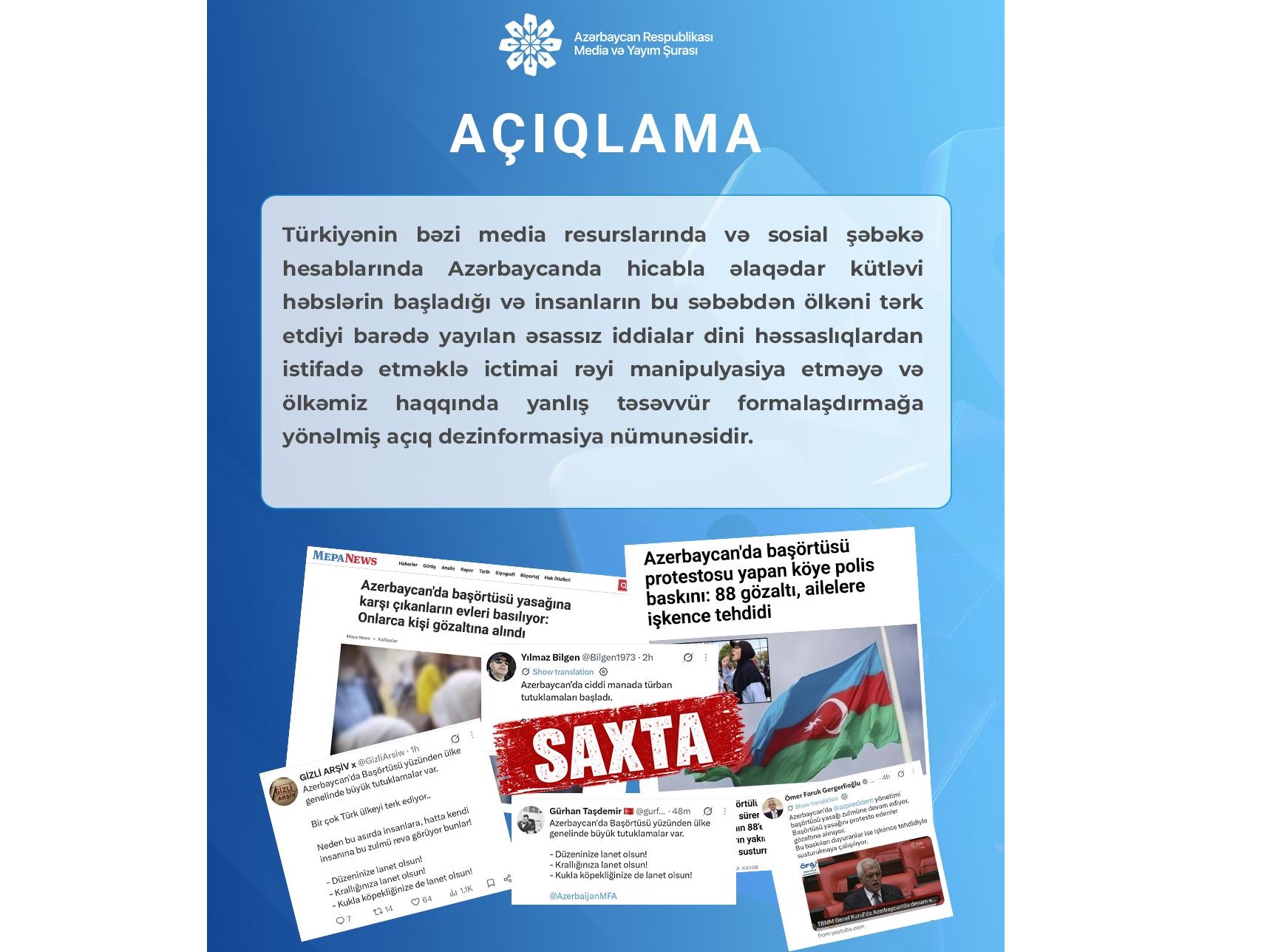
Azerbaijan’s Media Council Slams ‘Fabricated’ Hijab Arrest Claims as Disinformation Exploiting Religious Sentiments
BAKU, Azerbaijan — Azerbaijan’s Media and Broadcasting Council has issued a forceful, sharply worded statement rejecting what it describes as a coordinated wave of disinformation spread through certain Turkish media outlets and social media accounts, alleging that Azerbaijan has carried out mass arrests over the wearing of the hijab and that citizens are fleeing the country as a result. In an official statement released on October 22, the Council said these reports are “a clear example of disinformation designed to exploit religious sensitivities, manipulate public opinion and misrepresent Azerbaijan.” The regulator’s unusually strong language reflects a growing determination among Azerbaijani authorities to confront false narratives that have gained traction online and, in some cases, been amplified by media platforms with substantial audiences. The Council’s statement arrives at a time when information warfare in the South Caucasus has become increasingly sophisticated, with social media serving as a fertile ground for provocations aimed at inflaming emotions, distorting realities, and undermining trust in state institutions. The hijab-related claims are particularly dangerous because they seek to weaponize religious identity, a deeply personal and sensitive matter for millions of Muslims both in Azerbaijan and across the wider region. By categorically denying the allegations and labeling them as manipulation, the Council has made clear that such reports are not simply journalistic errors but deliberate attempts to foment public unrest and damage Azerbaijan’s international reputation.
The statement emphasizes that Azerbaijan’s legal framework fully protects religious freedom and that the country’s social landscape has long been defined by peaceful coexistence among people of different faiths and cultural backgrounds. It also notes that the false reports are part of a larger pattern of attacks targeting Azerbaijan, using fabricated stories to create a misleading picture of life in the country. The Council expressed particular concern that certain political and public figures have chosen to amplify these baseless claims, warning that their participation in spreading disinformation violates their public responsibilities and constitutes an unacceptable abuse of their influence. This pointed remark underscores a recurring problem in modern information ecosystems: personalities with large followings can unwittingly — or perhaps intentionally — serve as vectors for harmful narratives. When public officials, commentators, or social media influencers share unverified allegations in inflammatory language, they dramatically extend the reach of the original falsehood and make it harder for ordinary citizens to distinguish truth from fiction. The Council’s statement is therefore not only a defense of Azerbaijan’s reputation but also a broader call for accountability in public communication, reminding all individuals with a platform that they bear a moral and civic obligation to exercise caution before disseminating sensitive material, especially on topics involving religion and national identity.
Behind the Council’s sharp rebuke lies a deeper reality: Azerbaijan is a predominantly Muslim country with a deeply rooted tradition of secular governance, where women have long worn the hijab or other modest clothing without hindrance, and where the state guarantees freedom of worship for all religious communities. The claim of mass arrests over hijab is not merely unsubstantiated; it contradicts the everyday experience of Azerbaijani citizens and the country’s established legal norms. Mosques, churches, and synagogues operate openly across the country, and religious leaders regularly participate in interfaith dialogue. Azerbaijani women wearing hijabs can be seen in universities, government offices, and public spaces, and there is no official policy banning or restricting religious attire. The allegation that people are fleeing the country because of such supposed arrests is equally absurd when measured against the actual social environment, which remains stable and peaceful. The Media and Broadcasting Council’s statement implicitly reminds readers that if such mass arrests had indeed occurred, there would be a trail of official records, court proceedings, and credible media coverage — none of which exists. Instead, the narrative appears to be built entirely on anonymous social media posts and sensationalized headlines, unaccompanied by verifiable evidence. The Council’s insistence that the public check information against reliable sources is a direct acknowledgment that in an age of viral misinformation, authenticity too often takes precedence over accuracy.
The spread of such disinformation must be understood within a broader geopolitical context. Azerbaijan has spent years strengthening its position on the international stage, securing major infrastructure projects, hosting international events, and playing a pivotal role in regional energy transit. This growing prominence makes the country an attractive target for actors seeking to destabilize it or tarnish its image. By linking Azerbaijan to an alleged campaign of religious persecution, the purveyors of the hijab narrative are attempting to rally international public opinion against the country, particularly among Muslim-majority audiences. The tactic is not new: religious sensitivities are often exploited as a tool of hybrid warfare because they produce strong emotional responses that override rational thought. A fabricated story about women being arrested for wearing a headscarf is almost guaranteed to generate outrage, regardless of whether it has any connection to reality. The Media and Broadcasting Council’s statement strikes directly at this mechanism, calling out the disinformation for what it is — a cynical effort to manipulate the hearts and minds of people who, quite understandably, feel protective of religious symbols and personal freedoms. In naming the manipulation of public opinion as a key motive, the Council is also warning observers both inside and outside the country to be vigilant about such tactics, which often escalate from social media chatter to broader political campaigns aimed at isolating a nation diplomatically or economically.
Equally important is the Council’s appeal to media professionals and public figures to uphold ethical standards in journalism and commentary. In an era where the race for clicks and engagement often trumps the pursuit of truth, media outlets sometimes resort to sensationalism without verifying facts, and social media amplifies the damage within minutes. The Council’s statement serves as a reminder that journalism is not merely a commercial enterprise but a social responsibility, and that those who abuse the power of the press to spread misinformation violate the trust upon which democratic societies are built. The reference to political and public figures as active participants in the disinformation campaign is particularly significant, as it suggests that the problem goes beyond careless reporting and involves deliberate actors with agendas. By calling on these individuals to act responsibly, the Council is appealing not only to their sense of ethics but also to their understanding of the potential consequences of their actions: public discord, intercommunal tension, and lasting damage to bilateral relations between countries that have historically enjoyed close ties. The statement also implicitly acknowledges the reality that even well-meaning citizens can become unwitting conduits of disinformation if they do not take the time to verify what they share. This is why the Council’s message is directed not only at media professionals but at the public as a whole — ordinary individuals scrolling through their social media feeds must learn to recognize manipulative narratives and refuse to amplify them.
The Media and Broadcasting Council concludes its statement with a strong condemnation of the false reports and a practical call to action: media representatives should act responsibly, and the public should critically assess such posts, check information against reliable sources, and refrain from spreading disinformation. This final appeal encapsulates the two essential components of any effective response to misinformation — institutional vigilance and individual discernment. No government body can fully eliminate disinformation by itself; the public must be equipped with the critical thinking skills necessary to question what they read, search for official confirmations, and resist the temptation to share shocking content without due diligence. The Council’s statement is ultimately an affirmation of Azerbaijan’s confidence in its own society — a society that, in the Council’s view, will not be easily divided by manufactured provocations. It also represents a broader message to the international community: that Azerbaijan will not allow external forces to distort its reality or undermine its stability through false allegations. As false news continues to proliferate across digital platforms, the response from Azerbaijan’s Media and Broadcasting Council offers a model of clarity and firmness, demonstrating that the best antidote to lies is not silence but transparent, principled, and reliable information. The hijab disinformation episode, if nothing else, has made clear that Azerbaijan remains vigilant against attempts to exploit religious feelings for political ends, and that the country’s commitment to peace, tolerance, and truth will not be shaken by baseless online provocations.