


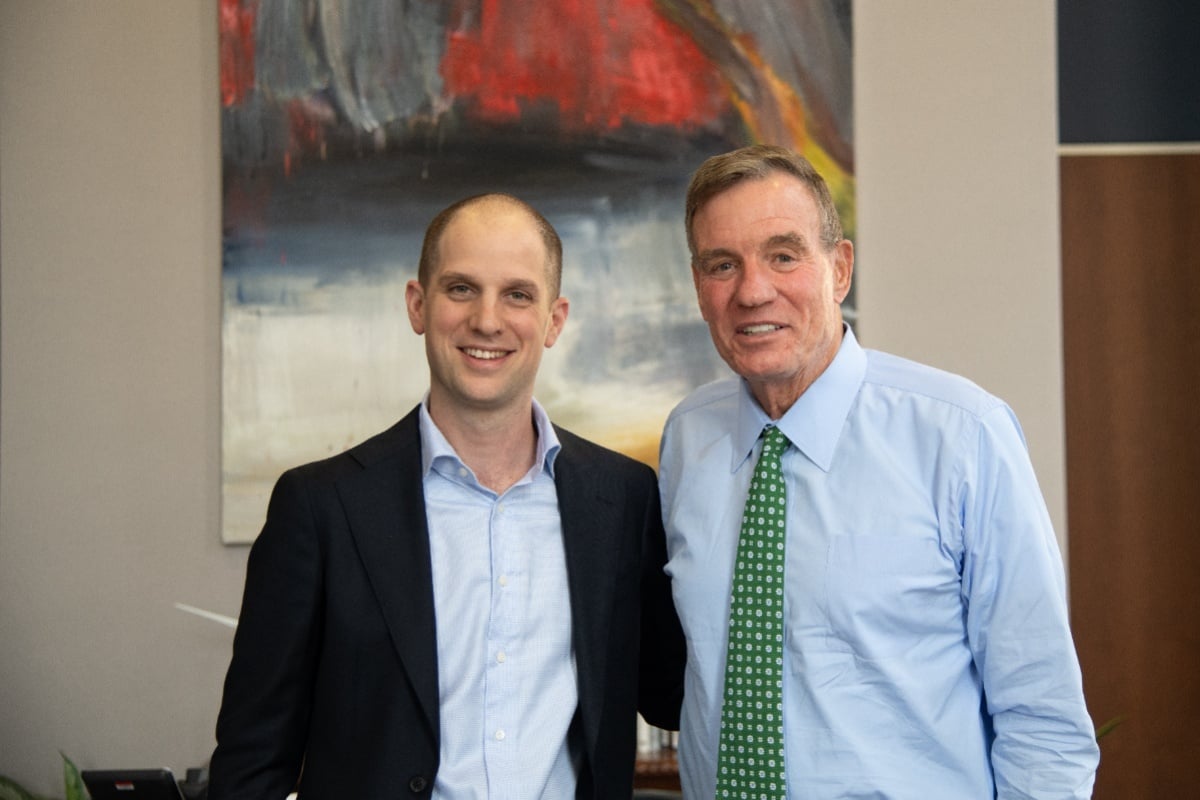
Two senior members of Congress are warning that Russia is running an active, targeted misinformation campaign against Democratic candidates ahead of the midterm elections, even as intelligence agencies have found no evidence that any foreign adversary can penetrate voting systems or alter the outcome of the vote. Senator Mark Warner of Virginia and Representative Jim Himes of Connecticut, both members of their chambers’ intelligence committees, made the warning after receiving a classified briefing from Director of National Intelligence Jay Clayton. Warner and Himes requested the briefing on October 2, according to Just Security, seeking more transparency about foreign threats to the midterms. In interviews with Reuters, reported by The News Tribune, the two lawmakers said they could not reveal the specific misinformation material because it remains classified. But they described a robust and ongoing effort to distort public perception of the vote, with Himes summing up Moscow’s approach as “same old, same old.” Russian operatives, he said, are “throwing everything out there,” including efforts to stoke chaos and distrust of voting machines. The Connecticut Democrat was careful to separate that influence activity from any attempt to actually interfere with how votes are cast or counted. He said there was no evidence that any country could penetrate U.S. election systems and change the results, and that the available information did not suggest capability or intent to interfere with election systems even as a robust influence environment persisted. Warner and Himes also said they were concerned that President Donald Trump could try to contest the election results by claiming foreign hacking of voting infrastructure, even though no such evidence exists. Their concern, they suggested, was one reason the intelligence community needed to be explicit about what it has and has not found, and why they were pressing for public transparency about the threats ahead of November.
The congressional briefing echoes findings from outside researchers who have tracked a surge in Russian-linked activity this fall. According to The New York Times, a Russian government-backed operation known as Doppelgänger has been stepping up its attempts to sow division in the United States, working to damage Democrats by portraying them as having retreated from support for Israel. The Times reports that the operation is run by Russia’s Social Design Agency, which has been sanctioned by both the United States and the European Union. The same reporting found that U.S. intelligence assessments did not find evidence of any attempts to take aim at voting machinery itself, reinforcing the distinction lawmakers drew between influence operations and attacks on the voting process. Social media posts tied to the campaign promoted claims that bipartisan support for Israel was collapsing, part of a broader effort to fracture Democratic coalitions ahead of November. The tactic is notable because it marks a shift from earlier Russian efforts to exploit existing divisions across the political spectrum; the current material is squarely directed at Democratic candidates and appears designed to turn traditionally Democratic constituencies against the party’s nominees. Researchers say the Doppelgänger operation uses social media personas, branded content and manipulated news-style material to make these messages look genuine. The targeted nature of the messaging, combined with the stakes of the coming election, has raised alarms among election-security experts, who say the operation is designed less to change votes than to depress turnout and cast doubt on the legitimacy of the outcome.
Separately, a Russian-linked network dubbed Matryoshka has been flooding social platforms with fabricated videos and doctored news content aimed at Democratic candidates nationwide. A Bloomberg review cited by the Sydney Morning Herald found that between September 10 and October 9, the network published 130 videos and doctored newspaper front pages targeting the midterm races, hitting 29 of the 36 Democratic candidates running for governor and 20 of the 35 vying for Senate seats. Two of those targets, identified in news reports cited by Warner, are James Talarico, who is running for U.S. Senate in Texas, and Jon Ossoff, who is seeking re-election to his Georgia Senate seat. News reports cited by lawmakers say fake AI-generated advertisements targeted both men. Bloomberg’s review found a fabricated video falsely alleging Talarico paid OnlyFans models, and another falsely claiming Ossoff owned eight undeclared properties; the outlet noted there is no evidence the IRS discovered any undeclared Ossoff properties. The same report found that tactics have shifted from exploiting divisions across the political spectrum to focusing solely on attacking Democrats. Matryoshka posts used automated accounts to make fabricated stories appear popular, with view counts jumping as high as 200,000 within the first hour before quickly plateauing—a pattern researchers flagged as evidence of manipulation. The fake ads were often designed to look like authentic news reports, using doctored front pages and fabricated video segments, and in some cases were spread through social media groups before being amplified by bot networks. The scale of the operation, combined with the speed of its distribution, has made it one of the most visible examples of foreign interference in the current cycle. The fact that the targets include not only high-profile senators but also state-level and lower-profile candidates suggests a broad effort to shape the national narrative rather than a narrow attempt to tilt one or two races.
Officials have repeatedly emphasized that none of this activity amounts to evidence that votes themselves have been altered. Himes told Reuters there was no reason to believe China had not conducted extremely targeted efforts to influence voters as it had in the past. That remark drew a sharp rebuke from the Chinese embassy, which on Wednesday called it a false allegation and a serious smear. The Russian embassy, the White House and the Office of the Director of National Intelligence did not immediately respond to requests for comment. Moscow has in the past denied meddling in U.S. elections, and Beijing has previously denied interfering as well. The no-evidence finding tracks with the broader historical record. According to The Record, U.S. intelligence officials found no evidence that any foreign adversary successfully interfered in the 2024 presidential election, even though Russia, Iran and China each ran influence campaigns that year. A 2019 bipartisan Senate Intelligence Committee review likewise found no evidence that any votes were changed or that any voting machines were manipulated during the 2016 election, according to Just Security’s summary of that report. The distinction is important because public alarm about fake videos and manipulated news stories can itself become a form of disruption, eroding confidence in election infrastructure even when the infrastructure remains secure. Election officials have sought to counter that by emphasizing the layers of security around voter registration databases, ballot tabulation and post-election audits, all of which make it difficult for an outside actor to alter outcomes without detection. At the same time, officials acknowledge that the information environment is vulnerable, and that false narratives can spread quickly even if the underlying systems are not compromised. The practical takeaway from both intelligence assessments and outside research, officials say, is that the greatest threat is not a hacked voting machine but a hacked public conversation.
Behind the current wave of fabricated content is a technological shift that researchers say is reshaping the threat landscape. Just Security notes that advances in artificial intelligence are lowering the technical and financial barriers to sophisticated foreign influence operations, while the Brennan Center for Justice has described AI as now a standard feature of both influence operations and cyber operations, increasing their speed and scale. The Council on Foreign Relations has similarly observed that China, Iran and Russia are all still pursuing influence operations that could be made more effective and easier to conduct with the help of artificial intelligence. The Office of the Director of National Intelligence shared a report with Congress in recent weeks warning that foreign adversaries were using artificial intelligence to spread disinformation online; that report identified Russia as the most active foreign adversary in using digital tools to undermine confidence in election integrity, according to the Sydney Morning Herald’s reporting. The practical effect is that what once required large teams of paid trolls and substantial financial resources can now be done with generative text, image and video tools available for little or no cost. Fake videos of candidates saying or doing things they never said or did can be produced in minutes and distributed across multiple platforms before fact checkers can respond. Even when the fakes are debunked, the debunking often reaches a smaller audience than the original falsehood, and the mere existence of a convincing fake can be enough to sow doubt about the authenticity of all political content. Despite those concerns, Just Security cautions that the foreign activity reported so far involves online influence operations, including fabricated videos, primarily by Russian actors, and that nothing in the public record suggests a foreign government is poised to carry out an election-altering operation this coming November. The intelligence community’s assessment, in other words, is that the principal danger is not a stolen election but a poisoned information environment.
The briefing lands amid a politically charged backdrop. Reuters/Ipsos polling showed Democrats leading Republicans nationally on the generic congressional ballot by high single digits to low double digits, a lead that has bolstered Democratic hopes of regaining control of the House and possibly the Senate, according to the News Tribune’s report. Trump, meanwhile, has eased economic sanctions on Russia in recent weeks even as he has increased pressure on Ukraine to end its fight against Russian forces. That juxtaposition has added another layer of sensitivity to the briefing, with Democrats wary that the administration may be reluctant to call out Russian interference for fear of complicating its policy priorities. State and local election officials, for their part, say they are navigating an increasingly contentious relationship with the federal government even as they brace for a range of threats. Politico reports that officials have prepared for everything from bomb threats at polling places to large-scale disinformation campaigns and state-backed hacking efforts as the midterms approach. Warner spoke about the growing role of artificial intelligence in these campaigns during an appearance on Capitol Hill, underscoring that lawmakers across both chambers are watching the issue closely as November nears. The combination of Russian influence operations, domestic polarization and the heightened capabilities of AI has created what many officials describe as the most complex threat environment for an election in modern American history. The intelligence community’s bottom line, as relayed by Warner and Himes, is that the mechanics of American democracy remain intact—but the trust that holds those mechanics together is very much under assault.