


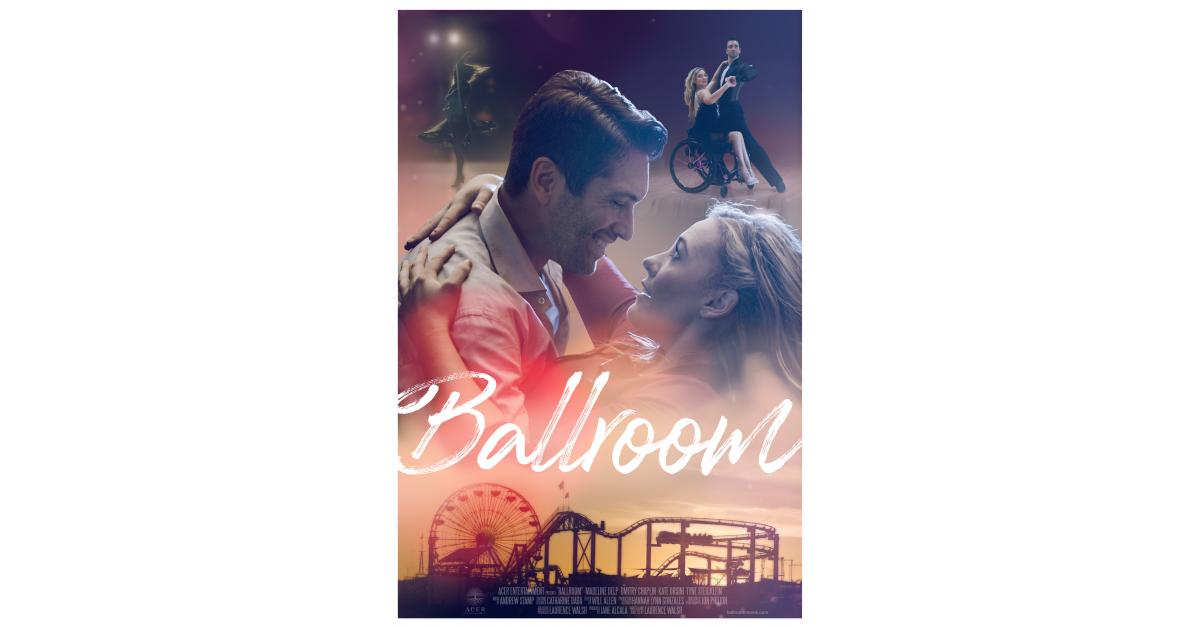
LOS ANGELES — Freestyle Digital Media, the digital film distribution division of Byron Allen’s Allen Media Group, has released BALLROOM, a musical romantic drama feature with a social impact message, across North American digital HD internet, DVD, cable, and satellite platforms starting September 25, 2026. Written and directed by Laurence Walsh, the film tells the story of Violet Galvert, an aspiring dancer whose dreams are shattered when a car accident leaves her paraplegic. The project is being positioned as a different kind of dance drama, one that pairs the emotional pull of ballroom and musical performance with a serious engagement with disability, recovery, and identity. The release is also notable for its commitment to authentic casting: Madeline Delp, an actress with a disability who uses a wheelchair for mobility, stars as Violet. In a statement accompanying the release, Walsh said the filmmakers chose not to cast an able-bodied actress in the role, a decision that he described as groundbreaking. Instead, the production used Delp’s lived understanding of loss and resilience to shape the performance, and employed a body double for the character’s standing sequences. The result, according to the filmmakers, is a portrayal that carries a degree of emotional truth rarely seen in mainstream films about disability. BALLROOM is now available on North American digital HD internet, DVD, cable, and satellite platforms, giving audiences multiple ways to watch the film. By positioning BALLROOM as a “social impact dance drama,” the filmmakers are inviting audiences to consider not just Violet’s individual story but also broader questions about how society treats disability. The combination of romance and dance is intended to draw viewers in, while the authentic casting and social themes are meant to leave a lasting impression. That dual purpose is reflected in the film’s distribution, which spans both commercial VOD platforms and traditional home entertainment channels.
At the center of BALLROOM is Violet’s emotional and physical journey. Before her accident, Violet is an aspiring dancer with her heart set on making it in a competitive performance world. The car accident that leaves her paraplegic upends not only her career ambitions but also her sense of self. As she struggles with depression, she withdraws from the activity that once gave her life meaning. Her therapists attempt to guide her through rehabilitation, but it is the arrival of Petro, a charismatic dance instructor played by Dmitry Chaplin, that begins to change her outlook. Petro serves as both a romantic interest and a mentor, encouraging Violet to explore dance from her wheelchair. The film shows her tentative first movements, her frustration, and her gradual rediscovery of joy through choreography. But the road to resilience is not smooth. A callback rejection reinforces her fear that the dance world has no place for her, while a devastating secret from Petro’s past threatens to destroy the trust between them. Violet is forced to confront the difference between seeking external approval and finding internal strength. The narrative uses these setbacks to build toward a story of self-love and determination, culminating in a fight for her place on the dance floor. Supporting the lead performances are Kate Orsini as Janet Galvert, Tyne Stecklein as Emery Madson, Jamison Reeves as PT Joe Stewart, and Mia Schaikewitz as OT Stacey Reed. Together, they create a world of family, medical professionals, and dance community members who shape Violet’s journey. Violet’s relationships with her therapists, portrayed by Reeves and Schaikewitz, provide a grounded counterpoint to the romance with Petro, reminding her that movement is not just about performance but about connection to her own body. The musical and romantic elements are woven through the narrative, with ballroom sequences serving as both spectacle and storytelling. For Delp, who also served as a producer on the film, the role represents a rare opportunity for an actress with a disability to play a lead character whose arc is not defined solely by her impairment.
“Authentic casting mattered deeply to us,” filmmaker Laurence Walsh said in a statement. “Rather than cast an able-bodied actress as Violet, we took a groundbreaking approach—casting Madeline Delp, an actress with a disability, and using a body double for the standing scenes. Madeline brought a lived understanding of loss and resilience that made her performance extraordinarily powerful—and, I believe, Oscar-worthy.” The quote captures the production’s core philosophy: that stories about disabled characters should be told, whenever possible, by disabled artists. Walsh’s approach stands in contrast to a long history of Hollywood casting able-bodied actors in disabled roles, often with prosthetic makeup or simulated physicality. By casting Delp, the filmmakers not only gave an actress with a disability a leading role, but also ensured that the film’s emotional beats were informed by real experience. The use of a body double for standing scenes is a practical filmmaking solution that allowed the production to show Violet before her accident without undermining the authenticity of Delp’s central performance. Delp’s involvement extended beyond acting, as she also served as a producer on the project. That dual role, according to the production, gave her a stake in how the character and the story were portrayed. The filmmakers have described the casting as an essential creative decision rather than a symbolic gesture, and they hope it will encourage other productions to think more inclusively when developing roles for characters with disabilities. The statement is likely to generate discussion among industry observers, and the casting decision aligns with the broader demands of disability advocates who have long called for “nothing about us without us” representation. The emphasis on authentic casting also extends the film’s social impact message, making BALLROOM a project that is not only about a disabled dancer but is also shaped by a disabled artist behind and in front of the camera.
Behind the scenes, BALLROOM was assembled by a production team committed to the project’s dual identity as entertainment and advocacy. Walsh served as executive producer, with Jane Alcala, Jon Philion, Will Allen, and Delp producing. The acquisition of the film by Freestyle Digital Media was negotiated directly with the filmmakers and Glen Reynolds of Circus Road Films. Freestyle Digital Media is the digital distribution unit of Byron Allen’s Allen Media Group, and its involvement brings BALLROOM to a wide range of platforms, including digital HD internet, DVD, cable, and satellite. The film has an IMDb page at https://www.imdb.com/title/tt6006552/, where audiences can find additional credits and information. The release strategy reflects the changing landscape of independent film distribution: rather than relying solely on a theatrical rollout, BALLROOM is being made available immediately across digital and on-demand formats. That approach allows the film to reach viewers in different markets and to build a word-of-mouth following among audiences interested in inclusive storytelling. The official trailer, released alongside the distribution announcement, teases the film’s blend of romance, dance, and drama. The casting of Delp and Chaplin, the latter a former professional dancer known to audiences from dance competition television, is likely to attract both dance fans and viewers interested in representation. With its mix of romance and social commentary, BALLROOM is positioned as a film that can entertain and educate. The production’s decision to include a body double for standing scenes also demonstrates a practical path for other filmmakers who want to cast actors with disabilities in roles that span before and after a life-changing event. According to the release, the deal was made directly with the filmmakers and Circus Road Films, a route that bypasses traditional studio packaging and gives independent projects more direct access to distribution.
Freestyle Digital Media, the company behind the release, is the digital film distribution division of Byron Allen’s Allen Media Group and one of the largest all-rights independent film distributors in the world. The company specializes in VOD and streaming distribution, film acquisition, and direct partnerships across all major cable, satellite, digital, and streaming platforms. With a veteran sales team and robust infrastructure, Freestyle Digital Media is a premier destination for independent filmmakers seeking multiplatform theatrical, VOD, and streaming distribution. Recent Freestyle releases include Up the Catalogue featuring Jonathan Bailey, Allswell in New York starring Emmy Award-winning Liza Colón-Zayas of FX’s The Bear, Diario, Mujer & Café starring Roselyn Sánchez in her directorial debut, and Charliebird, winner of the Founders Award at the 2025 Tribeca Film Festival. Additional titles in the Freestyle library include Survive starring Sophie Turner and Corey Hawkins, Dear Zoe starring Sadie Sink of Stranger Things, and Best Summer Ever, produced by Jamie Lee Curtis, Maggie Gyllenhaal, Mary Steenburgen, and Ted Danson. The range of releases shows the company’s appetite for independent films with distinctive voices and social themes. For independent filmmakers, Freestyle Digital Media offers a route to distribution that does not require an extensive theatrical infrastructure. The company’s direct relationships with platforms mean that films like BALLROOM can be made available in a relatively swift and efficient manner. In the case of BALLROOM, that infrastructure allowed a film with a relatively intimate scale and a social-issue focus to secure a North American release. For audiences, the wide availability across cable, satellite, DVD, and digital platforms means that the film can be seen in multiple ways, from streaming on demand to purchasing a physical copy. Freestyle Digital Media has also demonstrated a commitment to amplifying underrepresented voices, as evidenced by its slate of recent titles, and its involvement lends BALLROOM the resources and credibility of a major media organization in a crowded marketplace.
BALLROOM arrives at a moment when disability representation in film and television is receiving renewed attention. For decades, disabled characters were often played by able-bodied actors, and disability was frequently used as a narrative device rather than explored as an aspect of identity. In recent years, however, more productions have embraced authentic casting, and BALLROOM is part of that shift. The film’s story—a dancer who becomes paraplegic and then reclaims movement through wheelchair dance—could easily have been told through imitation. Instead, the production chose to center an actress with a disability and to adapt the filmmaking process to her, including the use of a body double for standing scenes. That decision has consequences both on screen and beyond. On screen, it gives the film a performance rooted in lived experience. Beyond the screen, it validates the idea that actors with disabilities can carry major roles and that audiences will respond to those stories. The social impact themes of BALLROOM are reinforced by its musical and romantic elements, allowing the film to reach viewers who may not normally seek out issue-driven dramas. The film’s message is ultimately one of hope and self-acceptance. Violet does not simply regain her ability to dance in the same way she once did; she creates a new relationship with dance from a wheelchair, and that evolution is central to the film’s emotional impact. As of September 25, 2026, BALLROOM is available on North American digital HD internet, DVD, cable, and satellite platforms. The film’s release represents a step forward for inclusive casting, and it offers audiences a love story, a dance drama, and a portrait of resilience in one package. Whether it earns the awards attention Walsh believes it deserves remains to be seen, but the conversation around the film has already begun. For now, the release of BALLROOM gives both independent cinema and disability advocacy a new point of focus, and it opens the door for more stories that put disabled artists at the center of their own narratives.