


New Jersey Launches Rutgers Center to Study Social Media’s Impact on Youth Mental Health
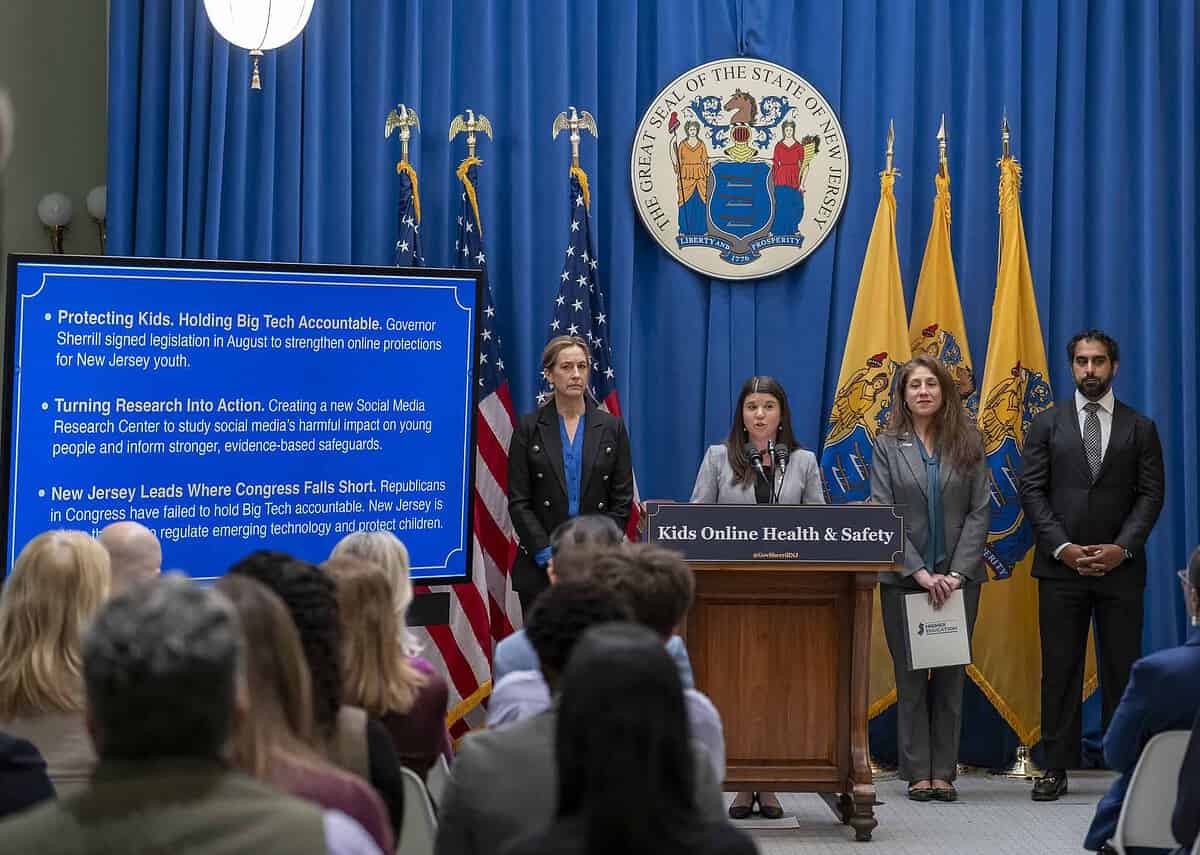
TRENTON — New Jersey is putting public money and university research muscle behind an urgent question facing families, schools, and policymakers: What is social media doing to the mental health of children and teenagers? On Monday, Oct. 19, 2026, Gov. Mikie Sherrill and Secretary of Higher Education Margo Chaly announced that Rutgers University will receive $500,000 in state funding to establish the New Jersey Social Media Research Center, a new multidisciplinary research hub selected through a competitive grant process. The center will study the relationship between social media use and mental health, with a particular focus on whether platform features designed to keep users engaged — such as algorithmic feeds, notifications, autoplay, and other engagement-maximizing tools — contribute to anxiety, depression, sleep disruption, and other harms. The funding comes from the state Office of the Secretary of Higher Education and was included in New Jersey’s fiscal year 2027 budget. The announcement was made at the State House in Trenton, with Sherrill, Chaly, Rutgers psychology professor Dr. Jessica Hamilton, and Rishi Bharwani, U.S. director of Reset Tech, in attendance. The center will draw on researchers from several Rutgers campuses and schools, including Rutgers Health, and will focus on three broad areas: assessing the effects of social media, developing interventions to address harmful or addictive use, and identifying ways to prevent problems before they start. It will also evaluate ways to reduce potentially harmful behaviors and develop recommendations for parents, schools, and policymakers. Officials emphasized that the center is not meant to be a purely academic exercise; rather, it is intended to answer the kinds of practical questions parents and educators face every day, including how much screen time is too much, which platforms carry the greatest risk, and what can be done to make digital environments safer by design.
At the center of the effort is a leadership team of three Rutgers associate professors, each bringing a different disciplinary lens to a complex problem. Dr. Jessica Hamilton, a faculty member in the School of Arts and Sciences who studies psychology and is affiliated with the Center for Youth Social Emotional Wellness, will serve as the center’s director. Hamilton’s research focuses on how digital environments affect adolescent emotional development, particularly vulnerability to depression and anxiety. She will be joined by Jeffrey Lane of the School of Communication and Information, an expert on the interplay between technology and human communication, and Vivien Wen Li Anthony of the School of Social Work, whose work addresses social work practices and youth behavior. Together, the three will lead a center organized around three interconnected research pillars. The first is assessment: understanding which patterns of social media use are most harmful to children and adolescents, and for whom. The second is intervention: developing and testing strategies to reduce harmful or addictive behaviors, including the possibility of warning labels on social media platforms. One area of research will examine whether such labels could discourage compulsive use in the same way warnings on tobacco and alcohol products have changed behavior over time. The third pillar is prevention: finding ways to stop problems from developing, whether through family guidance, school-based digital literacy programs, or stronger privacy and safety tools. The center’s connection to Rutgers Health also means it can incorporate clinical knowledge about pediatric mental health, sleep medicine, and eating disorders, allowing researchers to connect online behavior to real-world physical and psychological outcomes. This multidisciplinary structure is intended to bridge the gap between laboratory findings and practical solutions that can be used by clinicians, educators, and families.
The creation of the research center is not happening in a vacuum. It was authorized under legislation Sherrill signed earlier this year as part of a package of three bills addressing children’s online safety. The most prominent of those bills is the New Jersey Age-Appropriate Design Code, which imposes new obligations on technology companies that offer online services likely to be used by minors. The law limits the personal information that companies can collect and retain from children, requiring companies to minimize data collection by default. It also requires stronger default privacy settings for minors, meaning that safe settings should be the starting point rather than something parents have to navigate through complex menus. Perhaps most significantly, the law restricts certain platform features that are designed to encourage prolonged use, such as manipulative interfaces, infinite scrolling, and algorithmic recommendations that keep children and teenagers engaged long after they might otherwise stop. The legislation also establishes safeguards governing interactions between minors and adult users on social media platforms, a direct response to growing concerns about grooming, inappropriate contact, and exposure to adult content. The law specifically calls for a research center to study social media consumption and make recommendations to address addictive behaviors among children and teenagers. In addition to the center, New Jersey has created an Office of Youth Online Mental Health Safety and Awareness within the Department of Health. That office is charged with coordinating the state’s efforts, from public education campaigns to the deployment of mental health resources, and will likely be a key consumer of the Rutgers center’s research. Together, the law and the new administrative structures represent a significant shift in how New Jersey approaches the digital lives of its youngest residents.
The urgency of the mission stems from a substantial but still incomplete body of scientific research. Studies have found associations between certain patterns of social media use and mental health concerns, including anxiety, depression, sleep problems, and poor body image. Yet the relationship is complex, and researchers are still trying to determine when and how social media use contributes to these problems. For every young person who is harmed by social media, there may be another who finds necessary social connection, creative expression, or a sense of belonging online. The new center will try to move beyond the simplistic debate about whether social media is good or bad and instead identify the specific mechanisms and design choices that make it risky. It will examine questions such as: Is exposure to idealized images on Instagram more harmful than direct cyberbullying? Do late-night feeds disrupt sleep more than daytime use? Do certain features, such as streaks or personalized recommendations, function like hooks that encourage compulsive behavior? The center will also evaluate whether warning labels could discourage compulsive use, a question that has gained traction as a possible policy intervention. Governor Sherrill highlighted the stakes in her announcement. “Research has linked social media to depression and anxiety, fatigue and trouble sleeping, poor body image and disordered eating,” she said. “This new center will be an invaluable tool to help us better understand how technology is affecting our children, and more importantly, turn research into real solutions to protect our kids.” The center’s findings are expected to guide parents seeking practical advice, schools designing digital literacy curricula, and policymakers weighing new regulations. The research will also help distinguish between normal adolescent stress and clinically significant distress, giving health care providers better tools for early intervention.
The research center is also part of a larger legal and financial effort to hold social media companies accountable for harm to young users. In August, Attorney General Jennifer Davenport announced a $17.1 billion multistate settlement with Meta, the parent company of Facebook and Instagram. The settlement, which followed years of investigations and litigation over the company’s impact on young users, is expected to deliver significant funding to New Jersey. Under the agreement, the state is expected to receive at least $525 million and potentially more than $752 million, making it one of the largest infusions of social-media-related funds that New Jersey has seen. The agreement also requires Meta to implement additional safety features for children and teenagers, including more robust parental controls, restrictions on minors’ messaging with adults, and changes to algorithmic recommendations that could expose minors to harmful content. The permitted uses of the settlement funds are broad, and state leaders have said they may be used for youth mental health programs, crisis intervention, online safety investigations, and digital literacy initiatives. The Rutgers center could play an important role in evaluating these programs and ensuring that settlement dollars are spent effectively. By combining the resources of the Meta settlement with the research capacity of the new center, New Jersey is attempting to build both an accountability system and a public health response to the social media crisis. The center’s independent research could be used to assess whether the safety measures Meta is required to implement actually work, and whether the programs funded by settlement money are reaching the children and families who need them most.
The $500,000 grant marks the formal beginning of the New Jersey Social Media Research Center, but state officials made clear that the research produced will be an ongoing resource. The center’s work will span three focus areas: assessing the effects of social media on young people, developing interventions to address harmful use, and identifying ways to prevent problems. Its multidisciplinary structure, involving researchers from the School of Arts and Sciences, the School of Communication and Information, the School of Social Work, and Rutgers Health, is intended to ensure that recommendations are grounded in both empirical evidence and real-world practice. The presence of Rishi Bharwani, U.S. director of Reset Tech, at the announcement underscored the interest of technology accountability organizations in the center’s progress. The center is expected to share its findings with parents, schools, and policymakers, and to work alongside the Office of Youth Online Mental Health Safety and Awareness within the state Department of Health. As New Jersey prepares to receive hundreds of millions of dollars from the Meta settlement, the need for independent research will likely grow. The center can help evaluate which interventions work, how to identify young people at risk, and how to design platforms that are safer by default. With the fiscal year 2027 budget providing its initial funding, the center has a clear mandate to turn academic inquiry into actionable solutions. In doing so, it could become a model for other states struggling to address one of the defining public health questions of the digital age: how to protect children from the harms of social media while preserving its benefits. The center will also have a role in tracking emerging platforms and trends, ensuring that New Jersey’s policies remain relevant as technology evolves. By bringing together researchers, clinicians, state agencies, and technology accountability groups, the center is positioned to be more than a research operation — it is meant to be a lasting infrastructure for safeguarding the mental health of the next generation.