


By AFP
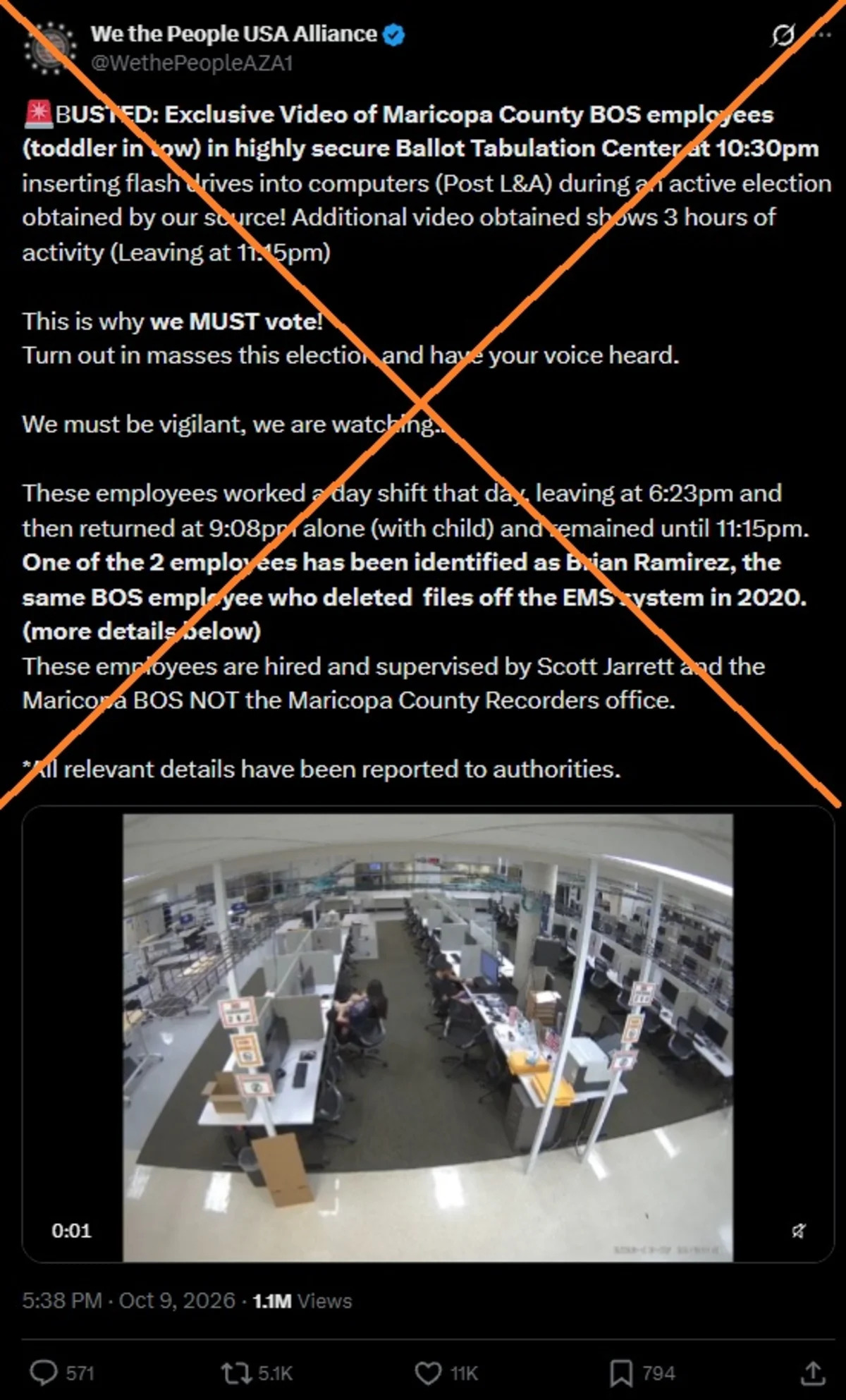
Maricopa County, Arizona, one of the largest voting jurisdictions in the United States, is once again battling unfounded election fraud narratives as the November 2026 midterms approach. The county, which has been at the center of false claims about election integrity for years, became the subject of a fresh wave of online accusations after a video appeared to show county employees inside a secure ballot tabulation center late at night, with a toddler in tow, using flash drives on computers. The video was posted on October 9, 2026, by We the People AZ Alliance, a group with ties to prominent election deniers. The accompanying text read: “BUSTED: Exclusive Video of Maricopa County BOS employees (toddler in tow) in highly secure Ballot Tabulation Center at 10:30pm inserting flash drives into computers (Post L&A) during an active election obtained by our source!” The timestamp on the video was October 7, the first day of early voting in Arizona. Within hours, the clip was being shared across social media platforms as supposed proof that election workers were tampering with vote-counting equipment. But county officials responded that the employees were performing authorized software updates after mandatory logic and accuracy testing, and that the work had nothing to do with the tabulation of votes. They said there is no evidence of widespread fraud impacting the election, and they warned that the video had been stripped of context to create a false narrative.
On October 14, Maricopa County Elections issued a statement saying the “work was and is authorized.” The county’s Board of Supervisors, led by Chair Kate Brophy McGee and Vice Chair Debbie Lesko, released an additional statement explaining that the employees were performing necessary software updates to the ballot duplication system, a process used when a ballot is returned damaged and cannot be read by tabulators. They stressed that the work did not involve the Election Management System or the tabulators used to count votes, and that the use of USB drives is a standard procedure permitted by Arizona state law. The machines in the tabulation center are not connected to the internet, they noted, making remote tampering impossible. The controversy escalated after local media reported that Shelby Busch, an official with We the People AZ Alliance, had contacted the County Recorder about the video. That contact prompted staffers in Recorder Justin Heap’s office to escalate the matter to the FBI. Heap has been in a prolonged legal battle with the Board of Supervisors over control of elections, and his office’s decision to refer the video to federal authorities added a new layer of tension. Brophy McGee criticized Heap’s handling of the situation, saying his actions put county employees at “great risk.” The county’s clarification did not stop the spread of the video, which continued to be cited by election deniers as evidence of wrongdoing.
Before the video surfaced, another election-related controversy had already drawn national attention. On October 5, US President Donald Trump called Maricopa a “very dishonest county” when asked about mail ballots that had been mistakenly sent out ahead of Arizona’s early voting period. The error was acknowledged by Runbeck Election Services, a vendor involved in the mailing process. The company said that 3,126 mail ballot packets were mistakenly delivered to the US Postal Service on October 1, six days earlier than scheduled. The Maricopa County Recorder’s Office issued a statement on October 4 saying the premature mailing was not authorized by the office and that officials were notified only after it occurred. The statement emphasized that the correct ballots were mailed to the correct voters, and that the only issue was the timing of the mailing. After consulting with the Maricopa County Attorney’s Office, the county determined that the ballots remain valid and do not need to be voided or reissued. The incident, while attributed to human error by the vendor, was seized upon by online users who claimed it was evidence of a plot to manipulate the election. AFP has previously debunked additional claims about Maricopa County’s mail ballot envelopes, and the latest episode underscored how even minor administrative mistakes can be weaponized in the current political climate.
A third and even more extreme claim that circulated widely in the month before the midterms alleged that the Maricopa County Board of Elections had issued an apology to Trump, claiming that local officials presented evidence that then-Secretary of State Katie Hobbs, now governor, and then-Speaker of the Arizona House Rusty Bowers personally ordered them to destroy tens of thousands of Trump mail-in ballots and to count tens of thousands of ballots cast by illegal aliens for Joe Biden in Arizona’s largest county during the 2020 election. This claim is false. In 2020, Biden defeated Trump by 10,457 votes to win Arizona’s electoral votes, and there is no evidence of widespread fraud. A report issued by the Maricopa County Elections Department concluded that the November 2020 general election was administered with integrity and that the results were accurate and reliable. The report found fewer than 100 potentially questionable ballots were cast out of 2.1 million. Similarly, the Office of the Attorney General of Arizona conducted an extensive investigation of the 2020 election, which resulted in less than 0.001 percent of ballots cast statewide being referred for prosecution, according to the non-partisan group Protect Democracy. Despite these findings, the false apology narrative continued to circulate, often presented as a bombshell revelation rather than a recycled hoax.
Keyword searches trace the apology claim to a March 19, 2026 post on X by Joshua Hall, a man who has been convicted of threatening to kill a US congressman and perpetrating an online fraud scheme. His post came after the opening of an investigation into suspected noncitizen voters in Arizona. In September, Maricopa County’s top prosecutor, Rachel Mitchell, said that 52 of 60 individuals flagged to her office by an unreliable federal database were in fact citizens. Noncitizen voting in federal elections is illegal and has been shown to be exceedingly rare. The fact that Hall, a convicted felon, was the original source of the claim did not prevent it from being widely shared. Social media users reposted the claim without mentioning his criminal history or the lack of any official announcement from Maricopa County. The episode reflects a broader pattern in which debunked allegations from fringe figures are repackaged and presented as credible news. Election officials in Maricopa County have repeatedly had to correct the record, but the sheer volume of misinformation has made that task increasingly difficult. The county has become a symbol in the ongoing debate over election integrity, even though multiple reviews have confirmed the accuracy of its results.
With the November 2026 midterms approaching, Maricopa County officials have urged voters to rely on official sources of election information rather than unverified social media posts. The county has stressed that its election processes are governed by state law, subject to mandatory testing and audits, and designed to ensure every valid ballot is counted. The latest controversies — the late-night software update video, the early mail ballot mailing and the recycled 2020 apology hoax — illustrate the challenges facing election administrators in a battleground county that remains a flashpoint for false narratives. AFP reached out to Maricopa County’s election officials for additional comment, but a response was not forthcoming. For now, officials say there is no evidence of widespread fraud impacting the election, and they continue to urge the public to reject claims that undermine confidence in the democratic process. The midterms will test whether voters can separate fact from fiction in a county that has become ground zero for election misinformation.