


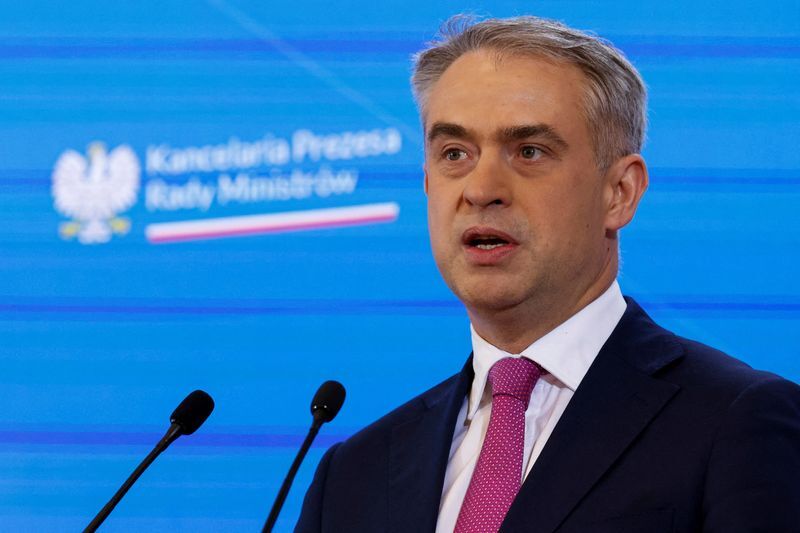
WARSAW (Reuters) – Poland’s digital affairs minister accused social media platforms on Wednesday of acting as a “silent ally” of Russia in an ongoing “digital war,” saying they have done nothing to curb disinformation and threatening to impose financial penalties on companies that ignore state requests. Krzysztof Gawkowski told a news conference that platforms were effectively enabling Russian influence operations by failing to act on tens of thousands of reports of fake accounts and manipulative content. His remarks escalate a long-running confrontation between Eastern European governments and major tech companies, and come as Poland seeks to position itself as a leading voice in European efforts to counter Russian interference. The minister’s threat of fines adds a new dimension to a debate that has so far relied largely on voluntary cooperation from social media firms. He singled out no companies by name, but the platforms involved include some of the world’s largest digital services. Gawkowski’s language was unusually blunt, describing the platforms as profiting from disinformation and treating it as a source of revenue. He also said that data showed the response by platforms to Polish state reports was not merely inadequate, but reflected deliberate choices. “A digital war with Russia is underway,” he said. “And inside this digital war there is a disinformation front. On this disinformation front, there is a silent ally of Russian bots and the Kremlin’s GRU: the social media platforms.” The GRU is Russia’s military intelligence agency, which Western officials have repeatedly accused of orchestrating disinformation campaigns. Gawkowski’s comments were accompanied by new data from Poland’s National Research Institute NASK, which he said demonstrated the scale of the problem.
According to NASK data, Polish authorities submitted more than 65,000 reports of fake accounts and disinformation to social media platforms in the first half of 2026. The platforms acted on fewer than a quarter of those reports. Specifically, they removed 7% of the flagged content and moderated more than 17%. Gawkowski said this showed that the platforms were not only failing in their obligations but were deliberately allowing harmful content to remain online. He argued that the low response rate was a business decision, because engagement-driven disinformation generates advertising revenue and user activity. The figures are likely to intensify pressure on tech giants operating in the European Union, where the bloc’s Digital Services Act already imposes legal obligations on platforms to remove illegal content and disinformation. Poland has been among the most vocal member states calling for stronger enforcement of these rules, and Gawkowski’s threat of national fines suggests that Warsaw is unwilling to wait for Brussels to act. Discord, Google, Meta, X, Telegram and TikTok did not immediately respond to Reuters requests for comment on Wednesday. The lack of an immediate response from the platforms may further fuel the Polish government’s narrative that they are ignoring state concerns. Gawkowski said that the data “indicate not only a failure, but a deliberate action by platforms — they profit from disinformation, they use it, and they treat it as a source of revenue.” His remarks underline a growing frustration among Central and Eastern European governments, which often feel that disinformation campaigns targeting their countries receive less attention than those aimed at Western Europe or the United States.
Gawkowski elaborated on the nature of the “digital war,” saying that Russian bot networks and the GRU were using social media to sow division, undermine public trust in democratic institutions, and destabilize Polish society. He did not present new evidence linking specific platforms to Russian operations, but he argued that by refusing to act decisively on Polish reports, the platforms were giving Russian operations cover. “The social media platforms are doing nothing about it,” he said. The minister’s accusations reflect long-standing concerns in Poland, which has been a major target of Russian influence operations since at least the start of the war in Ukraine. Polish officials have repeatedly pointed to disinformation campaigns that spread false claims about Ukrainian refugees, NATO’s presence in the region, and Poland’s role in supplying military aid to Kyiv. Moscow has denied these allegations and says that Western governments are exaggerating the Russian threat for their own political purposes. The Kremlin’s denial did not appear to soften Gawkowski’s stance. He insisted that the scale of the problem is visible in the NASK data, which tracks reports sent to platforms by Polish institutions responsible for identifying fake accounts and manipulative content. The fact that only a small fraction of those reports led to action, he said, showed that the platforms have no interest in cleaning up their services. He also rejected the argument that platforms lack the resources to moderate Polish-language content, pointing out that they operate sophisticated systems for other markets. The minister’s comments come as Poland strengthens its cyber defenses and steps up cooperation with NATO and EU partners on countering hybrid threats, making the issue of platform accountability all the more urgent.
In a clear set of demands, Gawkowski said he had asked the platforms to establish effective Polish-language content moderation teams and to maintain direct, real-time communication with Polish authorities responsible for flagging disinformation. He called for the elimination of what he described as “fictitious appeal procedures,” which he said were used by platforms to delay or avoid taking action. He also demanded the immediate removal of any identified bot networks and a significant reduction in response times to all reports of this kind. “In addition, I have made it clear that any request from the state that remains unfulfilled by these platforms will initiate proceedings aimed at imposing financial sanctions on them,” he said. The threat of fines is not entirely new; EU member states can impose penalties under the Digital Services Act, and Poland has previously warned that it would use its national powers to hold platforms accountable. But Gawkowski’s language suggests that the Polish government may be preparing to take a more aggressive stance, possibly imposing fines on non-compliant companies in the near future. The exact amount of the potential fines was not disclosed, and the minister did not specify a timeline for the proceedings. He did, however, say that the state’s requests were not optional. The demand for real-time communication with moderators is particularly significant, because it would represent a major shift in how platforms interact with national governments. Currently, most content moderation decisions are made by private companies, often based on global policies that do not always align with local concerns. Polish authorities have long complained that platforms do not understand the regional context of disinformation campaigns, particularly those originating in Russian-language networks. By requiring Polish-speaking teams and direct channels, Gawkowski is effectively asking platforms to treat Poland as a priority market.
The absence of immediate responses from Discord, Google, Meta, X, Telegram and TikTok left the threat of fines hanging over the industry. These companies have faced mounting criticism from governments around the world over their handling of disinformation, but they often argue that they are already investing heavily in content moderation and that they remove harmful content when they are made aware of it. The Polish data, however, appears to contradict that claim, at least in the context of state reports. The standoff also reflects a broader geopolitical shift. Poland, as a frontline NATO state and a key transit hub for Western military aid to Ukraine, has become a prime target for Russian information operations. Warsaw has repeatedly urged Washington and Brussels to treat disinformation as a security threat, not merely a content moderation issue. Gawkowski’s framing of social media as an “ally” of Russian military intelligence is likely to resonate with other countries in the region, particularly the Baltic states, which have also called for tougher action against tech companies. At the EU level, the Digital Services Act provides a legal framework for regulating platforms, but enforcement has been slow. The European Commission has opened several investigations into major platforms, but national governments have shown increasing willingness to act unilaterally. Poland’s threat of fines could set a precedent for other member states, potentially leading to a patchwork of national regulations. For the platforms, the immediate risk is financial, but the longer-term risk is reputational. Being labeled a “silent ally” of the GRU by a NATO government is a serious accusation, and the companies may feel pressure to respond quickly to avoid being associated with Russian disinformation campaigns in the public eye.
Gawkowski’s warning marks a new phase in Poland’s campaign against digital disinformation, moving from public appeals to concrete threats of enforcement. Whether the threats will translate into actual fines remains uncertain, as legal proceedings against major technology companies can be complex and lengthy. The companies may also challenge the Polish government’s interpretation of the NASK data, or argue that they have already taken appropriate action on many of the reports. Still, the minister’s message was unmistakable: Poland is prepared to act alone if platforms do not step up. He also made clear that the issue is not just about removing individual posts or accounts, but about changing the underlying business model that allows disinformation to thrive. By describing disinformation as a source of revenue for platforms, he is pointing to a fundamental conflict of interest between the companies’ profit motives and the public interest. This argument has gained traction in academic and policy circles, but it is rarely stated so directly by a government minister. For now, the ball is in the platforms’ court. They can choose to engage with Warsaw, set up the Polish-language moderation teams and real-time reporting channels the minister requested, and demonstrate that they are willing to act. Or they can ignore the demands and risk fines, legal battles, and further damage to their reputation in one of Europe’s most strategically important countries. Gawkowski, for his part, appeared determined to press the case. The coming months will show whether Poland’s digital war against Russian disinformation will be fought alongside the platforms or against them.