


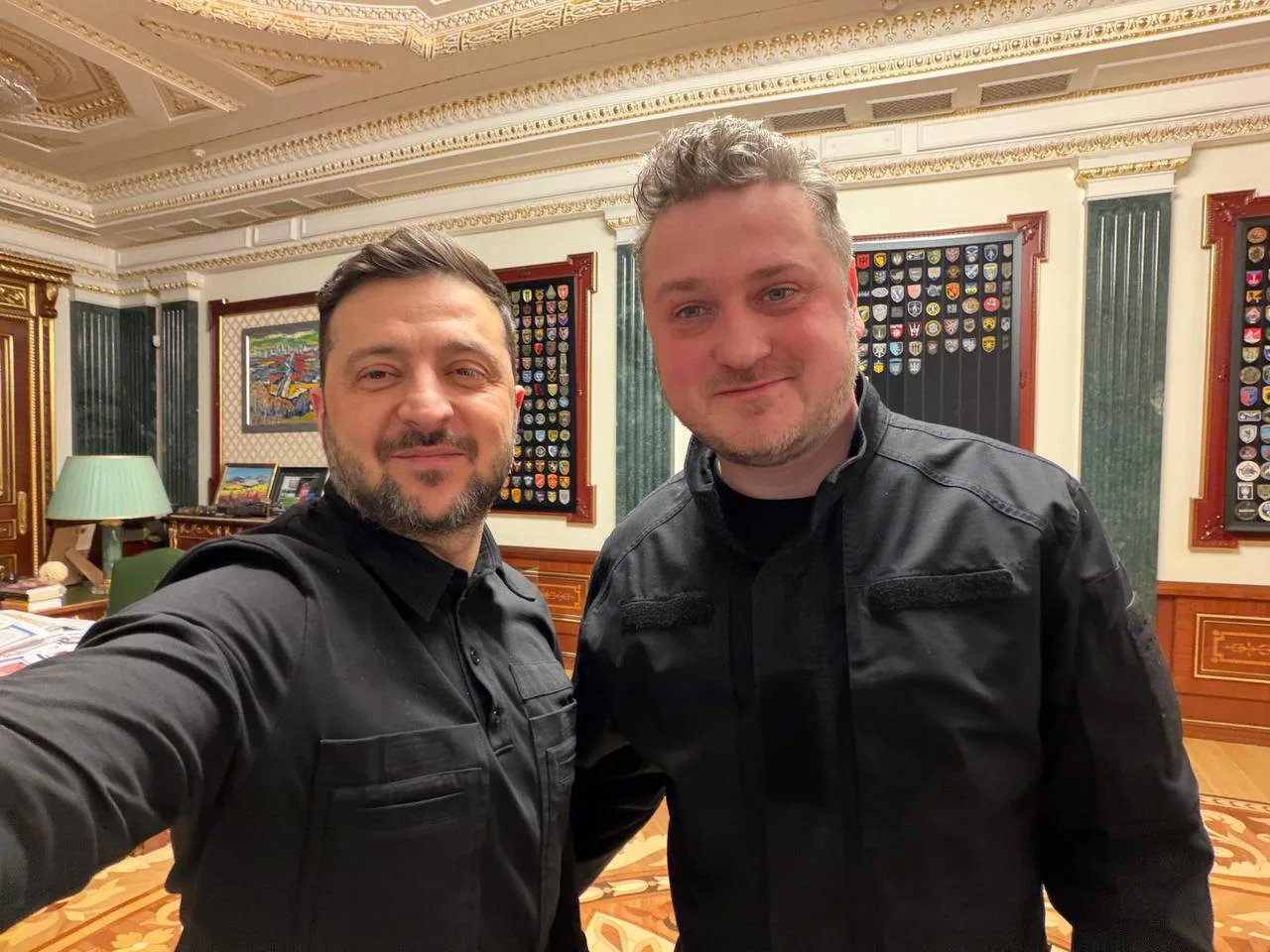
Zelenskyy dismisses Andriy Kovalenko as head of counter-disinformation center in sweeping national security reshuffle
KYIV, Ukraine — President Volodymyr Zelenskyy has dismissed Andriy Kovalenko as head of the Center for Countering Disinformation (CCD), the powerful agency under the Ukrainian National Security and Defense Council (RNBO) that has served as Kyiv’s first line of defense in its information war against Russia. The decision was made official on Tuesday through Presidential Decree No. 971/2026, published on the presidential website, the Ukrainian National News agency (UNN) first reported. The decree, which simply stated “To dismiss Andrii Valeriiovych Kovalenko from the position of head of the Center for Countering Disinformation,” took effect immediately, ending a tenure of more than two and a half years that saw the underfunded institution evolve into an internationally respected bulwark against pro-Kremlin propaganda. Kovalenko, who had served in the role since January 26, 2024, announced his resignation in a statement shared to his Telegram channel shortly after the decree was made public, framing the move as a voluntary decision and thanking the president for accepting his resignation. His departure comes on the same day that Zelenskyy dismissed Oleh Khramov, the head of the SBU’s internal security department, signaling a wider recalibration of Ukraine’s national security establishment at a time when the war against Russia has entered a complex military and diplomatic phase.
This is far from the first time that Zelenskyy has intervened in his security and intelligence hierarchy, but the timing and the nature of the change have captured attention in political and military circles. Kovalenko’s center, created in 2021, has operated as the central state hub for identifying, analyzing, and debunking disinformation, coordinating with allies, and producing real-time warnings for both the public and the government. Under Kovalenko, the CCD became a globally recognized brand — one whose analyses of Russian election interference, cyber influence campaigns, and fake-news narratives were read by diplomats, journalists, and military officials from Washington to Brussels. His dismissal, therefore, is not seen as a demotion of an incompetent official, but rather a strategic reset. Neither the White House nor NATO has issued a formal reaction, but officials close to the Ukrainian military leadership, speaking on condition of anonymity, told reporters that Kovalenko had been in discussions with the president’s office about shifting into a more operational role. According to the statement from Kovalenko himself, he will remain in the field of national security and “cognitive confrontation” with Russia, suggesting his departure is less a retiremnt than an evolution of his mission.
Kovalenko’s background made him a natural choice to lead the information-counteraction body when he was tapped for the role in early 2024. A native of Kryvyi Rih — the same city as the President — the forty-year-old analyst graduated from the Taras Shevchenko National University of Kyiv and later earned a master’s degree in international law. Long before the Russian full-scale invasion, Kovalenko was a vocal expert on hybrid warfare and Russian strategic culture. He authored several reports and gave testimony to parliament about the dangers of separatist narratives in the Russian-language media. In 2019, he joined the office of Valerii Zaluzhnyi, then Commander-in-Chief, as an advisor on civil-military cooperation and communications. From there he moved to the National Institute for Strategic Studies, an in-house Ukrainian think tank that provides analytical products to top leadership. His appointment to the CCD on January 26, 2024 (Decree No. 29/2024), was applauded by anti-disinformation civil society, since he was seen as one of the few senior figures who had been publicly advocating for a structural overhaul of Ukraine’s cognitive-security response since 2015.
The Center for Countering Disinformation, known by its Ukrainian acronym CCD, was initially created by Ukraine’s security council to centralize government efforts to detect, repel, and deter information threats coming primarily from the Russian Federation. But after 2022, its mandate expanded dramatically. The agency created an advanced media monitoring tool—known internally as the “Z-Index”—to track Russian propaganda channels across Telegram, TikTok, YouTube, and X. It established the “Sunday Morning Debunk” series, a weekly investigative format that dissected fake news, forgeries, and deepfakes. It also began publishing thematic reports on Russian election meddling in the United States, France, Germany, and Poland. Crucially, the CCD worked as a Eurasian network of analysts, often sharing intelligence with private companies like Meta and OpenAI to remove coordinated bot networks. Kovalenko frequently claimed the center had taken down over 600 fake profiles on social media in just 2025. In his farewell post, he highlighted the expansion of foreign partnerships, a view corroborated by western diplomats who noted the near-real-time information sharing between Kyiv and allied intelligence agencies regarding state-sponsored disinformation. “I believe that my team and I managed to build a strong institution, expand media products to counter disinformation and shape Ukraine’s agenda,” he wrote.
The outgoing official’s statement was lengthy and emotional for a government official departing a leadership post, showing a mixture of pride, exhaustion, and humor. “Three years at the Center for Countering Disinformation of the National Security and Defense Council is a long journey. I am grateful for the opportunity to serve the state in this area,” he wrote. “I will remain involved in national security and the cognitive confrontation with Russia,” he noted, using a term that has become central to his personal intellectual framework. On a positive note, he appeared optimistic about the future of the center, adding, “A wonderful team that will certainly do much more for the state.” Mstyslav Chernov, a Ukrainian correspondent who has won Pulitzer prizes for his coverage of the Mariupol siege, tweeted that Kovalenko was “one of the rare officials who understood information warfare beyond TikTok.” Iryna Herashchenko, a member of the Ukrainian parliament, said she hoped “the state interest will prevail in the next appointment,” hinting at the intense lobby battle that often erupts behind the scenes in Kyiv when a top post becomes vacant. Possible successors, according to political press, include Taras Bilous, executive director of the independent anti-fake agency Texty, and Sofia Kostiuk, a well-known communications strategist in the finance sector.
The removal of Kovalenko cannot be isolated from the broader backdrop of the conflict. Russian energy strikes have pummelled civilian infrastructure throughout the summer, and a second front has opened in the war of narratives, particularly involving the upcoming European Union elections. Ukraine’s civil society has often criticized the CCD for focusing too much attention on pro-Russian sources and not enough on threats from other malicious actors, but Kovalenko had just returned from a tour of Latin America, where he was securing partnerships to combat disinformation about global food security. His departure also comes amid an unannounced review of SBU anti-corruption mechanisms, exemplified by the surprising sacking of Oleh Khramov. While the president’s office described the dismissals as unrelated, some analysts view the simultaneous vacancies as part of a broader set of instructions intended to bring fresh energy into government communications before an expected autumn offensive. Zelenskyy must now find a replacement capable of managing a sprawling bureaucratic apparatus as well as commanding public confidence. In the meantime, his deputy Yurii Zavhorodnii will take over as acting director. The challenge ahead is immense: the next leader of the CCD will preside over an information security landscape where the threat of artificial-intelligence-generated content and coordinated foreign influences will continue to escalate — a fight that Kovalenko acknowledges is far from complete. “Success to the Center,” he said in his final sign-off, but the true measure of his legacy, as well as Ukraine’s information resilience, will be determined in the difficult months that lie ahead.