


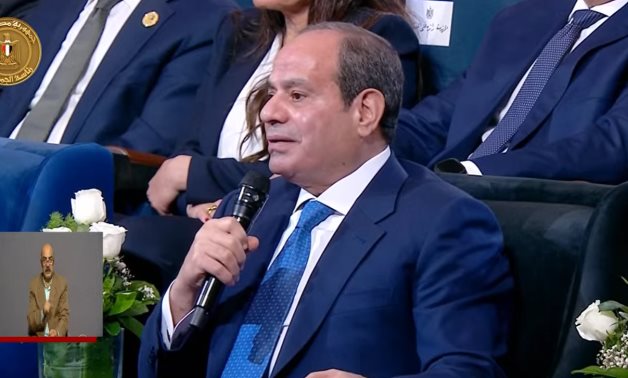
CAIRO – 19 October 2026 — Egypt’s President Abdel Fattah El-Sisi attended the opening session of the Egypt Forum 2026 on Monday at the St. Regis Hotel conference center in the New Capital, an event designed to place the country’s development trajectory, national challenges, and future priorities under a public microscope. The opening session was not confined to official speeches alone; it was accompanied by a series of recorded messages from a diverse group of prominent Egyptian voices, including world-renowned cardiac surgeon Dr. Magdi Yacoub, engineering expert Hany Azer, journalist Mohamed Ali Kheir, Mohamed Mustafa Sherdy, writer Ibrahim Eissa, and broadcaster Azza Mustafa. In their messages, these figures offered their expectations for the forum, reflecting on the potential outcomes and the tangible benefits Egypt could derive from such a wide-ranging national conversation. Perhaps the most striking segment of the opening was a video presentation that posed a disarmingly simple question to ordinary citizens: “What would you say to President El-Sisi?” The responses were as varied as the Egyptian population itself. Some citizens expressed heartfelt gratitude for major housing projects, specifically mentioning the Al-Asmarat neighborhood, as well as the construction of new universities and broader development initiatives that have reshaped parts of the country. Others took the opportunity to articulate pressing demands: job creation, enhanced pensions and social security, better healthcare services, support for small businesses, and an accelerated push toward full digital transformation. The inclusion of these citizen voices was clearly intended to signal that the Egypt Forum 2026 would not be a one-way presentation of state achievements, but rather a platform for listening, dialogue, and accountability.
Prime Minister Mostafa Madbouly reinforced that message in his remarks, declaring that all questions submitted by citizens through the forum’s website had been compiled and would be addressed with complete transparency throughout the event. He revealed a number of the most pressing inquiries received, including: What is the government’s plan regarding the national debt? Was the New Administrative Capital a priority? Were the major transportation projects truly essential, or should resources have instead been directed to education and healthcare? By acknowledging these difficult questions head-on, Madbouly sought to demonstrate that the government is aware of public skepticism and is prepared to engage with it openly rather than dismissively. He further noted that authorities had identified several top concerns among Egyptian youth, including education, inflation and commodity prices, healthcare services, wages and pensions, safety and stability, and the labor market. Based on these insights, the forum’s sessions have been structured to span multiple days, allowing for deep dives into each of these critical areas. The prime minister’s emphasis on transparency appeared designed to build trust in a country where public discourse has often been constrained, and where economic pressures have generated considerable anxiety. His remarks suggested that the forum would function as a kind of national audit, with the government expected to present not only its successes but also its justifications for difficult choices made in the face of scarce resources. By framing the event around citizen questions, the government signaled a recognition that public confidence cannot be taken for granted, and that the legitimacy of major state projects depends, in part, on the willingness of officials to explain their reasoning and submit to scrutiny.
In his address, President El-Sisi placed significant emphasis on the importance of national memory and public awareness, warning against attempts, particularly on social media, to dismantle the collective understanding of Egypt’s recent history. He stressed that such efforts were already underway in the lead-up to 2014, and that attempts to influence a pivotal nation with a large population, or to marginalize and undermine its role, would not cease. The president explained that his frequent references to the events of 2011 are intended to evoke national memory and awareness, especially among children and young people who did not live through that period and may not fully comprehend the fragility of the state. He acknowledged that differences in perspective are acceptable and even natural, but he drew a firm line at preserving the Egyptian state itself, describing this as a fundamental boundary that cannot be crossed. “Anything can change and improve as long as we live on our own land,” El-Sisi said. “Protecting the country is the most important thing, regardless of any differences in our viewpoints.” This formulation was clearly aimed at establishing a unifying principle that transcends political disagreement, while also implicitly cautioning against dissent that could be perceived as threatening national cohesion. The president’s warnings about social media were particularly notable, as they reflect a broader concern among Egyptian officials about the role of digital platforms in shaping public opinion, mobilizing protests, and potentially destabilizing the state. He argued that moderation is essential in all aspects of life, especially given ongoing attempts to isolate individuals and manipulate or incite segments of the population toward the destruction of their own country. In this context, he placed responsibility on Egyptian families to strike a balance between embracing technological progress and supervising their children’s use of digital tools, suggesting that the battle for national memory and stability begins in the home.
President El-Sisi also addressed the heavy cost of stability, a theme that carried both emotional and political weight. He pointed out that the stability achieved in recent years came at a very high price, one paid not only in financial terms but in blood. He recalled the immense sacrifices made by Egypt, most notably the lives of martyrs from the armed forces, the police, and the judiciary, as well as worshippers targeted in mosques and churches during periods of terrorist violence. In addition to these human losses, the president acknowledged the substantial financial resources that were spent to secure stability and combat terrorism. “The stability the country has achieved did not come without a price,” El-Sisi said. “We paid a very high cost, one involving human sacrifice, not just financial loss. We still remember the chaos, instability, and looting that took place during 2012 and 2013.” By evoking this period, the president sought to remind citizens of the dangers of political turmoil and to contrast the current situation with the insecurity that plagued Egypt between 2011 and 2013. His remarks were a clear appeal to the public to value the relative peace and order that have been established, even if economic conditions remain difficult. The reference to looting and chaos was also intended to underscore the stakes of the national project: without a stable state, he suggested, no development is possible, and all other rights and aspirations become secondary. This framing has been a consistent feature of El-Sisi’s public communications, but the forum provided a more structured setting in which to articulate it, with the government presenting data and achievements as evidence that the sacrifices have yielded tangible results. The president’s emphasis on the human cost of stability also served to preempt criticism of the security apparatus, casting the military and police not as instruments of repression but as protectors of the nation against existential threats.
Turning to the future, President El-Sisi noted that in recent years, the Egyptian people have embarked on a genuine phase of state-building, a project that involved high-risk decisions but was necessary given the country’s demographic realities. He highlighted that Egypt’s population has grown by nearly 30 million people since 2011, a staggering increase that places enormous pressure on infrastructure, public services, housing, education, and healthcare. In this light, he framed major projects such as the New Administrative Capital and extensive transportation networks not as luxury expenditures but as essential investments required to absorb this growth and prevent the collapse of urban and economic systems. The president urged citizens to pay close attention to the details and data presented throughout the forum, because these numbers have a direct impact on their daily lives. He indicated that the government would use the sessions to outline its achievements to date, the potential consequences if these measures had not been taken, and the outlook for the future. This forward-looking approach was combined with a sober acknowledgment of the risks involved, but El-Sisi insisted that the decisions were necessary for Egypt’s survival and prosperity. He also returned to the theme of technological progress and social media, cautioning that while he is not against scientific and technological advancement, Egyptian families must strike a balance when it comes to their children’s use of digital platforms. The president’s broader message was one of resilience and continuity: “While individuals come and go, Egypt will remain!” This statement encapsulated his vision of the state as a permanent entity that transcends any single leader or government, and it served as a reminder that the current sacrifices are intended to secure the nation for future generations.
The Egypt Forum 2026 thus emerged as a carefully orchestrated exercise in national communication, blending transparency, accountability, and patriotic narrative. The president concluded by emphasizing that the goal of the forum is for the government to listen carefully, throughout its discussions, to all the details surrounding topics that directly impact the lives of citizens, as well as the lives of their children and grandchildren in the future. This concluding remark reaffirmed the forum’s stated purpose: not merely to announce policies, but to engage in a sustained dialogue with the Egyptian public. The event brought together government officials, experts, journalists, and ordinary citizens in a format designed to bridge the gap between state decision-making and public understanding. The inclusion of critical questions about debt, megaprojects, and resource allocation suggests a degree of openness that is relatively unusual in official Egyptian discourse, and it remains to be seen whether the sessions will deliver the thorough answers that citizens expect. The forum also served as a platform for the president to restate his core political philosophy: that stability is the foundation of all progress, that national memory must be protected against attempts to rewrite or erase it, and that the preservation of the Egyptian state is a red line that transcends political differences. With the country facing significant economic challenges, a rapidly growing population, and an unpredictable regional environment, the Egypt Forum 2026 represents an attempt to build consensus and trust through dialogue. Whether it succeeds will depend on the government’s willingness to follow through on its promises of transparency and on the public’s readiness to engage constructively with the data and arguments presented. For now, the opening session sent a clear signal: Egypt’s leaders are prepared to answer questions, explain difficult choices, and ask citizens to join them in safeguarding the nation’s future.