


Lebanese youth turn crisis into commitment: inside UNESCO’s media literacy drive in South Lebanon
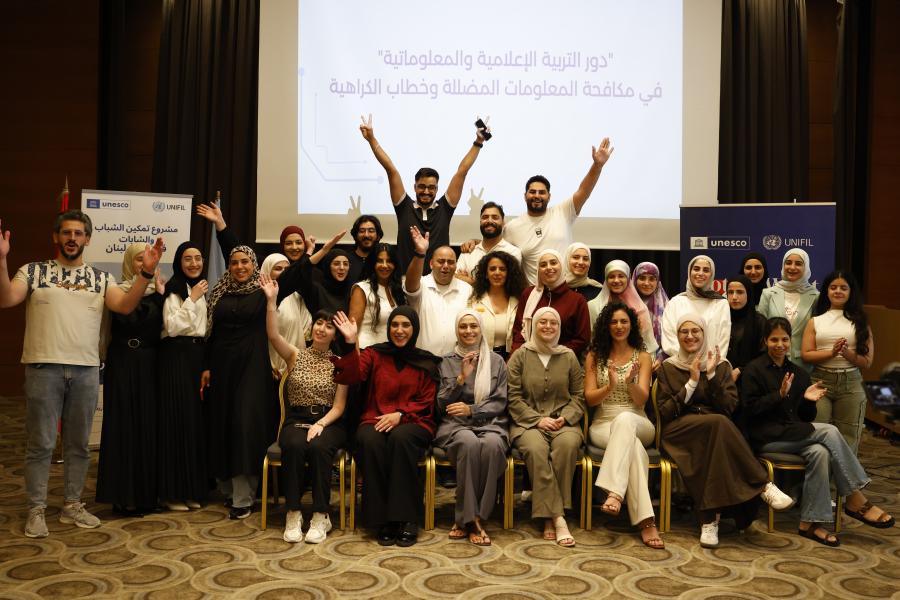
For more than a year, young people across South Lebanon have been engaged in a determined effort to strengthen their skills, find their voices and navigate an information environment where misinformation and hate speech can have real, sometimes dangerous, consequences. Then came the night before the Advanced Media and Information Literacy training, when a suitcase was being packed for three days away: clothes, personal belongings and the essentials. But before it could make its way to the training, it had to be packed again — this time for evacuation. For some of the youth, the crisis had become part of the journey itself. Yet, despite the uncertainty and the need to leave their homes, they remained committed to making their way to the training. They chose to show up. Many of them had personally experienced the impact of false information and hate speech. They knew how quickly a message can create fear, how a rumour can spread before it is verified, and how harmful speech can deepen tensions in communities already under pressure. More than 300 young people from communities across South Lebanon took part in UNESCO’s Youth Empowerment Project funded by UNIFIL, the United Nations Interim Force in Lebanon. From this group, 83 were selected to advance to the Media and Information Literacy and Training of Trainers sessions, where they have been developing skills in fact-checking, critical thinking, public speaking, communication, cybersecurity, digital content creation and the responsible use of artificial intelligence. But what makes their journey remarkable is not only what they have learned — it is the commitment that brought them there, and what they are now doing with that knowledge.
Behind the statistics are personal encounters with the harm misinformation can cause. For Fatima Awali, the consequences of false information are something she has seen first-hand. “One night, false information made the whole city evacuate,” she said. “Today, I’m here to turn this false information into awareness, and to help people know how to distinguish between what is true and what is not.” For her and others in the group, fact-checking is not simply a digital skill. It is a responsibility to the people around them — a way of protecting communities from panic, division and violence. The same is true for Ali, who lives in a community where false news can spread quickly. As someone with a role in a local association, he saw an opportunity to take what he was learning beyond the training room. “The community I live in circulates fake news,” he said. “I was sharing everything we learned with these people, and I started seeing something positive through the information I was giving them.” For Ali, the experience also showed the importance of creating more opportunities for young people to build these skills, so that the habit of verification can spread far beyond the small group who first attended the training. His story reflects a broader truth emerging from the programme: that media and information literacy is not an abstract concept, but a practical tool for everyday survival in communities where a single rumour can change everything.
For many participants, the training changed something simple but important: the way they respond to information. Intissar has seen how misinformation, online violence and cyberbullying can affect women and girls, sometimes with serious consequences. “Today, many women and girls are exposed to violence and online blackmail,” she said. “Sometimes, a rumour or misleading information can push people to a certain way of thinking, even to the point of thinking about ending their lives.” The training reinforced for her the importance of stopping before sharing. “This training taught us how important it is that when we want to publish news, information or even a rumour, we verify it,” she said. But verification was only one part of the learning. Participants were also learning how to communicate responsibly, including through digital content and in front of a camera. “This training also taught us how to speak in front of the camera, and that through our work we have a responsibility to deliver this message,” Intissar explained. “This message needs to be delivered in a safe and responsible way.” Her message to other young people is clear: “I encourage young men and women to take part in this type of training because we need this awareness. With the spread of social media, it is very important to know how to use it in a safe and responsible way without harming one another.” Her words underline a central theme of the programme: that the fight against misinformation is not only about rejecting false content, but about building a culture of careful, ethical communication.
For Zeinab, the training has also become a way to connect what she is studying with what she sees happening around her. As a student graduating in journalism and digital media, she knows that keeping pace with technology is increasingly important. “As a student graduating this year in journalism and digital media, I definitely have to keep up with the developments happening in technology and the digital world, so that I can verify information and fake images circulating on social media,” she said. The skills quickly became useful in her everyday life. She recalled how her mother might come across a post on TikTok about a threat in a particular area. Instead of simply accepting it, Zeinab would check the information herself. “I go and check it more carefully, and it turns out that the information is not true, or that it was published earlier and she saw it as if it were new,” she said. For Zeinab, this is where change begins: with one person questioning what they see, then sharing that habit with others. “My goal is not only to have an impact on my small family, but to increase the impact, reaching my local community, then the wider community, Lebanon and the world,” she said. Her story illustrates how media literacy can ripple outward, from individual households to entire communities, creating a more informed and resilient public.
Over time, the training has become about more than acquiring technical skills. Participants have been learning from one another, exchanging experiences and recognising that they share many of the same challenges in their communities. For Roaa, the experience has strengthened her ability to express her views while grounding them in evidence. “In this course, I learned that I can express my point of view in a very objective way,” she said. “I can use solid evidence, as our trainers taught me, to prove to the world that this piece of news is false.” The training also introduced her to the opportunities and challenges of artificial intelligence. “It gave me an idea about artificial intelligence and how it can be used in creating digital content,” she said. “It helped me understand that there are situations where we can use AI and situations where we should not. We remain the foundation.” But perhaps just as important was the sense of community created through the programme. “It was an opportunity to get to know the trainers, the people leading the project and the participants who share the same goals as us,” she said. What began as a group of participants has grown into a network of young people with a shared understanding: that information carries responsibility, and that they have a role to play in how it is created, shared and understood. This network is not limited to the training room; it is a living community of practice that continues to grow and support its members long after the formal sessions end.
The training does not end in the training room. The youth are now taking what they learned back to their communities, developing and delivering community initiatives and sharing their knowledge with others through awareness activities and training sessions. Some are bringing fact-checking and critical thinking into their local networks. Others are focusing on cybersecurity, combating hate speech, responsible digital communication and helping other young people navigate the information they encounter online. The aim is not simply to create informed individuals, but to multiply knowledge and reach wider circles of communities. For these young people, the programme came at a time when their communities were still being affected by crisis. They could have chosen not to come. Instead, they chose to learn. They chose to question. They chose to verify. They chose to use their voices responsibly. And now, they are taking those skills back with them. The suitcases they carried to the training may have been packed for only a few days, but they returned carrying something that could travel much further: knowledge, confidence and a shared responsibility to their communities. Their training is not the end of the journey — it is the beginning of what they will carry forward, into a future where the truth matters more than ever.