


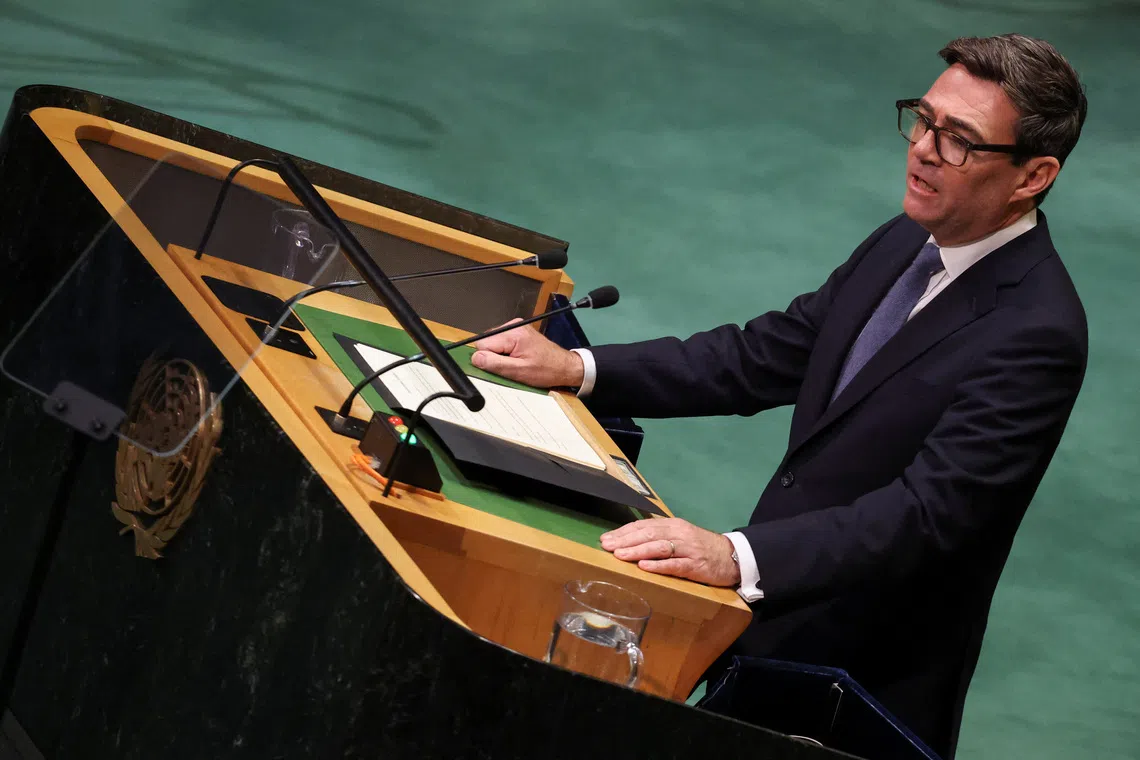
LONDON — The British government has reportedly announced plans to create a new National Centre for Information Defence, a dedicated institution designed to push back against hostile state disinformation and to protect the public from an “industrial-scale” assault on the shared facts that underpin democracy. According to the report, Defence Secretary Wes Streeting told BBC Radio 4 that a world where “the public finds it hard to separate fact from fiction, propaganda from reality, is a dangerous place for a democracy to be.” The centre, he reportedly added, would “mobilise trusted voices across civil society” in order to strengthen the country’s information environment. The plans were announced by Britain’s Prime Minister Andy Burnham during his speech to the United Nations General Assembly on 22 September, a setting normally reserved for foreign policy and international security. That choice of venue underlines the extent to which information warfare has moved to the centre of the national security agenda. The prime minister reportedly argued that, in recent years, hostile actors have conducted an industrial-scale assault on the information environment in the UK and that of many allies. The new centre is intended to be the answer: an agile, cross-government body capable of detecting, attributing, and disrupting hostile state information attacks in real time. Its creation reflects a growing recognition that democratic societies are vulnerable not only to physical attack and cyber intrusion but also to manipulation of what people see, hear, and believe. The phrase “industrial-scale assault” is particularly striking. It suggests something far more serious than the usual background noise of social media trolling. It points to a coordinated effort by state agencies, using spies, fake accounts, proxy media, and automated tools to shape, disrupt, and deceive.
The prime minister reportedly accused Russian agencies specifically of using every means at their disposal to spread lies and disinformation and to prey on people’s fears. He is said to have repeated accusations that Moscow attempted to interfere in Britain’s 2019 general election. The implication is that the new centre will operate not simply as a public relations unit or an advertising campaign, but as a security institution equipped with the tools and capabilities needed to fight back. Its tasking includes not just detecting and attributing attacks, but actively disrupting them. This could involve exposing foreign operations, stripping disinformation networks of their anonymity, and working with allied governments to shut down malicious infrastructure. At the same time, “mobilising trusted voices” implies a positive communications mission: making sure that credible information reaches people before the lies take hold. According to the report, Burnham’s UN speech combined a stark warning with a call to action. “Today, I am tasking our security chiefs to begin work on a new National Centre for Information Defence – to detect, attribute and disrupt these kinds of hostile state information attacks,” he said. The use of the word “tasking” is significant: it conveys urgency and directness. Burnham, who according to the report became leader of the Labour party and prime minister this summer, is treating information defence as a core executive responsibility rather than a task for regulators or social media companies alone. The report also quotes him saying, “As more elections approach across Europe, more nations are grappling with these issues.” That sentence serves as a warning to other democracies. The UK’s move is likely to be studied by governments in Eastern Europe, Scandinavia, and elsewhere that have experienced similar Russian-inspired disinformation.
Burnham’s reference to elections is critical: the ultimate aim of hostile information operations is often to influence the outcome of votes, to weaken trust in democratic institutions, or to delegitimise the electoral process itself. In 2019, concerns about interference centred on leaked documents and online messaging that appeared to align with Russian strategic interests. The report says that Moscow was accused of trying to interfere with that election, and the new centre is partly a response to that failure. By building an institution capable of detecting and disrupting interference at speed, the government hopes to avoid a repeat of those vulnerabilities. But the report also makes clear that the centre’s remit is broader than elections. It is designed to counter the background hum of propaganda and subversion that has become a constant feature of the modern digital public square. This includes attempts to amplify far-right narratives, to deepen social divisions, and to exploit moments of national trauma. The prime minister is reported to have accused Moscow of stoking “tensions and unrest in the wake of horrific events”—an allusion to the way algorithms and hostile actors can turn violence and tragedy into opportunities for division. The centre will therefore need to work with internet platforms, intelligence agencies, civil society groups, and independent researchers. It will also need to develop clear protocols for sharing information with the public. In the past, governments have been reluctant to disclose evidence of foreign interference, either for national security reasons or to avoid embarrassing the platform companies that allowed it to happen. The new body, according to the report, will be tasked to mobilise trusted voices in civil society rather than relying solely on official pronouncements. That suggests a more transparent approach, one that invites journalists, scientists, and other credible sources to help expose disinformation and explain the difference between verified fact and hostile fiction.
The announcement comes against a long background of suspicion about Russian meddling in British politics. Russia has been suspected of seeking to influence the outcome of the 2016 Brexit referendum, one of the most divisive episodes in modern British history. However, the previous Conservative government faced criticism for failing to investigate those allegations in depth. The new report frames the National Centre for Information Defence as a corrective: an acknowledgment, perhaps, that earlier responses were too slow and too fragmented. Parliamentary committees, journalists, and civil society groups have repeatedly called for the government to publish evidence of Russian interference and to hold social media platforms to account. Their efforts were often stonewalled or delayed. Now, according to the report, a new Labour administration is making information defence a national priority. The report’s mention of “far-right narratives” is also notable. It indicates that Russian agencies are not simply spreading generic pro-Russian content; they are trying to amplify existing divisions and extremes in British society. By stoking far-right anger after tragic events, they hope to make it harder for society to unite and for governments to function effectively. The phrase “tensions and unrest” evokes scenes seen in Britain after knife crime incidents, riots, and terror attacks, when online rumour and hatred have spread faster than facts. The new centre will attempt to disrupt this dynamic, perhaps by issuing rapid public warnings, working with platforms to remove coordinated inauthentic content, and cooperating with police and intelligence agencies to identify the origin of malicious narratives. The history of Russian active measures is long and well documented. During the cold war, Soviet agencies used fake newspapers, forged documents, and agents of influence to sow confusion in Western societies. The digital age has multiplied the scale and speed of these techniques. In the UK, the 2019 election became a focus of concern after reports surfaced of extensive online influence operations, coordinated botnets, and the selective release of hacked and leaked material. The report says that the prime minister repeated accusations that Moscow tried to interfere with that election. That is a strong statement for a serving leader to make at the UN, because it effectively accuses another state of attacking Britain’s democratic process. It also creates an obligation to publish evidence and to ensure that the new centre does not remain an empty shell.
The report also warns of a new and more dangerous dimension of the information threat: artificial intelligence. Burnham is reported to have said that disinformation and cyber attacks would be worsened by AI, and he used his UN speech to issue a call for global regulation of the rapidly developing technology. As AI systems become more capable of generating convincing text, audio, and video, the cost of disinformation will fall dramatically. A single operator will be able to produce thousands of personalised fake messages, simulate a politician’s voice, or create a believable video of an event that never happened. This is no longer a distant threat; it is already being used in conflicts and elections around the world. The report says that Britain would take the lead on efforts to establish global AI standards. That is an ambitious claim, intended to position the UK as a rule-maker rather than a rule-taker in the governance of artificial intelligence. It reflects a broader debate at the United Nations about the need to steer AI away from harmful applications while promoting innovation and freedom. Alongside the standards initiative, Burnham reportedly announced an AI defence partnership with Washington to detect cyberattacks on critical infrastructure. The partnership is a reminder that the threat is not only to voters’ minds but also to the physical systems on which society depends. Power grids, water treatment plants, hospitals, banks, and communication networks are all potential targets for hostile states. If AI-powered cyber weapons are used to attack them, the consequences could be catastrophic. The UK-US partnership appears designed to combine intelligence capabilities and technological know-how, using machine learning to identify attack patterns before they cause harm. The word “defence” is significant: the partnership is not about launching cyber attacks but about strengthening resilience. This fits with the broader philosophy behind the National Centre for Information Defence. The government is trying to build a shield against information warfare that spans everything from a fake social media post to an attack on a nuclear power station. At the same time, the push for global AI standards creates an opportunity for international cooperation. But it also raises difficult questions about values. Who decides what is safe? Which countries will sign up? How can standards be enforced without threatening freedom of expression? The report does not answer those questions, but it makes clear that the British government believes the time for action is now. The intersection of AI and information warfare is likely to define the next decade of national security.
The report is, above all, an account of an international speech. Burnham chose the UN General Assembly as the venue for what some might see as a domestic security initiative. The reason is clear from the content itself: information attacks are inherently international. They are launched from abroad, routed through global platforms, and aimed at voters in many countries. The prime minister said, according to the report, that “as more elections approach across Europe, more nations are grappling with these issues.” This is a call for solidarity among democracies. The UK, through the National Centre for Information Defence, hopes to set an example and to build the cooperative structures needed to fight back. The speech comes at a moment when the European political landscape is anxious about interference from Russia and other adversaries. Elections in France, Germany, Poland, and other countries have already been targeted by disinformation campaigns, and the next European Parliament elections will provide a new opportunity for hostile actors. The report suggests that Britain’s new centre could work with allies to share threat intelligence, alert the public, and coordinate responses to cross-border influence operations. It might also become a hub for civil society organisations from many countries, helping to build a global network of fact-checkers, researchers, and digital investigators. The emphasis on civil society is significant. Democracies cannot simply rely on governments to define the truth; that would be a form of propaganda itself. Instead, the centre is intended to empower independent voices: universities, the press, local community leaders, and specialist organisations. According to the report, it will “mobilise trusted voices across civil society” to counter the work of hostile state actors. That may include training journalists, funding media literacy projects, or backing rapid-response teams that can identify and debunk viral disinformation. It is a strategy that borrows from the success of public health campaigns: rather than waiting for a disease to spread, you promote good hygiene and build immunity. The report’s language also suggests an intention to be more open about what the security services know. In an environment where citizens are sceptical of official institutions, secret warnings from intelligence agencies may no longer carry the weight they once did. The only way to convince people is to give them the tools to see evidence for themselves. This is a risky strategy; it exposes operational details and carries a risk of error. But it may be the only strategy that works in a radically open information age. The international context is urgent. If democracies fail to defend the information environment, they will lose the ability to make collective decisions based on shared facts.
The creation of the National Centre for Information Defence is, in one sense, an act of hope. It suggests that democracies can adapt to the challenge of hostile information warfare, that the public can be mobilised as a source of strength rather than seen as a vulnerable target. The report’s central warning, delivered by Defence Secretary Wes Streeting, is a world where the public cannot distinguish fact from fiction is a dangerous place for democracy. The quote is a reminder of why this matters: democracy depends on persuasion, and persuasion depends on some agreement about reality. If every fact is contested, every institution is suspect, and every motive is dark, then democratic deliberation becomes impossible. The new centre will not return us to a golden age of uncontested truth. It will, perhaps, be battling a tide of suspicion and algorithmic distortion. But the very act of creating it is a statement that information does not defend itself. It must be defended, and the defence must be shared between the state, civil society, and citizens. There are obvious dangers. A state body tasked with identifying disinformation could be accused of becoming a ministry of truth. The distinction between foreign hostile narratives and domestic legitimate criticism is not always clear. The government insists that the centre will focus on hostile state attacks, not on the ordinary cut-and-thrust of political debate. But in the heat of public controversy, that line will be tested. Oversight, transparency, and legal scrutiny will therefore be essential. The report does not provide details about accountability mechanisms, but the success of the centre will depend on them. It also leaves open the question of how to work with technology companies. Platforms that host disinformation are private, global, and often resistant to regulation. The new centre may need powers to compel them to remove content or to reveal the identities of those behind coordinated campaigns. Those powers will require legislative changes and public debate. The report’s quote from the prime minister is a promise: he is tasking security chiefs to begin work now. That suggests the centre will be built rapidly, using existing capabilities, and will grow over time. It will be a new institution for a new kind of warfare. Whether it succeeds will depend on its leadership, its credibility, and its ability to enlist the trust of the public.