


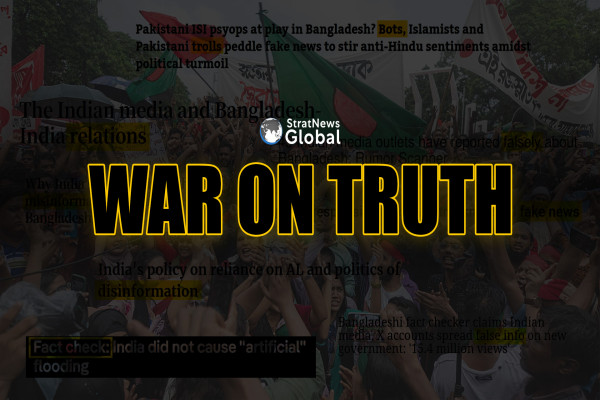
India-Bangladesh Tensions: A Case Study in Misinformation and Disinformation
The recent tensions between India and Bangladesh highlight the dangerous impact of misinformation and disinformation in international relations. While misinformation refers to the unintentional spread of false information, disinformation involves the deliberate propagation of falsehoods to manipulate public opinion. The current situation illustrates how these phenomena, particularly disinformation campaigns, can escalate tensions and even jeopardize regional stability. The core issue revolves around conflicting narratives surrounding the political transition in Bangladesh and the subsequent treatment of minorities, specifically Hindus.
From the Bangladeshi perspective, Indian media outlets have engaged in a smear campaign against the interim government, exaggerating instances of violence against Hindus to portray the revolution as religiously motivated. Dhaka argues that while isolated attacks have occurred, they are not indicative of systematic persecution and are often rooted in personal or political disputes rather than religious animosity. They accuse India of exploiting these incidents to undermine the new regime and push for the reinstatement of Sheikh Hasina.
India, on the other hand, views the new Bangladeshi leadership with suspicion, concerned about the inclusion of elements perceived as anti-India and religiously extremist. The rapid and unexpected collapse of the Hasina government, coupled with regional instability in Pakistan, the Maldives, and Sri Lanka, created a sense of unease in New Delhi. India’s concerns were exacerbated by the interim government’s dismissive response to reports of attacks on Hindus and temples, further fueling suspicions of a deliberate downplaying of the issue.
The incompatible narratives and accusations of disinformation campaigns have created a diplomatic deadlock. Bangladesh accuses India of spreading false claims of genocide and ethnic cleansing, while India suspects Bangladesh of systematically condoning or even orchestrating anti-Hindu violence. Both sides accuse the other of coordinated disinformation efforts, while simultaneously claiming that any negative actions on their own side are isolated incidents. The reality likely lies somewhere in the middle, with elements of both deliberate disinformation and unintentional misinformation contributing to the escalating tensions.
The media landscape plays a significant role in amplifying these narratives. India’s massive news industry, with its thousands of television channels and digital publishers, has a history of sensationalizing events and prioritizing competitive reporting over accuracy and national interest. During crises, this tendency towards sensationalism becomes even more pronounced, with misinformation and hyperbole often dominating the news cycle. Similarly, in Bangladesh, government responses often lean towards denial rather than acknowledgment of concerns, further fueling distrust.
This media-driven amplification of misinformation and disinformation makes it incredibly difficult to establish a constructive dialogue. The cacophony of conflicting narratives and accusations has poisoned the relationship between the two countries, making it challenging to address legitimate concerns and find common ground. Both sides have much to gain from a stable and cooperative relationship, given their shared geopolitical interests and the potential for economic collaboration.
Ultimately, diplomatic efforts are crucial to navigate this minefield of misinformation and restore trust between India and Bangladesh. Open communication, fact-finding missions, and collaborative efforts to address legitimate security concerns are essential. Recognizing the destructive potential of unchecked disinformation and actively working to counter its spread is vital for the future of the relationship. The current regional stability offers a window of opportunity for both countries to engage in productive dialogue, address their concerns, and rebuild a relationship based on mutual respect and cooperation.