


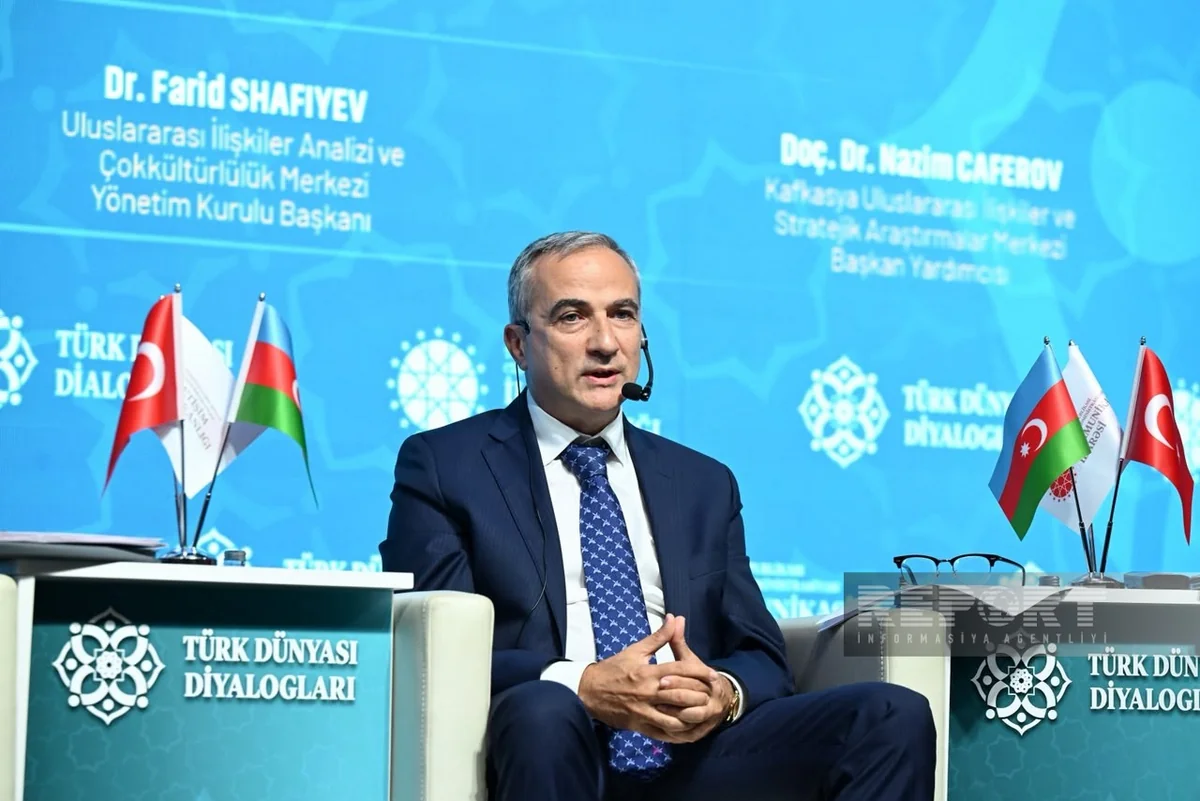
In a strong rebuke of coordinated hybrid attacks against the strategic partnership between two key Turkic states, Farid Shafiyev, Chairman of the Center for Analysis of International Relations and Multiculturalism (AIR Center), announced that sustained disinformation campaigns are being systematically waged against Azerbaijan–Türkiye unity on multiple fronts. Speaking at a high-level panel session titled “Turkic World Dialogues: Shared Future, Shared Vision” held in Baku, Shafiyev warned that these efforts are not incidental or spontaneous, but organized and deliberate, aimed at undermining the brotherly ties between Baku and Ankara. According to Report, Shafiyev highlighted the grave importance of recognizing such information operations, which seek to drive a wedge between the two allied nations at a time when regional security and geopolitical alignments are undergoing profound change. His remarks set the tone for a broader discussion among experts and policymakers about the resilience of the Azerbaijani-Turkish axis and its centrality for the future of the broader Turkic world. The panel itself became a forum for reflecting on how to address new threats that go beyond conventional military or diplomatic challenges, focusing squarely on the information domain where state and non-state actors use fake narratives, manipulative content, and targeted amplification to distort public perception and destabilize alliances.
Shafiyev specifically drew attention to the fact that coordinated disinformation campaigns are being conducted against Azerbaijan–Türkiye unity in different directions. He underscored that these campaigns are multifaceted, touching upon a wide range of issues in which Baku and Ankara share common positions or coordinate their foreign policy actions. The AIR Center chairman noted that the very idea of greater integration among Turkic states—political, economic, cultural, and strategic—has become a target for those who seek to preserve old hegemonic structures in the vast Eurasian space. He pointed out that in recent years, as Azerbaijan and Türkiye have deepened their cooperation in energy, transportation, defense industry, intelligence sharing, and regional diplomacy, the volume and intensity of disinformation targeting them have increased noticeably. The false narratives range from attempts to present the alliance as aggressive and expansionist to fabrications about internal disagreements between the two leaderships. Even more disturbing, Shafiyev argued, is the way certain circles are deliberately attempting to distort the historical record of Azerbaijani-Turkish relations, which are rooted in centuries of shared culture, language, religion, and mutual sacrifice. He dismissed these attempts as completely unfounded, especially the claim that closer ties among Turkic states represent a revival of Pan-Turkism in the aggressive, chauvinistic sense that was historically propagated by bygone empires and modern political opportunists.
The panel discussion highlighted that Azerbaijan–Türkiye intellectual ties are an essential layer of this strategic relationship, serving as a counterbalance to the disinformation ecosystem. According to Shafiyev, intellectual cooperation between the two countries—through research centers, think tanks, universities, media platforms, cultural exchanges, and public diplomacy—has played a major role in strengthening the resilience of the societies against false narratives. However, he stressed that more needs to be done, and that Turkic states must jointly combat disinformation as a collective security interest. The sharing of analytical expertise, fact-checking mechanisms, early warning systems, and communication strategies among Turkic-speaking nations was presented as a practical way forward. Shafiyev’s message was directed not only at Baku and Ankara but also at the wider Turkic community, including Kazakhstan, Kyrgyzstan, Uzbekistan, Turkmenistan, Hungary, and the Turkic Republic of Northern Cyprus. In the face of hybrid threats that target the entire Turkic world, a fragmented response would be ineffective. The clear call was for institutionalized cooperation in the information sphere, perhaps within the framework of the Organization of Turkic States, to identify and expose hostile narratives before they gain traction. Intellectual unity, he argued, is as crucial as political and military unity when it comes to warding off attempts to destabilize the Turkic world from within through misinformation and psychological manipulation.
Another key dimension of the discussion concerned the Middle East, where Azerbaijan is actively coordinating its policies with Türkiye. Shafiyev noted that this coordination is worrying some external actors, and specifically pointed to the issue of Israel as a major target for coordinated disinformation against Azerbaijan–Türkiye brotherhood. Azerbaijan has maintained a notable bilateral relationship with Israel, including in the areas of trade, security, and technology, while Türkiye has had fluctuating but often tense relations with Israel over the Palestine question and broader regional dynamics. This divergence has often been used by malicious actors to claim that Azerbaijan cannot truly be aligned with Türkiye in Middle Eastern affairs or that Baku must choose between Ankara and Tel Aviv. Shafiyev rejected such framing as misleading and dangerous, explaining that foreign policy is not a zero-sum game and that Azerbaijan is fully capable of maintaining pragmatic ties with multiple partners without compromising its strategic relationship with Türkiye. However, the manipulation of this issue for political ends poses a serious risk because it can inflame public opinion, provoke artificial crises in political discourse, and sow suspicion between allies. The disinformation campaigns concerning the Middle East reportedly include false stories about Azerbaijani military involvement in regional conflicts, invented statements by officials, manipulated videos, and coordinated social media amplification designed to present Azerbaijan and Türkiye as opposing forces behind the scenes.
The broader context of the panel session reflects the geopolitical significance of the Turkic world at a time when traditional international order is being contested. Rapid changes in the post-Soviet space, shifting alignments on the Silk Road, energy security concerns, and new conflicts have made the strategic partnership between Azerbaijan and Türkiye more important than ever. The two countries are viewed as anchors of stability in the South Caucasus and an essential bridge between Europe and Asia. Azerbaijan’s successful military operations to restore its territorial integrity, followed by large-scale reconstruction projects and normalization efforts with Armenia, have created new diplomatic dynamics. Türkiye has been a steadfast supporter of Azerbaijan throughout this process. This shared victory, while widely celebrated across the Turkic world, has also generated resentment and concerns among certain powers that have an interest in maintaining a fragmented geopolitical map in the region. As a result, Shafiyev argued, the information war against Azerbaijan–Türkiye unity is likely to intensify in the coming years. The panel stressed the need to build a robust, modern, and efficient communication infrastructure that can respond quickly and credibly to disinformation. This involves not only the government sector but also civil society, media professionals, researchers, content creators, and ordinary citizens who must be educated in media literacy and critical thinking to resist manipulation.
In conclusion, Farid Shafiyev’s remarks in Baku serve as an urgent wake-up call for Azerbaijan, Türkiye, and the entire Turkic world. The threat of coordinated disinformation is no longer a theoretical concern or a secondary issue in international relations; it is an active weapon used by hostile actors to weaken alliances, undermine trust, and distort the strategic choices of independent nations. The Azerbaijani-Turkish relationship, built on centuries of common history and strengthened by recent political and military cooperation, is a prime target of these attacks. The meeting titled “Turkic World Dialogues: Shared Future, Shared Vision” thus became a platform not just for celebrating unity but for charting a practical course toward defending it. Shafiyev’s call for joint action against disinformation is a recognition that the future of the Turkic world will depend not only on military balances, economic projects, or diplomatic negotiations, but also on the ability to win the battle of narratives. In an age where a lie can circle the globe before the truth gets its boots on, the Turkic states must create their own defense mechanisms, build trust among their peoples, and coordinate their communication policies with the same seriousness they devote to border security or energy infrastructure. Unless the forces that engage in disinformation are identified, exposed, and countered systematically, the strategic unity between Azerbaijan and Türkiye—and by extension the broader Turkic world—will remain vulnerable to constant erosion. Therefore, the message emanating from Baku is clear: friendship and brotherhood must be defended, and the information front is now one of the most critical battlegrounds for the future of the Turkic world.