


In Bangladesh, the intersection of digital life and mental health has become a quiet but mounting crisis, according to psychiatrists and psychologists who see the effects of excessive social media use in their patients and in wider society. With smartphones now common in both urban and rural households, and with platforms such as Facebook and YouTube dominating leisure time, mental health professionals say that children and young people are especially vulnerable to anxiety, depression, sleep disruption and attention problems linked to online habits. Yet the urgency of this issue has not been matched by policy action. On World Mental Health Day, observed under the theme “Lived Experiences Heard: Real Voices, Real Change,” experts in Bangladesh are calling for a fundamental shift in how the country treats the psychological consequences of digital connectivity. They argue that the conversation must move beyond anecdotal evidence and clinical observation into national-level strategies, funding and research. The theme is particularly apt because people’s lived experiences of social media-induced distress are increasingly common, but those voices are rarely heard in the corridors of policymaking. Without systematic intervention, the growing use of social media may deepen the country’s already severe mental health burden, they warn. Mental health experts emphasise that action is needed at every level, including government, healthcare institutions, schools, community organisations and families. The need is felt most acutely among younger generations, who find it difficult to disconnect and whose developing brains and emotional regulation systems are more sensitive to constant stimulation and online validation. This opening picture, drawn from interviews with leading psychiatrists and recent research, forms the backdrop to urgent calls for a coordinated response.
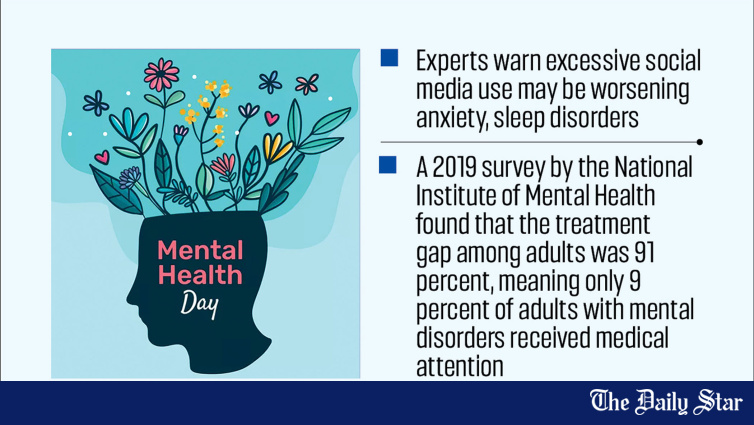
Data on the scale of mental distress remain sobering. The latest national mental health survey, conducted by the National Institute of Mental Health in 2019, found that 18.7 percent of adults aged 18 and above and 12.6 percent of children aged 7 to 17 had a mental disorder. These figures represent millions of people, yet they are already seven years old, and no comparable national data have been collected since. Mental health experts say that the current prevalence is unknown, but the trajectory of social media and internet use, which grew sharply during and after the COVID-19 pandemic, suggests that the burden has almost certainly increased. The 2019 survey also revealed a vast treatment gap: 91 percent of adults with mental disorders did not receive medical attention, leaving only 9 percent who managed to access care. That treatment gap is among the widest in the health sector and is likely even larger for children and adolescents, for whom mental health services are almost nonexistent. The combination of a high burden of mental disorders and a very low rate of treatment means that any new risk factor, such as social media overuse, can have outsized effects on a population that is already carrying an enormous hidden load. In this assessment, the addition of digital pressures threatens to overwhelm a mental healthcare system that is already seriously under-resourced. With no fresh national survey, policymakers are operating in the dark; researchers can only extrapolate from smaller studies, clinical observations and regional data. This lack of updated evidence is itself a concern, because mental health planning cannot be evidence-based if the evidence is more than half a decade old. Experts are therefore not only calling for awareness but also for the political will to undertake new national surveys, strengthen reporting mechanisms and invest in community-based mental health services that can reduce the treatment gap.
Personal experiences illustrate what the statistics point toward. Niaz Ahmed, an employee in the private sector, told this correspondent that he spends around six hours every day on social media, mainly Facebook and YouTube, often continuing late into the night. “As a result, I’m getting less and less sleep and becoming easily irritable by the day. Sometimes, I also find it difficult to absorb new information,” he said. His account matches the findings of a recent study conducted by a group of Bangladeshi researchers. The paper, titled “Social Media Use Time and Mental Health of Young Adults: A Cross‐Sectional Study in Bangladesh,” was published in the medical journal Wiley’s Health Science Reports in July last year. The researchers collected cross-sectional data from 440 young adults aged 18 to 35 in Dhaka and Cumilla between February and March 2024. The study found that participants who used social media for more than four hours a day had significantly higher odds of depression than those who used it for less than two hours. Abdullah Al Zubaye, one of the authors, said that longer use was also associated with higher chances of anxiety. The study’s design cannot establish causation, but the strength of the association adds to a growing body of international evidence that social media overuse and mental health problems are linked. The threshold of four hours is notable because many young people in Bangladesh use smartphones for far longer, either for entertainment, communication, or in some cases because of work and education. When usage creeps past that threshold, the risk of depressive symptoms rises markedly. Researchers underline that the findings are especially relevant for a country where mental health care is scarce, because prevention and early intervention in digital habits could provide a low-cost way to reduce the burden.
Mental health experts say excessive social media and internet use can contribute to addiction, sleep problems, poor concentration, irritability and other mental health difficulties. Prof MMA Shalahuddin Qusar, chairman of the psychiatry department at Bangladesh Medical University, said social media has a tendency to perpetuate rumours and misinformation, confusing people and creating problems in personal and family lives. “Social media has a tendency to perpetuate rumours and misinformation and confuse people, creating problems in personal and family lives. And internet addiction is increasing,” he said. He said there are clear impacts of social media on mental health, and it should be recognised as such rather than treated as a separate issue. “If we are forgetting things, unable to concentrate on work, losing sleep or becoming irritable because of it, then our mental health is certainly being affected,” the expert said. His comments reflect a broader shift among psychiatrists who are urging their colleagues to take social media use seriously as a clinical factor. In severe cases, internet addiction and social media dependency are now seen as conditions requiring treatment, and some countries have opened specialised clinics. In Bangladesh, however, such clinics are rare, and most mental health professionals do not routinely ask patients about screen time or online habits. This gap in clinical practice means that a significant driver of mental distress may be going unaddressed in consultations. Experts also note that the relationship is not purely one-way: people who are already depressed or anxious may seek refuge in social media, which in turn amplifies their symptoms. The constant comparison with curated lives, the fear of missing out, cyberbullying and the pressure to respond immediately to notifications all create a toxic cocktail for vulnerable individuals. The Bangladeshi context adds another dimension: many families have limited digital literacy, and parents may not understand the platforms their children are using or the risks they pose.
The impact on children is particularly worrying. Muntasir Maruf, associate professor at the community and social psychiatry department of the National Institute of Mental Health, said excessive social media use is also affecting children’s mental wellbeing, sleep patterns and concentration. Easy access to smartphones, changing family dynamics and fewer opportunities for face-to-face social interaction are encouraging children to spend more time online, sometimes leading to addiction, he said. “Children often become dependent on social media without realising it,” he said, adding that online recognition can influence adolescents’ emotions. For children and adolescents, the harm is more than simply lost study time. Sleep deprivation caused by late-night scrolling can affect brain development, memory consolidation and emotional regulation. The need to gain likes, comments and followers can become a measure of self-worth, making children more vulnerable to peer pressure and rejection. In Bangladesh, where emotional health conversations are often suppressed and many families avoid discussing psychological problems, these effects can be hidden beneath the surface, manifesting as irritability, declining marks or social withdrawal. Maruf urged parents to set limits on phone use at home, encourage children to take part in sports and cultural activities, and talk regularly with them about their online experiences. “Schools should also raise awareness of the risks and promote healthier social media use,” he added. This advice is especially important in a culture where children in urban areas are often left at home with a smartphone while parents work long hours, and where schools have limited counselling support. Experts argue for a public health approach that combines family rules, school-based digital literacy programmes and the development of healthy alternatives. They also highlight the need to create safe spaces, both online and offline, where children can express their lived experiences without shame and receive support from trusted adults.
Despite growing global recognition that excessive social media use can harm mental health, Bangladesh has been slow to respond. Prof Shalahuddin Qusar said internationally, concerns over the mental health effects of excessive social media use are increasingly being discussed. “But in Bangladesh, the issue remains largely confined to academic and professional discussions and has yet to receive sufficient attention at the policy level,” he said. “We also need more research to understand what is happening,” he said, adding that ignoring the issue could make an already serious mental health burden even more difficult to address. The gaps are visible in several areas: no national guidelines on screen use for children, no regulatory framework for platforms that host harmful content, no investment in digital mental health literacy campaigns, and very few services for people who develop internet addiction or related conditions. Even the mental health policy and the Mental Health Act of Bangladesh have not, in public discussions, focused on social media as a distinct risk. The 2019 survey, while valuable, did not measure social media or internet use in detail, leaving researchers with scattered academic studies and anecdotal evidence. Experts say the first step is a comprehensive national survey that tracks both mental health and digital behaviour, especially among adolescents and young adults. Such a survey should be repeated every few years to allow trend analysis. At the same time, caregiver education, school programmes and community workshops are needed to build digital resilience. On the regulatory side, experts say that social media companies should be held accountable for harmful content, and parents should be helped to understand tools for blocking and monitoring harmful material. Ultimately, the goal is not to demonise social media, which can be a source of information, social support and creative expression, but to ensure that its benefits do not come at the cost of a generation’s mental health. As the theme of World Mental Health Day reminds us, real change begins when lived experiences are heard; in Bangladesh, the voices of young people affected by social media are finally asking to be included in a national conversation.