


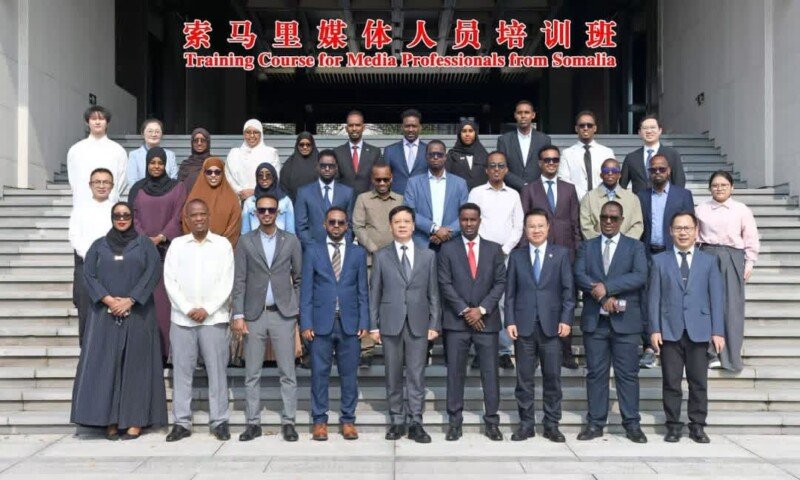
JINHUA, China — A 21-day training programme for 27 officials from Somalia’s Ministry of Information, Culture and Tourism has officially opened at Zhejiang Normal University in Jinhua, in eastern China’s Zhejiang province, marking the latest phase of a deepening cooperation between Mogadishu and Beijing on media, technology, and public communication. The intensive course, delivered by experts from the university, brings together directors, heads of government media departments, and other ministry personnel, who will spend the next three weeks studying modern media strategies, the application of artificial intelligence in communication, media management, and techniques for identifying and countering false information. The curriculum is designed to strengthen the professional skills of Somali government media staff as the country attempts to modernise its public communication systems and respond to the pressures of an evolving digital media landscape. At the opening ceremony, Zhu Yifeng, Vice-President of Zhejiang Normal University, said the workshop would promote the exchange of media expertise, strengthen bilateral ties, and advance cooperation between Somalia and China. Abdishakur Ali Ahmed, Director of the Media Strategy Department at the Somali Ministry of Information, described the training as a valuable opportunity for government media representatives to learn from China’s experience in modernising its media sector. He expressed gratitude to the Chinese government, the organisers, and the institutions involved, with particular thanks to the Chinese Ministry of Commerce, which financed the training, and the Chinese Embassy in Somalia, led by Ambassador Wang Yu, which facilitated the initiative.
The training did not emerge in isolation. It follows a series of high-level engagements between Mogadishu and Beijing on media and technology cooperation throughout 2026. Somalia’s Ministry of Information has already begun integrating advanced AI systems into national media operations, including automated translation, content generation, and digital distribution algorithms, which, according to reporting from the period, have reduced editorial production time considerably. In August 2026, Information Minister Abdulfatah Kasim Mohamud travelled to Beijing, where he met Cao Shumin, Minister of China’s National Radio and Television Administration, for discussions focused on media modernisation, institutional capacity-building, and professional training. The Minister also participated in the China-Africa Media Cooperation Forum, where he called for stronger support to modernise Somali broadcasting infrastructure. These meetings were part of a broader pattern of engagement: China has extended zero-tariff access to all 53 African nations with which it has diplomatic relations, and Beijing has deepened defence and security cooperation with Mogadishu. The media training in Jinhua represents another dimension of a relationship that now spans trade, security, and information. The initiative also follows the establishment in 2025 of Somalia’s first Media Satellite Teleport in more than three decades, a facility intended to modernise national broadcasting capability. That infrastructure investment, however, exposed the persistent gap between hardware and human capacity, making the training component an essential part of the long-term strategy.
At the opening ceremony in Jinhua, the tone was one of cautious optimism and diplomatic courtesy. Zhu Yifeng framed the workshop as a practical contribution to bilateral exchange, noting that media expertise is an area where China can offer significant experience, particularly in the use of technology for public communication and content management. Abdishakur Ali Ahmed thanked the Chinese institutions involved, specifically mentioning the Chinese Ministry of Commerce as the financier and the Chinese Embassy in Somalia under Ambassador Wang Yu as the facilitator. He stressed that the course had been tailored to the practical needs of Somali media officials and that participants would return home with concrete knowledge in media management and artificial intelligence tools. The selection of participants—directors, heads of government media departments, and senior ministry personnel—indicates that Mogadishu views this not as a junior-level orientation but as a strategic investment in leadership capacity. The Ministry of Information is central to the Somali government’s broader efforts to communicate with citizens, manage public narratives, and confront the information challenges facing the country. The programme is expected to cover both the theoretical foundations of modern media strategy and the practical application of AI-driven tools, including automated content distribution, audience analysis, and methods for identifying false narratives across digital platforms. Whether the skills acquired will translate into sustained institutional change depends on the follow-up that occurs after participants return to Somalia, a question that remains unanswered even as the workshops begin.
China’s engagement with Somali media fits into a broader pattern of Beijing’s involvement in Africa’s information and communication sectors, alongside its expanding economic and security interests. Across the continent, Chinese companies have built telecoms infrastructure, launched satellites, and supplied broadcasting equipment, often with training programmes attached. In Somalia, the appeal of this cooperation is deeply practical. The country’s state media infrastructure remains fragile despite recent investments, and the government has struggled to counter the sophisticated propaganda operations of Al-Shabaab, the militant group that has long maintained an effective media arm capable of producing professional videos, statements, and social media content. The government has also faced recurring challenges in managing misinformation during political crises, when false and inflammatory content can spread rapidly through messaging platforms and social networks. A federal state media system that is underfunded and often reactive is poorly equipped to respond quickly or credibly. In this context, the Jinhua programme addresses a genuine capacity gap. Modern media management skills and AI tools could help Somali state media detect coordinated disinformation, automate translation across the country’s multiple languages, and improve the efficiency of government communication. The ministry has already taken steps in this direction, with AI systems reportedly cutting editorial production times and enabling faster content generation. But infrastructure and algorithms are not substitutes for public trust. Many Somalis remain skeptical of state media, which is often seen as disconnected from ordinary citizens or vulnerable to political interference. A 21-day training course can introduce new techniques, but it cannot repair the structural weaknesses that have long undermined the credibility of government communication.
The challenges facing Somali media are not only technical. Independent outlets and press freedom organisations have accused the Somali government of orchestrating digital censorship campaigns, including the use of copyright strikes and bot-driven harassment against critical reporting. Journalists have been arrested and assaulted by security forces, and international watchdogs have documented a pattern of intimidation designed to discourage investigative coverage. These accusations create an uncomfortable backdrop for a training programme focused on modernising government media. The same ministry sending officials to learn about countering disinformation is also accused of participating in digital censorship at home. The programme organisers have not publicly addressed these contradictions. They have framed the course as a technical intervention, focused on improving capacity for public information management and the fight against false information. Yet the techniques being transferred are not politically neutral. AI tools designed to detect false information can also be used to identify critical voices, track dissenting sources, and amplify pro-government narratives while suppressing alternative viewpoints. The structural problems inside Somalia’s Ministry of Information—limited budgets, political interference, and a state media apparatus viewed with suspicion by much of the public—are unlikely to be resolved by a 21-day workshop. The course can introduce new concepts and provide useful skills, but it cannot alter the institutional incentives that shape how those skills are applied. International donors and partners have long called for comprehensive media sector reform in Somalia, including legal protections for journalists and the establishment of genuinely independent public service broadcasting. The Jinhua programme, focused exclusively on government employees, appears to prioritise state capacity-building over the strengthening of a pluralistic media ecosystem.
The deeper concern is one of orientation. China’s model of media management is built on tight state control over information flows, a framework that differs fundamentally from the pluralistic, if chaotic, media environment that has emerged in Mogadishu over the past decade. Since the collapse of the central state in 1991, Somalia has experienced an explosion of independent radio stations, online news sites, and social media activism—messy, contradictory, and difficult for any government to manage, but genuinely diverse. The current administration, through its Ministry of Information, has sought to reassert control over this landscape in the name of stability, security, and national unity. The Jinhua programme can teach Somali officials how to use AI to detect false information, but it cannot teach them how to resist the temptation to deploy the same tools for political advantage. In polarised environments, the label of misinformation is often used to justify silencing legitimate dissent. The same ministry participating in the training is the one accused of orchestrating digital censorship at home, and that contradiction is not lost on Somali journalists and civil society groups. As part of the broader bilateral relationship, the workshop represents a tangible investment in one dimension of Somalia’s institutional development, and the commitment of the Chinese Ministry of Commerce and the embassy in Mogadishu suggests this is not a one-off effort. But the long-term value of the programme will depend on how the participants apply their new skills once they return to Somalia. If the result is a more professional and credible state media sector that serves the public interest, the initiative may prove genuinely beneficial. If it leads to the further refinement of digital censorship and government propaganda, the potential harm is equally real. For now, the most honest assessment is that the Jinhua training programme is a welcome investment in capacity that carries significant unresolved questions about its political orientation and ultimate consequences.