


In November 2020, Barack Obama issued a warning that at the time sounded like a valedictory reflection but has since become an urgent text for our age. The former US president spoke of an “epistemological crisis” facing western democracies, a crisis in which polarisation and radicalisation were corroding trust in established information sources. He insisted that the marketplace of ideas, long considered the bedrock of democratic debate, cannot function if citizens lack the ability to distinguish truth from falsehood. That warning has aged badly only in the sense that the condition has worsened. Less than two months later, the US Capitol was attacked by rioters convinced that an election had been stolen; in the years since, once fringe conspiracies have entered the political mainstream and hostile foreign powers have grown far more skilled at exploiting social division. This week, at the United Nations, the British prime minister offered the latest and most explicit acknowledgement of that reality. Accusing Russia of waging what he described as an “industrial-scale assault” on the UK’s information environment, he outlined a campaign built on bot armies, fake websites and engineered falsehoods. He spoke of attempts to interfere in elections, foment discord, and poison inter-community relations. In response, he announced the creation of a National Centre for Information Defence, a new body intended to detect and counter campaigns of epistemological sabotage by hostile actors. The very name is striking: it places the defence of truth alongside the defence of territory, and acknowledges that the state has a duty to protect the cognitive landscape on which democratic life depends.
The threat described by the prime minister is not simply the production of falsehoods; it is the flood itself. Bot armies are not intended to convince anyone of a particular political proposition. Their purpose is to distort the appearance of consensus, to make minority opinions seem majoritarian, and to drive algorithmic discovery toward outrage. Fake websites, similarly, do not need a wide readership if their content is picked up by real users and amplified through the mainstream information ecosystem. The result is a digital hall of mirrors in which a lie can be repeated until it becomes indistinguishable from fact, at least for those not equipped to investigate. Election interference is the most obvious objective, and Russia’s record in this area is well documented. But the deeper goal is to weaken the bonds of trust that hold diverse communities together. By inflaming cultural resentments, suppressing minority voices and fabricating grassroots protest, an external actor can turn a country’s pluralism against itself. Inter-community relations are not merely collateral damage; they are a target. The creation of the National Centre for Information Defence represents an overdue acknowledgment that the United Kingdom has for too long treated these developments as a communications problem rather than a threat to national security. Civil defence is no longer only about bunkers, emergency services and flood barriers. It is about protecting the public from attempts to corrupt their understanding of the world, and about ensuring that democratic elections are decided by citizens rather than by algorithms owned by men in other countries. What remains to be seen is whether the new institution will have the powers, resources and independence to do its job. It will need to work across government, with media regulators, and with civil society—and it will need to avoid the temptation to become a tool of political convenience, or a censorious instrument of the state.
Yet the prime minister’s speech, for all its importance, told only part of the story. It is true that Moscow has turned disinformation into an industry. But the Kremlin would be wasting its money pumping out disinformation if large US tech platforms did not provide convenient channels for the toxin to spread. It would also fail if there were not a complicit audience in Britain sharing the offending material, and if the market for spreading pernicious propaganda were not so lucrative. Information warfare is always a two-way transaction: a foreign sender requires a domestic receiver. It only works when it exploits structural vulnerabilities that already exist in the target society. This is where the analysis becomes uncomfortable. Far-right material sowing hatred against migrants is most fruitful where the terrain has been fertilised by domestic politics. Years of hostile rhetoric about asylum seekers, housing pressures and national identity have created an audience primed to believe that migration is an existential threat. Economic insecurity, social isolation and the collapse of local institutions all contribute to the appeal of conspiratorial narratives. Foreign influence operations are an accelerant, not a cause. To acknowledge this is not to blame the victims of disinformation; it is to understand that a healthy society is the best defence. A democracy that has lost its intellectual confidence, or whose political class has itself embraced false narratives, is a democracy that will be easy prey. Thus, any strategy that focuses solely on Russia risks missing the deeper pathology. The enemy is not only a foreign intelligence service but also the willingness of domestic actors to weaponise the churn.
The evidence for this uncomfortable reality is mounting. Earlier this year, analysis by the Guardian found that more than half of the accounts on X that were posting about racially aggravated riots in Belfast and civil disorder in Southampton were based outside the United Kingdom. Seven of the most-read tweets about those events originated in the United States, including one posted by X’s proprietor, Elon Musk, the world’s richest man. This is not a coincidence. Musk has been assiduous in promoting a warped, dystopian idea of Britain as a failed state whose culture is being corroded by mass migration. His platform has become an echo chamber in which the distinction between reporting a riot and inciting one is dangerously blurred. Far-right activists have used X to muster gangs of masked men into mobs that obstruct roads, intimidate people and threaten asylum claimants at British ports. The online and the physical have become seamlessly connected: a single viral post can bring men in balaclavas to an immigration centre within hours. In this environment, the platform is not a neutral conduit. It is an active participant in the political process, with an owner who has clear opinions about the country in which it operates. Musk’s repeated interventions in British politics—his attacks on the elected government, his amplification of anti-Muslim content, his decision to restore accounts associated with the far right—suggest that the threat to Britain’s information environment does not come only from Moscow. It also comes from billionaires who believe they have the right to rewrite the rules of democracy, and who face almost no legal or political accountability for the consequences.
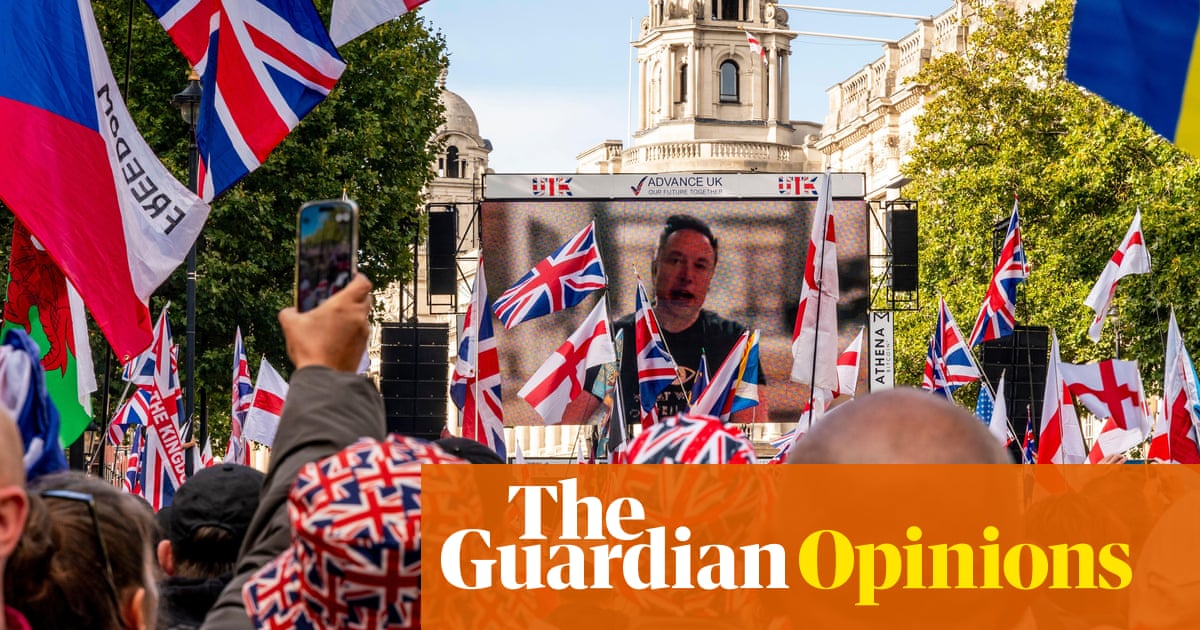
The convergence of these forces was laid bare in the strange friendship between Elon Musk and Tommy Robinson. Last year, Musk addressed a rally organised by Robinson, where he called for the Labour government to be removed. Robinson, whose real name is Stephen Yaxley-Lennon, has been a persistent figure in far-right street politics for years. Earlier this year, he travelled to Moscow on a trip funded by the Musk Foundation. The stated purpose of the trip, according to Robinson, was to “see the beauty of a civilised society.” It is difficult to imagine a more complete contradiction: a man who claims to be defending British values praising the capital of an autocratic state that actively works to undermine the United Kingdom. The episode illustrates the strange alliances that have emerged at the intersection of populism, social media and geopolitical confrontation. Yet the prime minister did not address that side of the anti-democracy equation in his speech to the UN. Perhaps he felt it would be impolitic to impugn US big tech under the president’s nose. President Trump is himself an originator and disseminator of falsehoods online, and his administration has shown little interest in holding American platforms to account for their global impact. Transatlantic diplomacy places limits on what a British prime minister can say in a public forum. If he had spoken out against Trump, he would have risked the relationship on which trade, intelligence and military support depend. So the speech concentrated on the Kremlin, a safe target that unites western audiences. But the gap in the analysis is not merely rhetorical; it is a gap in strategy.
Under the circumstances, it made sense for the prime minister to concentrate his remarks on the threat from Russia. But that must not signal the limit of his policy focus. British democracy is indeed under attack from Moscow, and a national information defence centre is a sensible and overdue step. Yet an effective campaign to build resilience has to recognise also the complicity of domestic extremists and the digital privileges they enjoy thanks to US technology companies. This is delicate diplomatic and constitutional terrain. The UK cannot simply regulate American companies by decree, although it has tried to do so through the Online Safety Act. It must also engage with the uncomfortable fact that some of its own citizens are eager consumers of propaganda, not innocent dupes. The defence of truth cannot be outsourced to a single agency. It requires a broader effort to renew public life: reinvigorating local media, teaching critical digital literacy in schools, protecting political discourse from commercial manipulation, and demanding accountability from those who profit from division. It also requires leadership that is willing to name the problem, even when the problem is at home. The marketplace of ideas cannot work if the market itself is rigged. At its best, the National Centre for Information Defence could become the cornerstone of a new social settlement between technology companies, citizens and the state. At its worst, it could become just another slogan. The prime minister’s speech at the UN was a necessary step. But the first step is not the destination. The real work lies in building a democracy resilient enough to distinguish what is true from what is false, no matter how many bots, billionaires or proxies are enlisted to confuse the distinction. If leaders cannot say plainly that they care about the truth, then the next election, the next riot, the next conflict will simply be another round in the crisis that Obama described—a crisis that has only grown more dangerous while political elites have hesitated to confront its full dimensions.