


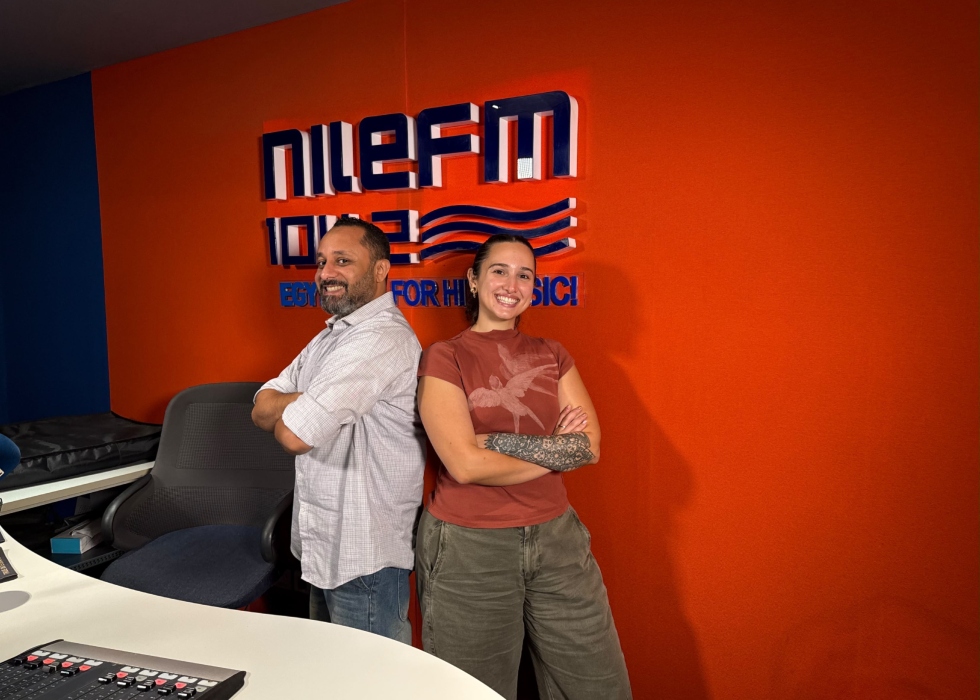
CAIRO — When Rebecca Doudak first started making short videos, she was not looking for fame. She was looking for a way to understand herself. In a candid interview with NileFM, the Egyptian-Canadian creator described a childhood spent between the quiet streets of Toronto and the crowded, loud, generous rooms of her Egyptian family home. She remembered how her name, Rebecca, marked her as both familiar and foreign; how her Arabic was interrupted by English; how she often translated for her parents at doctor’s appointments while feeling unable to translate the complexity of her own inner world. That in-between feeling stayed with her into adulthood. It shaped the way she spoke, the way she laughed, and the way she presented herself to the world. For years, she told NileFM, she tried to perform a version of herself that would make others comfortable: less Arab in certain settings, more Arab in others, never fully one thing. It was exhausting. The idea of “finding her voice” was not about becoming a celebrity; it was about deciding that her own story deserved to be told in her own words. That decision came slowly. Early attempts to be a conventional digital creator made things worse. She tried cooking trends, lip-syncing clips, and generic motivational posts, but the content felt hollow because her real voice was missing. Then, almost by accident, she shared something personal: a short video about not being able to understand her grandmother’s jokes in Egyptian Arabic. She expected little. Instead, thousands of young viewers responded with similar confessions. They had hidden their imperfect Arabic, pretended to know the cultural references, and felt distant from relatives in Egypt. For Doudak, that response changed everything. It proved that specific, honest storytelling beats generic viral formulas. It also gave her permission to think of her social media pages as something more than entertainment. They became a safe room for reconciliation—between cultures, generations, and the many versions of herself she had been carrying silently for years.
After that first taste of connection, Rebecca Doudak decided to stop trying to please the algorithm and start listening to her own instincts. Her content began to shift, taking on the mix of comedy and confession that would become her signature. She started making videos about growing up with Egyptian parents in the West: the embarrassment and pride of shared family meals, the constant question “have you eaten?”, the pressure to be a doctor or engineer, the joy of heaping plates at Eid, and the strange experience of being read as a foreigner when she returned to Cairo. She did not try to sanitize these moments. Instead, she leaned into their awkwardness and tenderness, doing impressions of well-meaning aunties and long phone calls with her father. The result was a form of storytelling that felt both deeply new and instantly recognizable. Her audience growth, she was careful to point out in the NileFM conversation, was not linear. There were weeks when a video she labored over disappeared without a trace, and short informal posts that unexpectedly got millions of views. She needed to learn, she said, that numbers could not be the measure of her worth. More important was the community that formed around her posts. Young people in Cairo, Alexandria, and the diaspora wrote to her about their own struggles; some asked how to reconnect with relatives they had lost touch with; others asked whether they were “Egyptian enough” to claim a culture they had only encountered through the internet. Doudak answered them, sometimes privately, sometimes in public videos, because she recognized her own face in these questions. She also began to understand that her creative voice was not fixed. It could become stronger, softer, angrier, funnier, more political. The point was to remain honest. That honesty is what convinced her to turn the camera not just on her own apartment and family, but on Egypt itself. She booked a ticket, landed in Cairo, and began what she calls the second act of her story: discovering the country that had always existed in her imagination but was only beginning to become real to her.
The first time she seriously visited Egypt as an adult, Rebecca Doudak said she was overwhelmed. In the NileFM interview, she described the sound of the city—street vendors, car horns, music drifting from shops, the call to prayer mixing with the buzz of the afternoon—as something she had to learn to listen to after years of living in curated Canadian silence. She walked through Coptic Cairo, stood in front of the pyramids, took a boat along the Nile, and ate koshary with her cousins. But the discovery she spoke about most passionately was not tourist sights. It was the discovery of family relationships and national intimacy: the way her uncles argued over football, how her aunts welcomed her with bowls of fava beans and bottomless tea, how a trip to the local market turned into an hour-long conversation about her mother’s childhood. She realized, she explained, that Egypt was not simply a place she visited; it was a set of practices she carried in her body. She had been performing Egyptianness her whole life—the gestures, the affection, the loud overlapping conversations—without always understanding where it came from. Seeing that behavior alive across a crowded family home was like finding the origin code. It changed her relationship to her content. Her Instagram and TikTok feeds began to feature Egypt as more than a background; they became a chance for her to thank the country for giving her parents the language of love and humor that she had inherited. She also confronted the privileges and complications of being a diaspora Egyptian. At moments she felt like a visitor, stared at because of her accent or her Canadian mannerisms, and other times she felt more at home than she ever had in Toronto. She used that tension, rather than hiding it, as material for social media. The videos that came out of her trips were not simple travel diaries. They were attempts to answer a question she had carried since childhood: “What does it mean to be Egyptian?” Her answer, she told NileFM, is still unfinished. But her willingness to keep asking the question, publicly and with humility, has resonated with thousands of followers who are searching for the same thing.
Rebecca Doudak’s engagement with Egypt soon moved beyond food, travel, and family videos. As she began to understand the country’s social realities, she also began to think more deliberately about how to use her platforms for impact. In her conversation with NileFM, she spoke about the responsibility that comes with a large audience, especially one that includes young people who may see her as a role model. She recalled being contacted by Egyptian women, many of whom had never told anyone about their dreams, and by young men who asked her how to talk about mental health without being shamed. These messages pushed her to use her voice not just for comedy or nostalgia but for things she cared about deeply: women’s education, mental health awareness, supporting local Egyptian artisans, and amplifying the work of emerging Arab artists that mainstream algorithms often ignore. She began to structure her pages around a simple philosophy: attention is a resource, and it should not be wasted. For Doudak, impact does not always mean a fundraiser or a petition. Often it means representation—producing images and narratives that counter the reductive way Egypt and the Arab world are depicted globally. She wants viewers outside the region to see Egyptians as ordinary people with full interior lives, not as stereotypes. At the same time, she wants young Egyptians back home to feel that their culture is not a museum display but something living, contradictory, and self-ironic. She described the social media environment as a kind of Cairo street: noisy, competitive, sometimes beautiful, sometimes unfair. Her strategy is to keep walking, acknowledge the people around her, and occasionally stop to help someone get up. This attitude has made her a respected presence in the Egyptian digital scene, not because she claims to have all the answers, but because she is willing to ask the questions publicly. She told NileFM that she hopes her work is useful before it is liked. If a video disappears after a few hours, she said, that matters less than whether a single viewer felt less alone after watching it. That is the impact she measures.
Of course, building a career on the internet has not been easy. Rebecca Doudak was open with NileFM about the emotional cost of constant visibility, especially for someone whose work is so deeply personal. She spoke about the pressure to remain accessible, the exhaustion of reading harsh comments, and the strange loneliness of turning intimate family moments into content. She sometimes worries, she said, that her life in front of the camera is a performance that she cannot step out of. To keep herself grounded, she sets strict boundaries: days without social media, long walks in Cairo, phone calls with old friends who know her outside the internet, and writing sessions where no one is listening. She has also learned to sit with criticism. Some viewers accuse her of not being Egyptian enough; others criticize her for leaning too heavily on sentimental portrayals of Egypt. Doudak does not reject those comments outright. She sees them as a sign that her work matters, that people are watching closely because they claim her. The same audience that celebrates her is the audience that holds her to account. That, she says, is part of living in a relationship with a culture and a country. She has also had to revise her own expectations after going viral. Viral moments, she said, can be addictive, but they are not the same as building a sustainable creative practice. She has deliberately diversified her work, experimenting with longer videos, interviews, collaborations with other Arab creators, and even some acting. She wants to prove that many of the skills she learned making short clips are transferable: timing, empathy, observation, editing, and the ability to make a stranger care. Her great lesson from the digital trenches is that the algorithm changes, but people do not. They still want to feel known, to laugh at shared absurdities, and to be given permission to speak honestly about what they do not know yet. Doudak’s own story is just that: a slow, loud, imperfect discovery of a voice that she once thought was lost.
Looking ahead, Rebecca Doudak is not slowing down. In the NileFM interview, she shared plans to continue developing projects in Egypt, including collaborations with Egyptian filmmakers, creators, and brands who share her vision of dignified and joyful representation. She said she hopes to spend more time in Cairo, to keep learning Arabic in all its playful, profane, poetic registers, and to bring more members of the diaspora into conversations with local Egyptian communities rather than treating them as two separate audiences. She remains realistic about the limits of social media, but she also believes that the same tools that can distract and divide can be used, as she has used them, to heal. Her advice to young people trying to find their own voice is simple, in her telling: begin where you are, without waiting for permission. Do not feel that you need a perfect accent, a perfect body, a perfect story, or a perfect platform. You can make a video in your bedroom, in your car, at your grandmother’s kitchen table, and it can change someone’s day or even someone’s life. You just have to be willing to be real. Looking back at the path from a shy Canadian-Egyptian girl uncertain of her place to a creator whose words now echo across social media, Doudak says she would not erase any of the confusion she experienced. That confusion, she insists, makes the discovery of Egypt and the discovery of her own voice much sweeter. The interview on NileFM ended with a favorite metaphor: she sees her identity as a kind of living mixture—not one single thing, but a combination of ingredients that are stronger together than they are apart. It is a modest image, and also a profound one. Something similar could be said about her online world: a patchwork of languages, homes, and histories, gently shaken together until it becomes something new. For Rebecca Doudak, that is not an identity crisis. It is a gift, and she has made it her mission to share it with everyone who is still trying to find their own voice in the chaos of modern life.