


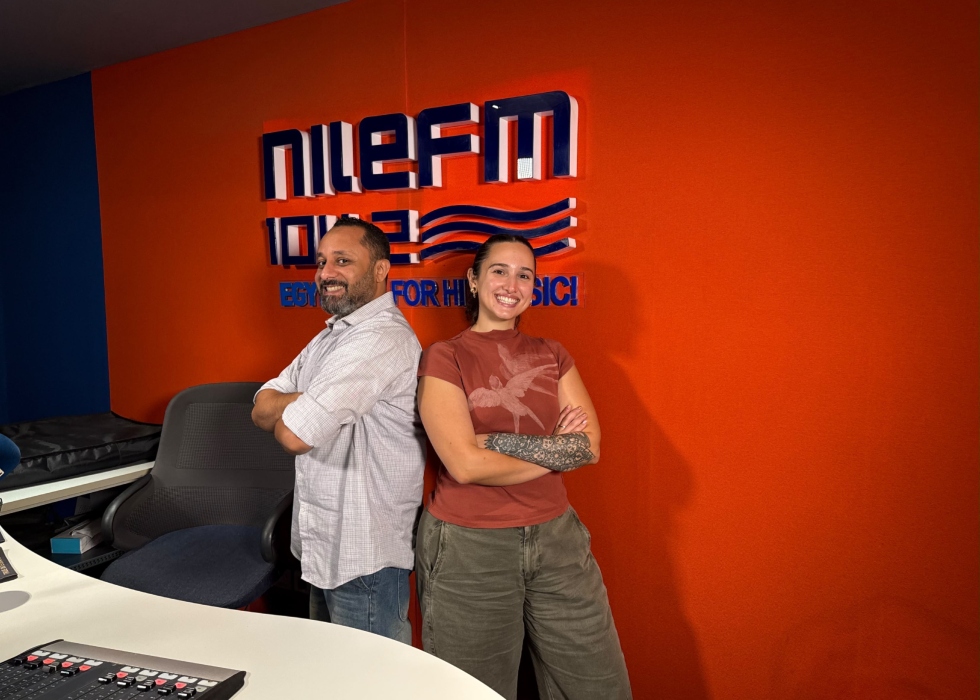
Rebecca Doudak: Finding Her Voice, Discovering Egypt and Using Social Media for Impact
In a revealing and deeply personal conversation on Nile FM, Rebecca Doudak opened up about her journey of self-discovery, her evolving relationship with Egypt, and the role social media has played in shaping her identity and her mission. The interview, which aired as part of the station’s continued commitment to showcasing voices that matter, offered listeners an intimate look at a young woman who has learned to navigate the modern world with grace, purpose, and an unshakeable sense of self. Doudak spoke candidly about the moments that defined her, the challenges that nearly silenced her, and the realization that her voice—once uncertain and hesitant—could become a tool for connection, creativity, and change. For an audience that has watched her grow in real time across various digital platforms, the conversation was both a confirmation of her evolution and a reminder that the path to authenticity is rarely a straight line. Her story is not simply one of personal success; it is a testament to the power of embracing one’s roots, finding strength in vulnerability, and using the modern tools of communication to build bridges across cultures and generations.
The first major theme of Doudak’s conversation was the difficult, often nonlinear process of finding her voice. She described herself as someone who, for a long time, struggled to speak up—whether in social settings, in front of cameras, or even in her own mind. Like many young people growing up in the digital age, she found herself comparing her life to the highlight reels of others, feeling invisible in a world that seemed to reward loudness and constant visibility. Doudak revealed that the turning point came when she stopped trying to fit into a mold and began to accept the parts of herself she had long tried to suppress. This internal shift did not happen overnight; it required patience, introspection, and a willingness to be uncomfortable. She credited a combination of personal experiences, supportive relationships, and a growing curiosity about her own identity with helping her move from a place of quiet self-doubt to one of quiet confidence. The key, she emphasized, was not learning to speak for the sake of speaking, but rather understanding why her words mattered and who they could serve. In an age where everyone seems to be shouting for attention, Doudak’s approach has been refreshingly deliberate: she listens more than she talks, she asks questions rather than assuming answers, and she treats her platform as a responsibility rather than a stage. Her journey to finding her voice, as she described it, was ultimately a journey toward self-acceptance—a process of realizing that she did not need to be the loudest person in the room to be heard, she only needed to be honest.
Alongside her personal growth, Doudak spoke at length about her discovery of Egypt—not as a tourist destination, but as a living, breathing part of her identity. Although she had visited before, it was only in recent years that she began to understand the country on a deeper level. Walking through crowded streets, listening to the rhythm of daily life, sharing meals with strangers who quickly became friends, and witnessing the warmth and resilience of the Egyptian people changed her perspective entirely. She described how the chaos of Cairo, which once felt overwhelming, now felt like a kind of music—unpredictable, vibrant, and full of energy. Through her eyes, Egypt emerged not as a collection of ancient monuments, but as a country of contradictions that somehow make sense: old and new, fast and slow, deeply traditional and constantly evolving. Doudak’s discovery of Egypt was also a discovery of herself. By embracing the culture of her surroundings, she was able to connect more meaningfully with her audience and with the stories they shared with her. She realized that she had been looking for a sense of belonging in all the wrong places, when the answer had been waiting for her all along in the land, the language, and the people around her. This connection to Egypt has since become a cornerstone of her content, influencing everything from the topics she chooses to explore to the tone and style of her storytelling. She spoke with a palpable sense of gratitude for the way the country has shaped her, and she made it clear that her relationship with Egypt is not a phase or a trend, but a lifelong commitment to understanding and honoring the place that, in many ways, helped her become whole.
Of course, any conversation about Doudak’s rise would be incomplete without addressing the role of social media in her life. She was refreshingly honest about the double-edged nature of the platforms that have given her a voice. On one hand, social media has allowed her to reach people she would never have met otherwise, to share her message with a global audience, and to create a community based on shared values and mutual support. It has given her the freedom to tell her own story without the filter of traditional media, and to connect with young people who may be going through the same struggles she once faced. On the other hand, she acknowledged the pressure that comes with living one’s life in public: the constant scrutiny, the temptation to perform, the endless cycle of validation and criticism, and the blurring of boundaries between the public and private self. Doudak described her strategy for navigating these challenges as one of intentionality. She is careful about the content she creates, not because she is trying to present a perfect image, but because she understands the impact her words can have. She has learned to see social media as a tool rather than a master—a means to an end that is bigger than likes, followers, or engagement metrics. Whether she is shedding light on social issues, celebrating Egyptian culture, or simply sharing a moment from her daily life, she approaches every post with the same question: does this serve a purpose? If the answer is no, she is not afraid to step back. This disciplined approach has earned her the trust of her followers and distinguished her from the countless influencers who treat every moment as an opportunity for self-promotion.
Doudak also used the interview to address the challenges and responsibilities that come with having a platform in today’s divided and fast-paced world. She spoke about the difficulty of maintaining authenticity when algorithms reward outrage and sensationalism, and the constant temptation to sacrifice substance for spectacle. She acknowledged that she has made mistakes along the way, posted things she later regretted, and struggled with the weight of knowing that her words can shape the opinions of others. Rather than pretending to have all the answers, she embraced her imperfections and admitted that she is still learning, still growing, and still figuring out how to be the best version of herself. This humility, far from being a weakness, has become one of her greatest strengths. It has allowed her to build a relationship with her audience based on mutual respect rather than adoration, and it has freed her from the impossible standard of perfection that so many online personalities chase. She also touched on the importance of mental health, a topic that is often overlooked in discussions of digital influence. The same screens that connect us to the world can also isolate us from ourselves, and Doudak stressed the need for boundaries, rest, and moments of silence in a life that is increasingly lived online. She encouraged her listeners to be mindful of their own consumption and to remember that the people they follow are human beings with their own struggles, not mere sources of entertainment. In an era of performative activism and shallow engagement, her call for depth, empathy, and intentionality felt both urgent and necessary.
Looking ahead, Doudak is focused on the future—not just her own, but the future of the young people who look to her as a source of inspiration. She spoke about her desire to use her voice to connect with the next generation, to help them navigate the complexities of an increasingly digital world, and to remind them that they too have something important to say. She is particularly passionate about encouraging young Egyptians to embrace their own identities, to take pride in their heritage, and to pursue their dreams without apologizing for their ambitions. Her message is one of hope: the world is changing, the rules are being rewritten, and there is room for everyone at the table. But she is also careful to remind her audience that meaningful change begins within. It begins with the decision to be honest with oneself, to do the inner work, and to show up in the world with courage and compassion. Throughout her conversation with Nile FM, Rebecca Doudak proved that she is far more than a social media personality; she is a storyteller, a bridge between cultures, and a voice for a generation searching for meaning in the noise. Her journey from uncertainty to confidence, from outsider to insider, and from observer to participant is a powerful reminder that the most important discovery we can make is not a place or a platform, but the person we are capable of becoming. As she continues to grow, evolve, and inspire, one thing remains clear: her voice, once small and hesitant, is now a force to be reckoned with—and she is only just getting started.