


The Viral “Switcheroo” Trend: How Gen Z is Redefining the Prank and Media Literacy on Social Media
At first glance, the videos appear to be a collection of cringe-worthy, embarrassing confessions. In one clip, a woman sits beside her husband, asking him how he feels about her pregnant body. The camera then cuts to the man, who delivers a long, theatrical “Ewwww,” a sound that is part retch and part shout. In another, a woman appears to ask her husband which family member he would date, to which he nonchalantly answers, “Her grandfather.” Other videos in this chaotic new genre show people boasting about attacking a starving orphan or discussing, in graphic detail, the logistics of having sex with 100 firefighters. However, these salacious or shocking confessions are entirely fabricated. They are the product of a new, wildly popular internet prank trend that has swept across TikTok and Instagram this summer, known as the “switcheroo.” In this format, creators record their partners, family members, or colleagues answering seemingly harmless or innocuous questions. Then, in post-production, they swap in completely different, far more embarrassing or compromising questions over the original audio, creating a hilarious and disorienting mismatch between what the subject appears to be saying and what they were actually asked.
This trend is the latest example of internet prank culture, a lighthearted form of digital mischief that relies on the deliberate and comically obvious manipulation of media. The brilliance of these videos lies not in their subtlety, but in their transparent deception. The edits are clunky, the lip-syncing is imperfect, and the audio transitions are jarring. This is a crucial feature, not a bug. By making the manipulation so blatantly obvious, creators avoid any real risk of defamation or causing genuine harm to their subjects, who are usually in on the joke either before or immediately after the reveal. However, experts suggest that beneath the surface of this playful genre lies a deeper commentary on contemporary digital culture. It reveals profound truths about how younger generations, specifically Gen Z and younger Millennials, perceive disinformation, consume media, and navigate an online world saturated with manipulated content, from slick reality TV editing to sophisticated AI-generated deepfakes. For these digital natives, the switcheroo trend is not just a joke; it’s a performance of their sophisticated media literacy and a knowing acknowledgment that on the internet, nothing is ever quite as it seems.
The mechanics of the prank are deceptively simple, yet endlessly adaptable. A creator might ask their subject to explain, in great detail, how they would eat four ice cream cones at once. The subject, unsuspecting, enthusiastically describes the process, using expressive hand gestures and vivid language to explain how they would lick one, then the other, to prevent them from melting. Once enough footage is captured, the creator records a new introduction for the video, posing a completely different, often sexually suggestive or socially inappropriate question. The previously innocent answer suddenly takes on an entirely new, graphic meaning. This specific formula has become a staple, with one iteration featuring a 78-year-old grandmother named Kathi Julison. Her granddaughter, Tessani Foster, filmed her answering the ice cream question, and then overlaid audio suggesting she had asked what her grandmother would do if four firefighters showed up at her front door. The resulting video, where Julison enthusiastically describes licking each cone “one at a time,” became an instant hit, amassing over six million views on TikTok. The humor is derived from the stark contrast between the subject’s innocent intent and the wildly inappropriate context imposed upon their words, creating a comedic dissonance that viewers find irresistible.
Beyond the humor, the trend serves as a fascinating case study in generational attitudes towards truth and deception in the digital age. Brooke Duffy, a communications professor at Cornell University, notes that younger people are acutely aware of the potential to manipulate media. They have grown up in a world where a video can be edited by a reality TV producer to create a villain, where a meme can be crafted to spread a political message, and where AI can create convincing frauds and fakery. The switcheroo trend is a way for them to engage in their own “deception-based entertainment,” taking control of the tools of manipulation for their own playful purposes. Furthermore, the videos act as a litmus test for cultural relevance and savviness. “If you’re in on the humor, then you’re in on it. If you’re not, then you’re old,” said Steffi Cao, a 27-year-old reporter who covers Gen Z online habits. If you don’t immediately recognize that these videos are a blatant, orchestrated lie, you are labeled as “washed,” “unc,” or “chopped”—slang terms that effectively communicate you are out of touch with the nuances of the current internet zeitgeist. The videos become a form of insider knowledge, a shared joke that reinforces a sense of community among those who understand the irony, while excluding those who don’t.
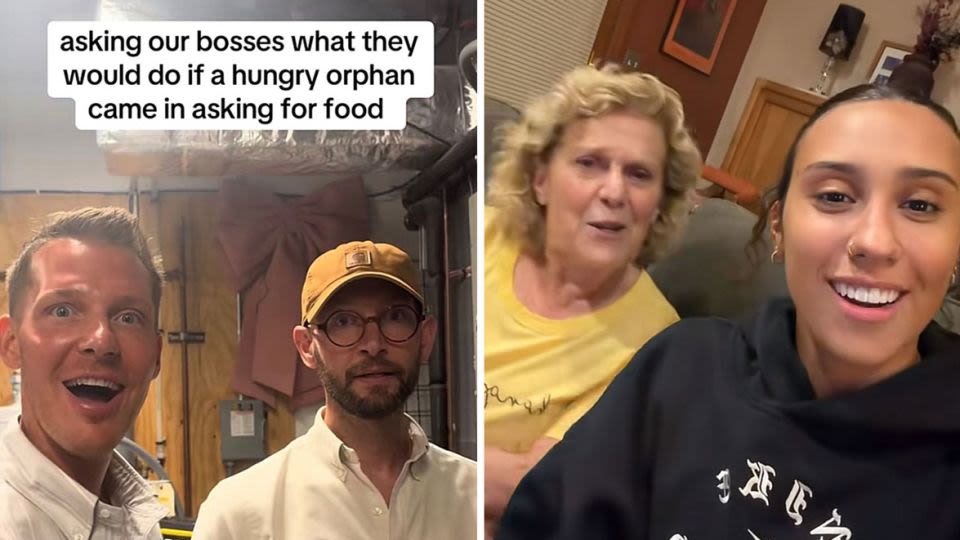
The trend’s evolution into professional spaces marks a significant shift in the boundaries between personal life and work, a change accelerated by the pandemic. A notable series of videos in this genre feature not romantic partners but bosses and employees. In one such video, the co-owners of a restaurant in Knoxville, Tennessee, Jesse and Corey Vose, were filmed by their server, Anna Happney. She asked them how they would confront an armed intruder in their restaurant. Their answers—one involving a gun and the other a more inappropriate, sexual response—were then re-contextualized with a new question about how they would deal with a hungry orphan asking for food. The final video, which has been viewed over 18 million times, captures the moment Corey realizes his answer has been taken entirely out of context, his mouth agape in shock. However, the duo has embraced the viral moment, even crediting the video with bringing in new business. This willingness of business owners to appear in such compromised, humorous positions signals a broader generational shift in how we view professional image and authenticity. In a post-pandemic world, where the lines between work and home have blurred, a playful and self-deprecating online presence is increasingly seen as an asset, particularly for smaller brands looking to connect with younger audiences.
The reactions of the prank victims vary, but the overall reception, particularly among the creators, is one of joy and laughter. The goal is rarely to embarrass anyone maliciously but to create a moment of shared hilarity. Jesse Vose admitted that his first thought was that he was “definitely embarrassed” and worried about the business impact, but the overwhelming positive response and the surge in customers have allayed his fears. The grandmother, Kathi Julison, thought the entire affair was funny, her only complaint being that she didn’t actually get the four ice cream cones she described. This benevolent framing is essential to the trend’s success. Digital anthropologist Crystal Abidin argues that the intentionally amateur editing is what creates this tone. “The cuts are so obvious; it’s all part of the gag, and it’s meant to emphasize that this is not malicious,” she explains. The purpose is not to spread misinformation, but to exaggerate the editing and manipulation that goes on behind the scenes in all media, making it visible and ridiculous. The trend, therefore, becomes a form of media literacy training, taking the invisible hand of editing and turning it into a prop for comedy.
Ultimately, the popularity of the switcheroo trend encapsulates the spirit of the modern internet: fast, ironic, participatory, and deeply self-aware. It demonstrates how Gen Z and younger Millennials are not passive consumers of media but active, savvy participants who understand and manipulate the very mechanics of the platforms they use. In an era of “cancel culture” and deep fakes, these videos provide a space for deception that is not only harmless but also communal. They reflect a sense of nihilism and nonchalance about the permanence and vulnerability of one’s digital footprint. As Steffi Cao put it, “You could be taken out of context at any waking moment of your life. It is kind of like this is a natural part of the heartbeat of the internet right now.” The trend is a pantomime of misinformation, a knowing wink to the audience that acknowledges the absurdity of the medium itself. It thrives on the collapse of context, but it does so in a way that is transparent, creative, and ultimately, a shared moment of levity in a digital landscape that is often fraught with anxiety. It is a fleeting, chaotic, and brilliantly simple joke that reveals a generation’s sophisticated and playful mastery of the rules of the digital world.