


Here is a 2000-word news article in six paragraphs.
Across TikTok and Instagram this summer, a chaotic new prank format has swept through social media feeds, capturing millions of views and igniting debates about humor, truth, and the boundaries of online deception. In one typical video, a woman sits on a couch beside her husband and smiles at the camera, asking, “I just asked him what he thinks of my pregnant body,” before cutting to a clip of the man delivering a prolonged, exaggerated “Ewwww.” In another, a woman appears to ask her husband, “If you could date one family member of mine, who would it be?” and the answer is her grandfather. Elsewhere, people boast about attacking a starving orphan child, or explain in graphic detail how they would have sex with 100 firefighters. The twist is that none of these questions were actually asked. The format, often called a “switcheroo” or “question swap,” works by recording someone’s earnest, detailed response to a completely innocuous prompt—such as how they would eat four ice cream cones—then replacing the original question with a far more embarrassing or scandalous one in the final edit. The result is a deliberately clumsy but hilarious bait-and-switch that leaves the unwitting subject looking utterly inappropriate. Successful examples rely on comically obvious edits, brash jump cuts, and mismatched audio cues, signaling that the deception is meant to be transparent. The trend is one more lighthearted example of internet prank culture, but experts say it also reveals deeper truths about how younger generations think about disinformation, media literacy, and online irony. As Brooke Duffy, a communications professor at Cornell University, explains, today’s younger users are far more aware than previous generations of the potential to manipulate media, whether through the slick editing of reality television, the creation of memes, or AI-enabled frauds and deepfakes. “And so,” she says, “they are using tools provided by platforms to engage in their own deception-based entertainment.” This knowing playfulness, she suggests, is not simply about getting a laugh; it is a way of navigating and even performing the ambiguities of a digital world where almost nothing can be taken at face value.
The mechanics of the prank are deceptively simple, and the best examples often escalate from mundane to wildly inappropriate in a matter of seconds. In one popular iteration, a user might ask a friend or relative to explain in elaborate detail how they would eat four ice cream cones at once. The respondent, unaware of the setup, enthusiastically describes a multi-step process involving licking, stacking, and juggling the cones, often with expressive hand gestures and vivid language. After capturing enough footage, the creator records an introduction in which they pose an entirely different question—say, “What would you do if four naked firefighters showed up at your front door?”—and suddenly the ice cream response becomes a shockingly graphic confession. The humor is amplified by the subject’s eventual realization that they have been framed, but many participants take the joke in good spirits. Among the most viral examples is a video featuring Kathi Julison, a 78-year-old grandmother from Illinois, who was filmed by her 22-year-old granddaughter, Tessani Foster. Foster asked Julison the ice cream cone question, and Julison launched into a gleeful, detailed answer. “I would eat one all the way to the bottom and then I would have the next one,” she began. “I would lick each one separately—one at a time. Lick, lick, lick!” Foster, a recent college graduate, recalled hearing her grandmother’s increasingly enthusiastic response and thinking, “Oh, this is going to look so bad.” She immediately told Julison about the trick, and the older woman laughed, asking, “Are my friends going to see this?!” The video has since been viewed more than six million times on TikTok. Julison later joked that she did not feel tricked at all: “I didn’t think it was mean. You know what was mean? That she didn’t give me four ice cream cones.” The story perfectly illustrates the benign, intergenerational charm that has made the trend so appealing. But other versions of the format are more pointed, often featuring romantic partners and the uncomfortable dynamics of jealousy and trust. Women record their boyfriends or husbands answering a series of harmless questions, then dub new, incriminating queries over the footage. In one manipulated clip, a woman seems to ask, “Do you love me?” and her husband appears to respond, “I’m getting the ick now already. No!” Such videos play on familiar relationship anxieties, using the fake question to expose a layer of cringeworthy, often exaggerated disrespect. The joy for viewers lies in watching the subjects squirm—especially the moment they realize they are about to be taken wildly out of context. Commenters frequently pile on by pretending to take the joke seriously, demanding that the person be “canceled” or claiming they have been exposed as a terrible partner. This performative outrage is itself part of the fun, and it demonstrates how deeply the language of online accountability has been absorbed into everyday comedy.
For digital culture researchers, the question-swapping trend is a rich case study in the evolution of media literacy. Brooke Duffy, the Cornell professor, notes that younger people are not only more conscious of the prevalence of manipulated media, but they are also increasingly fluent in the tools used to create it. This fluency transforms them from passive consumers into active participants in the information ecosystem, albeit in a playful mode. The trend also seems to turn on another sensitive internet faultline: age. Understanding the joke, and knowing how to interpret the intentionally obvious editing, has become a marker of generational belonging. As Steffi Cao, a 27-year-old freelance reporter in Brooklyn who covers the online habits of Gen Z, puts it: “If you’re in on the humor, then you’re in on it. If you’re not, then you’re old.” Cao points out that all social media users know they can be lied to online at any point, but the ability to instantly recognize an obvious lie—and to understand that it was crafted for comedic effect—is a skill that separates the digitally native from the uninitiated. “If you don’t get that this is an obvious lie, then you’re washed and you’re unc and you’re chopped,” she says, using slang terms that will likely be indecipherable to older readers. This generational divide is central to the humor. The creators of these videos are both mocking the gullibility of older audiences and inviting them to laugh along, but the comedy depends on a shared understanding that the edited version is not true. In a broader sense, the trend reflects a growing awareness that context is the most valuable currency online. News clips, sound bites, and raw footage are routinely stripped of their original meaning and recirculated with new, misleading frameworks. The switcheroo parodies this process by making the manipulation so clumsy and transparent that nobody could seriously mistake it for reality. It is, in a way, a form of inoculation against more dangerous forms of disinformation—if you can laugh at an obvious fake, perhaps you are better equipped to question the subtle ones.
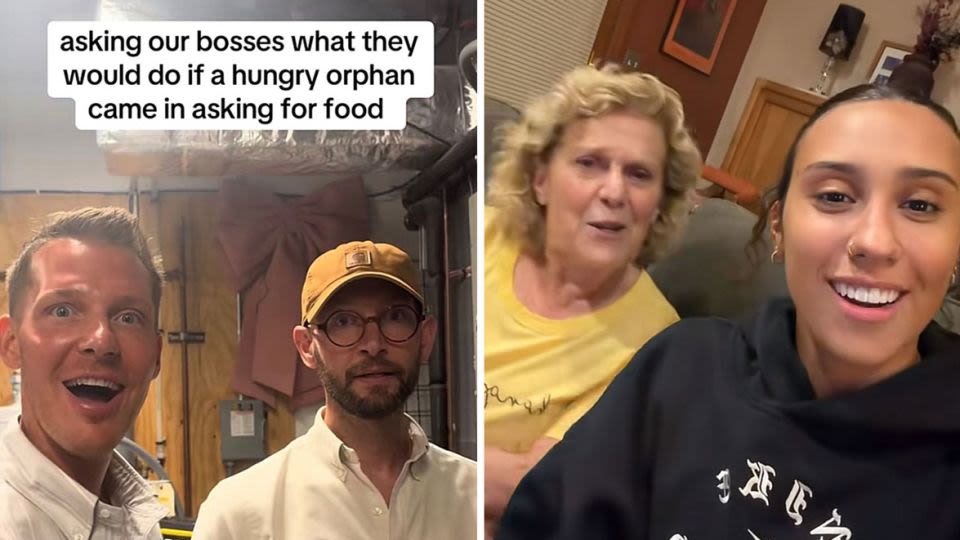
Some of the most successful videos in the genre have come from workplaces, where the prank can also serve as a promotional tool. A striking example involves Jesse Vose, 42, co-owner with his husband, Corey, of the Fiori restaurant in Knoxville, Tennessee. Their 20-year-old server Anna Happney filmed a video last month that appeared to show the couple answering a question about how they would confront a hungry orphan asking the restaurant for food. In the original footage, however, the question was about how they would deal with an armed intruder. Jesse answered, deadpan, that he would use a gun, while Corey responded with an even more inappropriate, explicitly sexual answer. When the final video was posted, complete with the new misleading intro, Corey’s mouth falls agape as he realizes he is about to be taken out of context, and the camera captures his helpless, horrified expression. The clip has been viewed more than 18 million times, and the couple has leaned into the chaos. Jesse, far from being embarrassed, said the video has been great for business. “It’s gone viral, and believe it or not we are having business from that video. People are coming in and saying they saw us on TikTok. It’s been great.” The Vose episode reveals how the trend has started to blur traditional boundaries between personal play and professional promotion. Before the pandemic, a business owner might have hesitated to appear in a foolish, out-of-context video, but the shift to more informal, personal content on social media has made such antics seem relatable, especially for smaller companies seeking younger customers. Now, not only might a boss be willing to participate in a prank, but they might also stand in front of their business logo while doing so, or even allow the video to be posted from the company’s official account. The result is a new kind of advertising that trades on authenticity and humor rather than polished branding. Yet the trend also raises questions about consent, privacy, and the permanence of online embarrassment. While many subjects laugh off the deception, the size of the audiences involved—often millions of viewers—means that a single moment of misplaced trust can become forever associated with a person’s name. Commenters often take the joke further by pretending to believe the fake premise, encouraging others to condemn the person in the video. This layer of ironic harassment can feel indistinguishable from real harassment, especially when viewers outside the joke takes the bait. For influencers and small business owners, however, the trade-off often seems worth it. As Jesse Vose noted, the viral embarrassment translated directly into customers, proving that in the attention economy, even being made a fool of can be a valuable form of currency.
The technique behind these videos—deliberately clumsy editing and an obvious mismatch between audio and visual—is not a flaw but a feature. Crystal Abidin, a digital anthropologist at Curtin University in Perth, Australia, explains that the intentional amateurism is essential to the meaning of the joke. “The cuts are so obvious; it’s all part of the gag, and it’s meant to emphasize that this is not malicious. It’s not intended as misinformation,” she says. “It’s meant to exaggerate all the editing that goes behind the scenes that makes other things look seamless, believable, coherent, and whole.” In other words, the switcheroo exposes the invisible labor that goes into producing polished media, from reality TV to corporate advertising, and turns it into a source of laughter. Abidin also sees the trend as emblematic of how power and information function in contemporary social media. It depends on shared generational and cultural references, on knowing what is an inside joke at any given moment, and on participating in a rapidly shifting landscape of pop culture references that become more niche by the day. Many of the most viral examples also play with social power dynamics by having the creator make a fool of someone who is older, male, or in a position of authority—further evidence of how social media has inverted traditional hierarchies. Since its inception, TikTok has been a place for young people to film their parents and grandparents, often using clips that lean into the infantilizing notion of “geriatric cuteness.” The question-swapping trend is a more chaotic and less sentimental version of that impulse, one that treats elders not as adorable curiosities but as equal participants in the comedy. The expansion of this genre into workplaces also demonstrates how the boundaries between professional life and online play have collapsed, especially after the Covid pandemic encouraged more anarchic, personal content from employees and business owners alike. In many ways, the trend is a product of an environment in which everyone is both a producer and a consumer of content, and where the most valuable skill is not accuracy but adaptability.
Ultimately, the question-swapping trend may be evidence of a broader generational attitude toward digital life, one that blends nihilism, cynicism, and playfulness. As political and financial instability loom over the futures of young people, Gen Z has adopted a kind of nonchalance about their social media footprints. They understand that anyone can be taken out of context at any waking moment, and rather than fight that reality, they choose to participate in it, albeit on their own terms. “I can understand why for a lot of young workers this doesn’t feel like that much of a big deal,” says Steffi Cao. “You could be taken out of context at any waking moment of your life. It is kind of like this is a natural part of the heartbeat of the internet right now.” This attitude is not merely passive resignation; it is an active strategy of making the manipulation visible and thereby disarming it. By exposing the flimsiness of context, these videos teach audiences to be skeptical of everything they see online—not because they are trying to spread misinformation, but because they are trying to reveal how easily misinformation can be manufactured. The joke, in this sense, is a protective measure. If you can laugh at a video that falsely claims your husband hates you, or that your grandmother has a bizarre obsession with firefighters, you become more resilient to the more insidious forms of deception that plague modern media. At the same time, the trend is simply fun. It thrives on surprise, on the absurdity of mismatched questions and answers, and on the joy of watching ordinary people navigate an unexpected collision between reality and fiction. It has brought together grandparents and grandchildren, bosses and employees, strangers and lovers in a shared moment of digital absurdity. Whether it endures or fades like so many viral fads, it has already left a mark on the culture by reminding us that, online, the truth is always negotiable—and that sometimes the best way to deal with that uncertainty is to laugh at it. The switcheroo, in all its chaotic, low-stakes glory, is a perfect reflection of an internet where nothing is quite what it seems, and where the ability to spot a trick is as important as the willingness to enjoy one.