


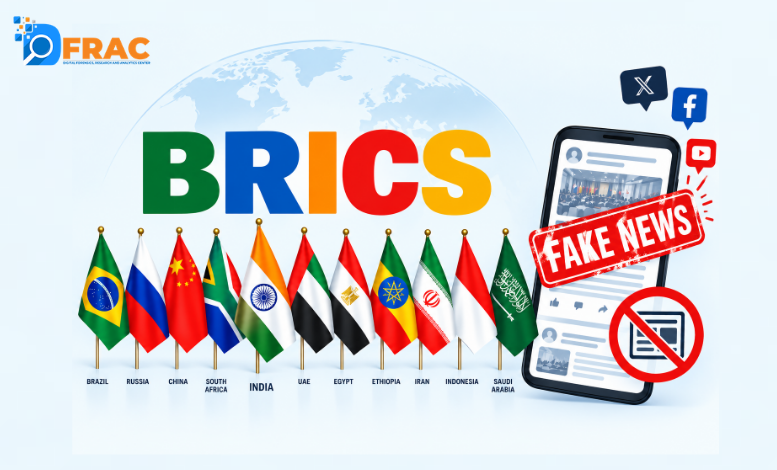
BRICS Summit in New Delhi Marred by Coordinated Disinformation Campaign, Fact-Checkers Find
India hosted the 18th BRICS Summit in New Delhi on September 12–13, 2026, bringing together member countries for high-level discussions on a broad agenda that included economic cooperation, reform of global governance, trade, artificial intelligence, public health, energy security, food security, and climate change. The summit concluded with the adoption of the New Delhi Declaration, in which member countries condemned terrorism in all its forms and emphasised the importance of multilateral cooperation in addressing global challenges. The event was widely seen as a significant moment for India’s growing diplomatic engagement on the international stage, with leaders attending bilateral meetings and plenary sessions aimed at deepening ties among the world’s major emerging economies. However, alongside the official proceedings, a parallel narrative of fake news and misleading information was observed across social media platforms, creating a shadowy counter-current to the summit’s substantive diplomatic work. Fact-checkers monitoring the information environment found that several types of false and misleading content were circulated, ranging from old photographs and videos being presented in a new context to AI-generated images and videos being passed off as genuine. The pattern of these claims revealed how content can be distorted by linking old material to current events, presenting it out of context, or using sophisticated AI-generated media to create confusion around India’s diplomatic engagements. The disinformation was not random; it followed a discernible structure, with coordinated accounts amplifying narratives designed to undermine public trust in the summit and in India’s role as host.
Among the most active sources of misleading content were accounts identified as Pakistani propaganda handles, which repeatedly shared fake and misleading information targeting India during the summit period. One such account, named Anushi Tiwari Indian, was flagged by fact-checkers for frequently sharing misleading content about events in India. The account listed Uttar Pradesh as its location in its X bio, while information available on X indicated that it actually operated from South Asia, a discrepancy that raised immediate red flags. The account was created in August 2025 and had changed its username five times since its creation, a common tactic used by propaganda accounts to evade detection and platform enforcement. Another account, War Analyst, was operated from Pakistan and had also repeatedly shared fake and misleading information targeting India. The account had been withheld in India, indicating that it had been restricted for violating platform policies, yet it continued to be cited and shared across social media. These accounts, along with others, played a significant role in seeding false narratives about the BRICS Summit, often using emotionally charged content such as videos of protests, police actions, and diplomatic interactions to generate engagement and spread confusion. The coordinated nature of their activity, combined with the rapid dissemination of their posts, suggested a deliberate effort to shape public perception of the summit and India’s diplomatic standing. Fact-checkers noted that these accounts did not merely share isolated false claims; they wove together a broader narrative of instability, repression, and diplomatic failure, none of which was supported by evidence on the ground.
One of the first major fact checks involved a video shared by Anushi Tiwari claiming that Delhi Police used force against young protesters during the BRICS Summit in Delhi and that a woman protester was dragged by her hair. This claim was widely circulated on social media, generating outrage and concern. However, investigation found the claim to be misleading. The viral video was not from Delhi at all; it showed an incident involving alleged police action during a protest by paramedical students in Tirupati, Andhra Pradesh. The video had been stripped of its original context and re-presented as if it were a recent event tied to the BRICS Summit. This technique of recontextualising old footage is one of the most common forms of disinformation, as it leverages real images to lend credibility to false narratives. In another instance, Anushi Tiwari shared a video claiming that during the BRICS event, an Indian organisation called “Cockroach” had started a march towards Delhi, with protesters allegedly entering the national capital after police failed to stop them. Investigation found this claim to be false. No such protest took place in Delhi during the BRICS Summit, and the viral video was actually from a farmers’ protest that occurred in 2024. The use of footage from an unrelated protest to claim a fictional march on Delhi demonstrated how easily old material can be repurposed to fit a current narrative. In yet another case, a video was shared with the claim that young people staged a protest in Delhi during the BRICS Summit and were forcibly removed by the police. Fact-checkers found the claim to be misleading, as the viral video was not recent and was actually from a CJP protest held on July 20. These repeated attempts to portray protests and police actions during the summit were all debunked, with each viral video traced back to a different time and place.
The disinformation campaign also extended to false claims about official actions and statements. During preparations for the BRICS Summit in Delhi, Anushi Tiwari claimed that the Lieutenant Governor of Delhi had recommended to the Ministry of Home Affairs that the BRICS Summit be shifted to another location due to security concerns. This claim, if true, would have suggested serious instability in the capital and a lack of confidence in the government’s ability to host the event. However, investigation found the claim to be false. The Lieutenant Governor had not submitted any such recommendation or report, and the summit proceeded as planned in New Delhi. This particular falsehood appeared designed to undermine confidence in the summit’s security arrangements and to suggest internal discord within the administration. In a separate incident, War Analyst shared a video claiming that Indian Ministry of External Affairs spokesperson Randhir Jaiswal was questioned sharply about a viral video allegedly showing him eating nuts during the BRICS Summit. The claim implied that Jaiswal was caught in an embarrassing moment and was forced to answer for it. Investigation found the claim to be misleading and the viral video to be digitally altered. In the original video, Jaiswal was not asked any such questions, and the altered version had been manipulated to create a false narrative. This case highlighted another layer of the disinformation problem: the use of digital editing to fabricate interactions that never occurred. By altering videos and presenting them as genuine, propagandists can create convincing but entirely false scenarios, making it increasingly difficult for ordinary social media users to distinguish fact from fiction.
Interestingly, fact-checkers also found that some Indian social media users shared misleading information related to the BRICS Summit, indicating that the problem was not limited to foreign propaganda accounts. A video of Prime Minister Narendra Modi was shared with the claim that his microphone was switched off as soon as he began speaking at the BRICS Summit. This claim was designed to portray the Prime Minister as being silenced or disrespected at an international event, a narrative that could generate domestic outrage. However, investigation found that the viral video was not from the BRICS Summit held in Delhi; it was from a BRICS Summit held in Brazil. Furthermore, fact-checkers found that PM Modi’s microphone was not switched off and that he delivered his address at the BRICS Summit without any such incident. In another instance, a video of Prime Minister Narendra Modi and Chinese President Xi Jinping was shared claiming that it was from the BRICS Summit, with the claim that PM Modi gifted Xi Jinping a portrait made from his own photograph. This claim suggested a highly unusual diplomatic gesture and was circulated to imply something about the relationship between the two leaders. Investigation found that the viral video was not from the BRICS Summit. The video was actually from 2019, when Xi Jinping visited India. During that visit, Chinese President Xi Jinping and Indian Prime Minister Narendra Modi exchanged gifts in Tamil Nadu. Xi presented Modi with a Chinese decorative plate featuring Modi’s portrait, while Modi gifted Xi a handwoven silk shawl embroidered with Xi Jinping’s portrait. The original event was a normal diplomatic gift exchange, but the recontextualised video made it appear as though the interaction had taken place during the BRICS Summit, thereby distorting the timeline and the nature of the event.
Another video shared with the claim that during the BRICS Summit, Indian Prime Minister Narendra Modi touched the feet of Iranian President Masoud Pezeshkian and sought his blessings, was also investigated. This claim was particularly charged, as touching the feet of another leader could be interpreted as a sign of deference or submission, and the image was widely circulated to provoke debate. DFRAC’s investigation found the claim to be false. PM Modi did not touch Pezeshkian’s feet, and the viral video was AI-generated. The use of AI-generated media to create a completely fabricated interaction represented a new and dangerous frontier in disinformation. Unlike old videos being recontextualised or edited footage being altered, AI-generated content can create events that never happened, making it even harder for viewers to identify falsehoods. The conclusion drawn by fact-checkers was clear: the BRICS Summit was accompanied by the circulation of fake and misleading information on social media on a significant scale. Several users shared old, edited, and out-of-context content by falsely linking it to the summit. These posts created confusion around events related to India and the BRICS Summit, demonstrating how recycled footage, manipulated content, and AI-generated media can be used to distort the context of major international events. As India continues to play an increasingly prominent role on the global stage, the spread of such disinformation poses a serious challenge to public understanding and trust. Fact-checkers urged social media users to verify content before sharing and to be cautious of accounts with suspicious histories, especially those that repeatedly change their identities and operate from locations different from those they claim. The BRICS Summit may have concluded with a strong declaration on multilateral cooperation, but the parallel battle against fake news is far from over.