


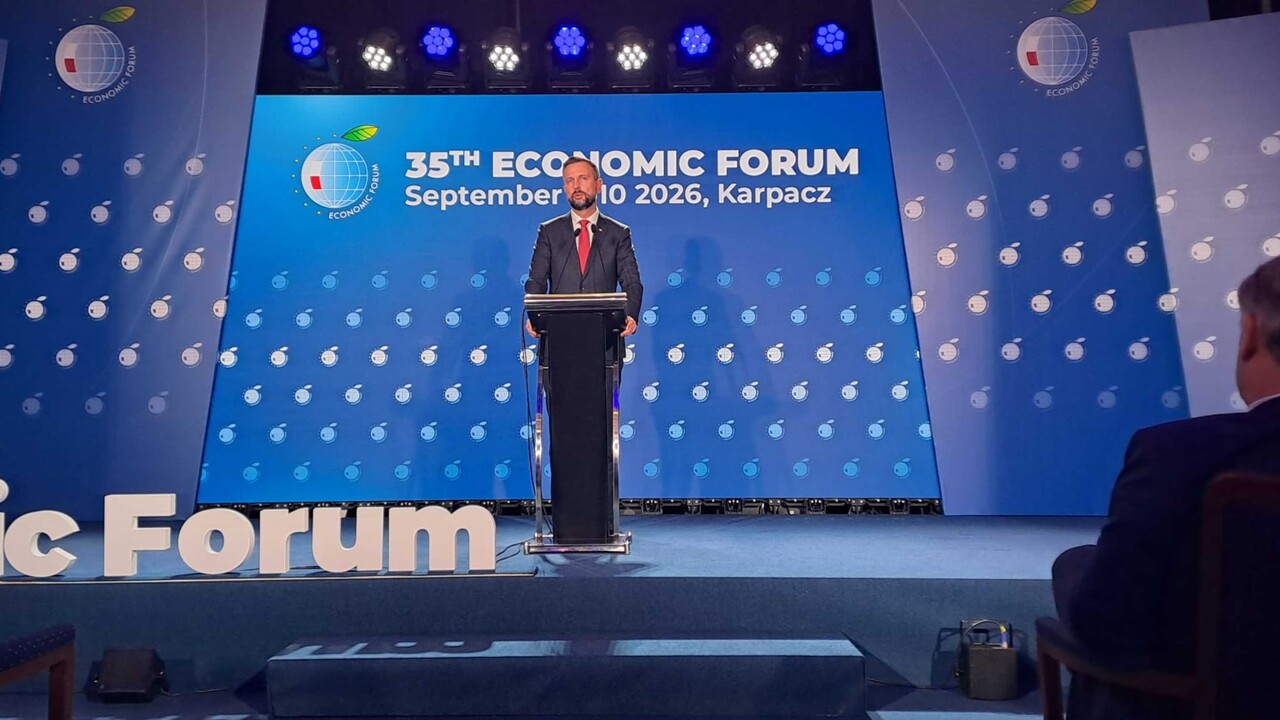
Poland’s defence minister has warned that Russia’s future confrontation with Europe will be defined less by massed tanks and more by sabotage, disinformation and airspace violations. In a major address at the 35th Karpacz Economic Forum, Wladyslaw Kosiniak-Kamysz said the Kremlin has adapted its fighting methods to exploit the grey zone between war and peace. “This aggression by Russia, as I would foresee it today, will take the form of an increase across Europe in acts of sabotage, an increase in disinformation and also incidents linked, for example, to airspace violations,” he said. His remarks were significant because they came from the defence minister of a NATO frontline state, a country that has been a primary conduit for Western military aid to Ukraine and a host for allied troops. The warning matched assessments held by several European intelligence services, which have detected a rising tempo of covert Russian operations across the continent. Unlike an open invasion, hybrid actions are designed to generate uncertainty, delay decision-making and avoid a clear-cut response. This makes them an effective tool against an alliance that remains wary of escalation. The annual Karpacz forum, held in the Karkonosze mountains, has long served as a meeting point for political and business elites; this year, security dominated the agenda. Kosiniak-Kamysz used the platform to argue that Europe must understand the true nature of the threat and prepare for a long period of tension in which the crime scene is often civilian infrastructure, not a fortified frontline.
Kosiniak-Kamysz specifically cited GPS signal jamming and issues relating to cables in the Baltic Sea among the threats facing Europe. These are not abstract worries. Pilots flying over northeastern Poland and the Suwalki Gap have reported losses of satellite navigation signals, a corridor critical to NATO’s defence of the Baltic republics. Aviation authorities in several countries have documented jamming and spoofing affecting aircraft near Kaliningrad, and airlines have been forced to cancel or reroute flights because of interference. In the maritime domain, the Baltic Sea has become a focus of concern because telecommunications cables and power connections running along the seabed are vulnerable to sabotage. Ships without clear ownership, sometimes described as Russia’s “shadow fleet,” have been observed switching off their automatic identification systems and sailing slowly over critical infrastructure. In 2024, several undersea cables suffered breaks, and investigations are still trying to determine how and why they occurred. Telecommunications infrastructure on the seabed carries the vast majority of digital traffic between Europe and North America, so any disruption can affect global financial markets, public administration and everyday services. The minister’s reference to these threats suggests he believes the next phase of Russian aggression will not be aimed at conquering terrain but at destabilising economies, communications and social trust. Sabotage campaigns can be carried out by operatives without official uniforms, using civilian vessels, local sympathisers or even unwitting contractors. By keeping its actions beneath the threshold of armed conflict, Russia can persist in hostility while leaving allied leaders the difficult task of proving responsibility and choosing a response proportionate enough to avoid escalation yet strong enough to deter.
In the face of this diffuse threat, Poland must strengthen its resilience and the ability of its citizens to recognise and report suspicious activity, the minister said. This is an essential part of Warsaw’s new defence philosophy, which combines the largest military modernisation in Poland’s post-communist history with civil preparedness. Kosiniak-Kamysz argued that the public should know what to look for: unusual movements near military installations, attempts to photograph critical infrastructure, unsolicited inquiries from strangers about transport schedules or security procedures, and electronic signals coming from unexpected places. The government has set up reporting mechanisms and informational campaigns, while local authorities are cooperating with police, the border guard and the Internal Security Agency. Resilience, however, goes beyond monitoring. It includes protecting energy systems, water supplies, hospitals and digital networks, as well as building emergency stockpiles and evacuation plans. The minister’s comments echo a broader shift in NATO thinking: the alliance has established specialised cells to coordinate responses to hybrid warfare, and member states are being encouraged to create rapid reaction procedures for attacks that do not meet the traditional definition of armed attack. Poland is at the forefront because it has experienced foreign-linked sabotage and subversion before, and because the memory of Cold War-era destabilisation remains alive in the region. The mobilisation of society, together with the strengthening of critical infrastructure and preparation of hospitals, transport systems and internal security institutions for a sustained period of tension, is part of preventing Russia from achieving its goals without firing a single shot.
Yet Kosiniak-Kamysz was careful to distinguish hybrid threats from the immediate danger of a conventional invasion. He stressed that Warsaw does not currently anticipate a Russian aggression against Poland of the same kind as that carried out against Ukraine. “There is no such build-up of forces,” he said, referring to the Russian military deployment that had been visible along Ukraine’s borders before February 2022. That assessment is significant. It does not mean dismissing the risk, but rather using intelligence to avoid panic and to allocate resources correctly. Since the full-scale invasion of Ukraine, Russia has suffered enormous losses in manpower and equipment, and it has committed many of its best units to the Ukrainian front. According to Western estimates, Russia would need months or even years of preparation to assemble the troops, logistics, air support and command-and-control infrastructure needed to threaten a direct ground offensive against NATO territory. However, the absence of an immediate build-up does not mean the threat has disappeared. Russian leaders continue to describe NATO and the European Union as adversaries, and Moscow is rebuilding its armed forces with increased production of missiles, drones and ammunition. Poland is therefore pushing ahead with one of the most ambitious defence programmes in Europe, spending roughly four percent of GDP and acquiring tanks, artillery, helicopters, Patriot air defence systems and long-range strike weapons. The minister’s words served two purposes: to reassure Poles that an invasion is not expected in the near term, and to urge the public to understand that the real challenge now comes from a level of aggression that is violent but below the threshold of war.
Disinformation, in Kosiniak-Kamysz’s view, remains one of the main weapons in Russia’s arsenal and can cause significant harm to society. He indicated that false narratives are already being spread systematically across Europe, often in multiple languages and tailored to local fears. The Kremlin has become adept at using social media, fake websites, forged documents, manipulated videos and fake official accounts to create chaos and erode trust. Disinformation is not merely a separate propaganda track; it is often linked to sabotage and airspace incidents, because all are intended to instil fear, undermine confidence in governments and turn citizens against one another. In Poland, Russian narratives have included blaming Ukrainian refugees for economic problems, questioning the reliability of NATO and the United States, denigrating Polish leaders, and claiming that European sanctions alone are responsible for inflation and energy crises. Similar themes can be observed in Germany, France, the Baltic states and Scandinavia. The harm is cumulative: when falsehoods are repeated over time, societies become less able to distinguish truth from fiction. This weakens democracy and reduces the capacity of a nation to respond to a genuine emergency. Poland has established fact-checking institutions, ran public awareness campaigns and cooperated with technology platforms to limit the reach of foreign interference. But the minister’s warning makes clear that this work must be continuous. Russia is ready to shift its stories, exploit accidents and weaponise grief, fear and anger to amplify division. For this reason, media literacy and education are no longer optional extras; they are vital parts of national security.
Kosiniak-Kamysz’s address at the 35th Karpacz Economic Forum captured the changing nature of the Russian threat for the entire Euro-Atlantic community. For years, experts have discussed hybrid warfare as a hypothetical concept, but the front-line response is now being tested across the continent almost every week. Attacks on critical infrastructure, subversive acts in European cities, drone incursions, jamming of navigation signals and cyber intrusions may not trigger a massive military response, but they force NATO and the European Union to develop more flexible deterrence. Poland, along with other eastern flank countries, is calling for stronger counter-hybrid capabilities: better intelligence-sharing, faster sanctions against individuals and companies involved in such acts, and a clear framework for collective action when aggression cannot be easily attributed. There are also practical proposals, including the protection of submarine cables, air defence systems capable of intercepting small drones, jamming-resistant navigation equipment for civilian planes, and more robust cybersecurity standards for infrastructure operators. The minister’s speech underlined that Russia’s aggression has changed but has not diminished. In the coming years, Europe may see fewer tank columns and more fires, anonymous cyberattacks and false narratives. To face this challenge, nations must combine strong armies, well-trained citizens and resilient democratic institutions. The Karpacz forum gave Poland an opportunity to make its case that the best answer is preparedness and unity — a message that goes far beyond the Eastern European country’s own borders.