


Paragraph 1
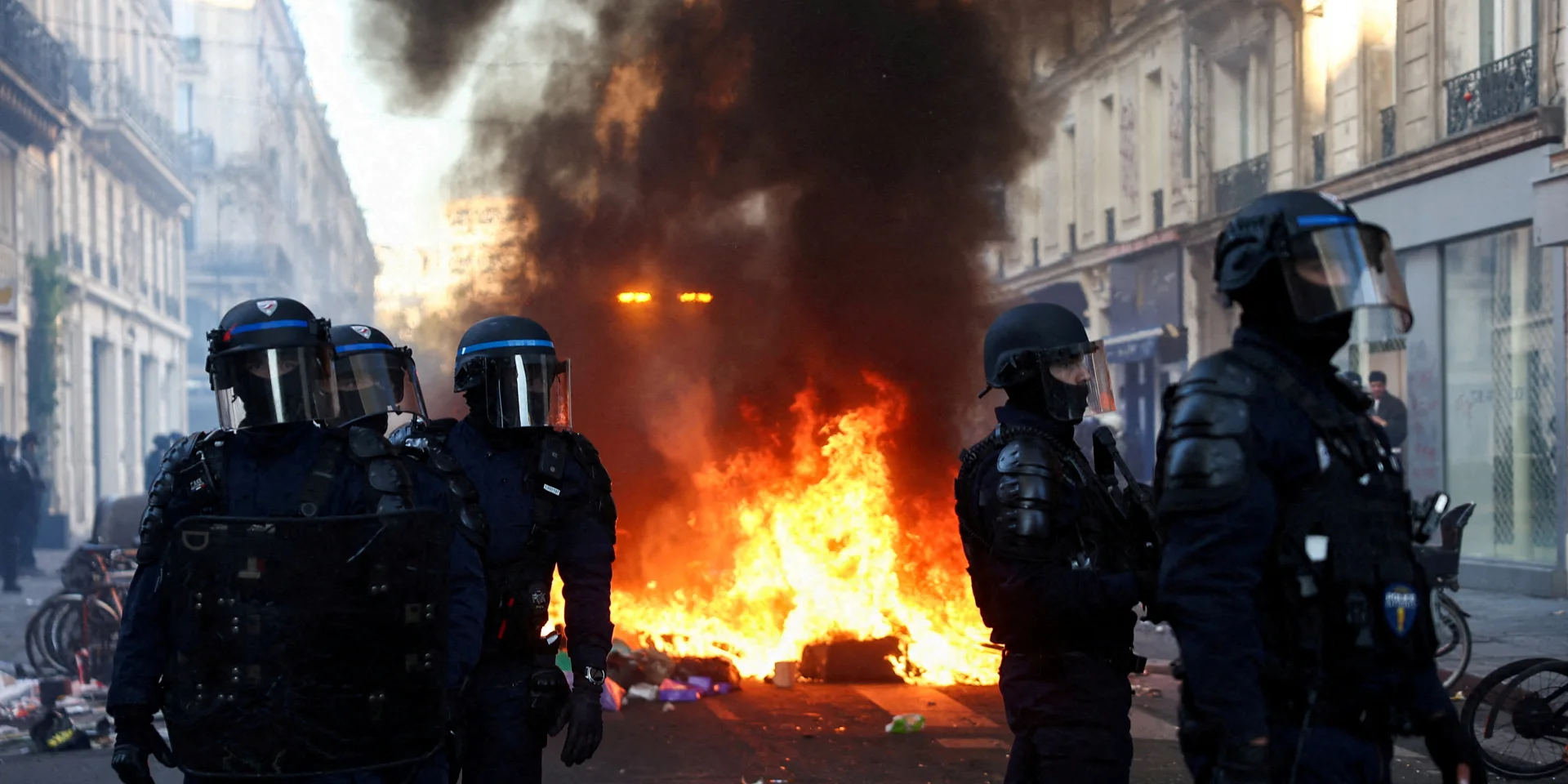
Paris was plunged into chaos on October 18, 2026, as nationwide protests against the rising cost of living exploded into violent unrest, looting and running battles with police. The demonstrations, which began on October 17 and continued into the following day, saw thousands of people take to the streets in cities across France, with Paris emerging as the epicenter of the turmoil. French authorities reported staggering damage: approximately 2,000 stores were looted, nearly 2,400 people involved in the unrest were arrested, and around 1,000 police officers were injured while attempting to restore order. The scale of the violence shocked the country and drew urgent attention from European capitals, particularly as social media began to fill with graphic videos of burning vehicles, shattered storefronts and confrontations between protesters and riot police. The unrest was rooted in legitimate and deep-seated public anger over the accelerating cost of living, which has squeezed households already struggling with higher prices for food, energy, housing and transportation. Many protesters expressed frustration with state institutions, accusing the government of failing to shield ordinary citizens from economic hardship. The scenes in Paris were reminiscent of previous episodes of social upheaval in France, but the speed and intensity with which the unrest spread, and the simultaneous appearance of coordinated social media campaigns, raised alarm among security officials who suspected that foreign actors might be seeking to exploit the crisis for their own geopolitical purposes.
Paragraph 2
European Union security officials quickly identified a troubling pattern: pro-Russian and far-right social media accounts were actively circulating videos of violence amid the protests in an apparent attempt to sow chaos and deepen societal divisions. These accounts amplified the most inflammatory and violent content, sharing footage that often lacked context or was outright fabricated, in order to inflame tensions and portray the situation as even more explosive than it already was. “It is possible that Russian information campaigns … are taking place, but social media platforms should not amplify them through their algorithms,” an EU official said, pointing to the central role that recommendation systems and engagement-driven feeds play in spreading disinformation. The concern was not merely that foreign actors were posting content, but that the algorithms governing major platforms were boosting that content to vast audiences, giving it an outsized influence over the narrative surrounding the protests. Security officials warned that the combination of genuine domestic anger and foreign disinformation operations created a volatile mix that could escalate violence and undermine public trust in democratic institutions. The far-right element was also significant, as domestic extremist groups appeared to share and promote some of the same content as pro-Russian accounts, creating a cross-ideological echo chamber that amplified the chaos. EU officials began pressing social media companies to take down content that encouraged street violence and to examine whether their platforms were inadvertently acting as megaphones for foreign state-linked influence operations.
Paragraph 3
David Colon, a disinformation researcher at Sciences Po, said that “pro-Kremlin influencers” linked to the Russian Storm-1516 network had “brought greater attention to the events and spread a number of false narratives.” He also pointed to another Russian influence network known as Matryoshka, which has been documented in previous European disinformation campaigns. However, Colon cautioned that pro-Russian social media users “did not initiate the demonstrations and had no influence on how events unfolded,” according to the Financial Times. This distinction was echoed by a European intelligence official, who said: “We are dealing with a genuine mobilization of people angry at state institutions over legitimate grievances, and foreign state actors are trying to amplify it.” That assessment highlighted the delicate challenge facing governments: how to address real public anger without allowing foreign adversaries to exploit it for their own ends. The French government has asked intelligence agencies to determine whether Russian operatives played a more active role in fueling the street unrest, including potentially coordinating with protesters or financing certain elements of the demonstrations. A senior intelligence official said there was no concrete evidence of such a role so far. The official added that Russian disinformation had largely been reactive to events, meaning that Moscow and its proxies were seizing on footage and narratives as they emerged rather than orchestrating the protests from the start. Still, the investigation remains in its early stages, and officials are concerned that more evidence of active involvement could come to light as they analyze social media data, financial records and communications intercepts.
Paragraph 4
The Financial Times identified several social media accounts posting violent content, including videos purportedly filmed in France that had attracted millions of views. One account on X, the platform formerly known as Twitter, with just 5,000 followers, posted footage of protesters throwing incendiary mixtures, drawing nearly 6 million views. The FT found that the footage was actually filmed during protests in Tbilisi in 2024, meaning that viewers were being shown scenes from a different country and a different time as if they were live coverage of the French unrest. This tactic is a hallmark of modern disinformation campaigns: recycling authentic images of protest and violence from one context and presenting them as evidence of an ongoing crisis elsewhere. The effectiveness of this approach lies in its speed and emotional impact; viewers who see dramatic footage of masked figures hurling firebombs are unlikely to pause and verify the source, especially when the content is shared by accounts that appear to be independent observers or news aggregators. The X account in question, despite its modest following, managed to reach millions of users because the platform’s algorithm rewarded the content for high engagement, further underscoring the EU official’s warning about algorithmic amplification. The revelation that such a large portion of the viral content was fake raised serious questions about the reliability of social media as a source of information during breaking news events, and about the willingness of platforms to act decisively against disinformation that could incite violence.
Paragraph 5
Experts believe that interactions between influencers and foreign state operations could lead to “extreme instability” in some countries. The concern is not limited to France; across Europe, the combination of economic hardship, political polarization and sophisticated influence operations is creating fertile ground for chaos. Influencers, particularly those with large followings on platforms like X, Telegram, TikTok and YouTube, can act as force multipliers for state-sponsored narratives, lending an air of authenticity and grassroots legitimacy to content that is actually part of a coordinated campaign. In some cases, these influencers may be unaware that they are amplifying foreign disinformation; in others, they may be willing participants who share a common ideological affinity with the foreign actors. The result is a murky information environment in which it becomes increasingly difficult for ordinary citizens to distinguish between genuine reporting, amateur footage, and deliberately fabricated or manipulated content. EU officials stressed that social media posts should not encourage street violence, and called on platforms to take greater responsibility for the content they host. They also urged member states to improve their own resilience against foreign interference, including by investing in media literacy, strengthening fact-checking capabilities and coordinating more closely with international partners. The events in France, and the disinformation that accompanied them, are likely to become a case study for European policymakers seeking to understand how to respond to hybrid threats that blur the line between online propaganda and real-world violence.
Paragraph 6
The unrest in France was not an isolated incident. Over the weekend, mass protests erupted in Italy, with demonstrators taking to the streets over the rising cost of living, higher fuel prices and tax burdens. Clashes with police occurred in Milan, Turin, Bologna and Bergamo, as crowds blocked roads, set off flares and threw objects at officers. The Italian government, fearing that the protests could spiral out of control, deployed 500 troops to reinforce police and secure key locations. The parallels between the French and Italian protests were striking, and security officials across Europe began to ask whether the same foreign disinformation networks were active in both countries. While there was no immediate evidence that Russian actors had orchestrated the Italian demonstrations, analysts noted that the same economic grievances were present in both countries, and that social media accounts linked to pro-Russian networks had been quick to amplify footage of the Italian unrest as well. The broader picture is one of a continent under pressure: inflation, stagnant wages, housing shortages and a widespread feeling that governments are unresponsive to ordinary people’s needs. Foreign adversaries, particularly Russia, are watching these tensions carefully and are prepared to exploit them whenever they boil over. The French and Italian protests have served as a warning that the threat of disinformation is not abstract or confined to election periods; it is a constant feature of the information landscape, ready to latch onto any crisis and magnify its destructive potential. As investigations continue, European leaders will be grappling with a difficult question: how to protect their societies from foreign interference without suppressing legitimate dissent and free expression. The answer, many experts argue, lies not in censoring protests, but in building more transparent and resilient information systems, holding platforms accountable for their algorithms, and addressing the underlying economic grievances that make such manipulation possible in the first place.