


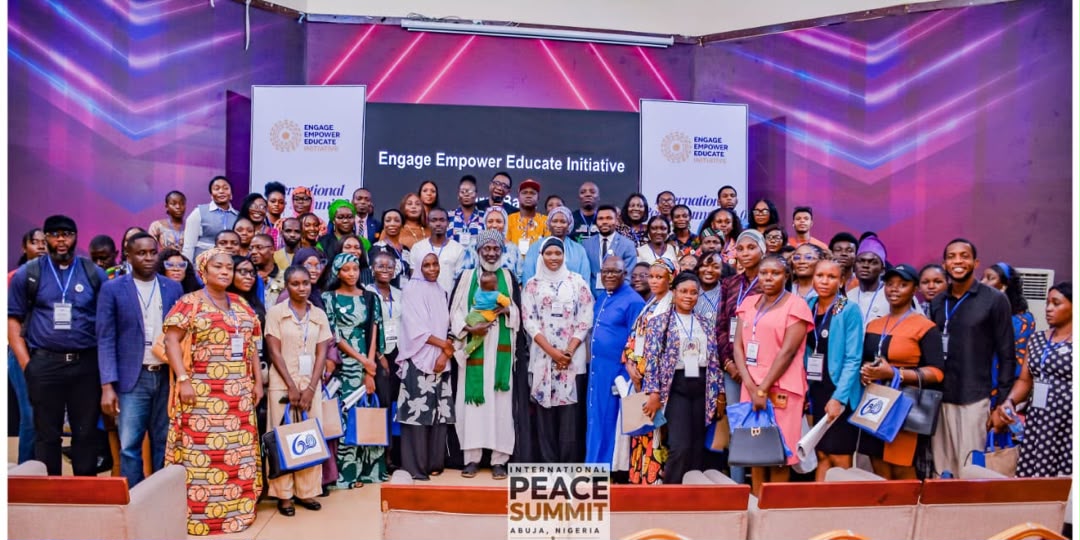
ABUJA, Nigeria — The Engage Empower Educate Initiative has announced the launch of ‘Peace by Design: Responsible AI for Peace in Africa’, a continent-wide project confronting one of the most urgent threats to Nigeria’s upcoming elections: the weaponisation of artificial intelligence to manufacture lies at scale. During the launch, the body warned that fabricated videos and voice clones of public figures are already circulating online, engineered to look and sound real. Belema Meshack-Hart, Founder of the Engage Empower Educate Initiative, said that unlike the disinformation of past election cycles, this new generation of fakes is fast, cheap to produce, and convincing enough to fool even careful viewers — arriving in a media environment with little infrastructure to catch it before it spreads. “We built Peace by Design because we saw the danger before it became a crisis. A fabricated video of a candidate can spread across WhatsApp in minutes and shape how millions of people vote, or whether they trust the result at all. Nigeria cannot afford to treat this as a side issue. This is a direct threat to the integrity of the election and to the peace of the country afterwards,” Meshack-Hart said. The launch signals a turning point in how civil society organisations are preparing for a digital battlefield where truth itself is under attack, and where the difference between a manipulated clip and a genuine statement can determine the outcome of a national election.
The threat is not theoretical, and it is not waiting for a future election cycle. According to the Initiative, fabricated videos and voice clones of public figures are already moving through online communities in Nigeria, designed to deceive voters and destabilise public trust. In previous election seasons, disinformation largely took the form of text messages, static images, and rumour campaigns on social media. Those tactics were damaging, but they were often detectable with basic media literacy and manual fact-checking. The current generation of AI-generated fakes, however, is qualitatively different. Generative artificial intelligence tools allow anyone with a smartphone and an internet connection to create synthetic audio and video that mimics a politician’s face, voice, gestures, and even mannerisms. A voter can receive a WhatsApp message showing a candidate allegedly accepting a bribe, or allegedly making a hateful statement, and have no reliable way to know that the footage never happened. The clip can be shared from group to group, translated, re-edited, and stripped of context until it becomes an unshakeable belief in the minds of millions. The speed and scale of this manipulation are unprecedented, and the damage is not limited to election day. If large numbers of citizens come to believe lies about the electoral process, they may reject the legitimacy of the results, leading to protests, violence, or long-term democratic erosion. That is why the Engage Empower Educate Initiative has made peace and AI responsibility central to its mission, treating disinformation not merely as a communications problem but as a security threat that can destabilise communities and trigger conflict.
At the heart of the project is ‘Verify Before You Share’, a nationwide, non-partisan campaign built to reach voters where disinformation actually spreads: WhatsApp groups, radio, and local-language content across Nigeria’s regions. WhatsApp remains one of the most powerful communication tools in the country, with messages often forwarded through family, religious, and community networks with little scrutiny. Radio, similarly, is a trusted source of information for millions of Nigerians, especially in rural areas, and it is often the medium through which voters receive news about candidates and elections. The campaign will train a network of Digital Peace Ambassadors who can identify deepfakes and manipulated content in real time, stand up a rapid-response fact-checking desk to debunk false claims before they go viral, and press platforms, political parties, and candidates to commit publicly to a no-deepfake pledge. This pledge is designed to create accountability at the highest levels of political communication. Candidates and parties who sign it would be making a public promise not to create, distribute, or amplify synthetic media designed to deceive voters. The Initiative hopes that such a commitment will raise the cost of using AI-generated lies, making it politically unacceptable for campaigns to engage in this kind of manipulation. At the same time, the fact-checking desk will work with journalists, civil society groups, and ordinary citizens to verify suspicious content, issue corrections, and provide accurate information to the public before lies can take hold.
Ezinne Okoro, who led the workshop on AI and peace communication in Africa at the International Peace Summit 2.0, will work closely with the Initiative on the project. That workshop is where the scale of the threat and the absence of a coordinated response first came into focus. Participants from across the continent shared examples of AI-generated content already appearing in political discourse, and many expressed concern that neither governments, tech companies, nor civil society were prepared to respond. The conversation revealed a gap between the speed of technological change and the slowness of institutional adaptation. “What we heard in that room made clear this isn’t a future risk; it’s happening now. Communities need the tools to recognise manipulation in real time, and they need them before ballots are cast, not after the damage is done,” Okoro said. Her involvement signals the importance of building a broad coalition of actors who understand both the technical dimensions of AI and the local realities of Nigerian media consumption. Peace by Design grew directly out of the International Peace Summit 2.0, organised by the Initiative, and reflects the organisation’s belief that peacebuilding in the digital age requires new strategies, new partnerships, and a willingness to confront emerging threats before they become entrenched. The project is designed not as a one-off intervention but as a sustained movement that can build resilience across the continent, with Nigeria serving as the first major test.
The Initiative is also calling on major technology platforms operating in Nigeria to act now, not after the damage is done, urging them to label AI-generated content clearly, accelerate takedowns of election-related fakes, and invest in moderation capacity in Hausa, Yoruba, Igbo, and Pidgin — languages that are too often an afterthought for global trust-and-safety teams. For years, African users have complained that content moderation systems are less effective in African languages than in English, and that harmful material often circulates for hours or days before it is removed. This is not a minor technical issue. If platforms cannot understand what is being said in local languages, they cannot effectively detect lies, hate speech, or manipulation. The Initiative’s call to action recognises that technology companies have a responsibility to ensure their systems are fair and effective for all users, not just those in wealthy, English-speaking markets. Labelling AI-generated content is one step, but labelling alone is not enough. Platforms must also build systems that can quickly identify and remove fake content that threatens electoral integrity, and they must deploy human moderators and automated tools that understand the linguistic and cultural context of Nigerian communication. Without these investments, the platforms will continue to be conduits for manipulation, and their failures will have direct consequences for the safety and stability of Nigerian democracy. The Initiative’s demand is not simply a request for better customer service; it is a demand for accountability from global corporations whose products are being used to undermine elections in the Global South.
Finally, Peace by Design is reaching beyond Nigeria, calling on international AI developers, fact-checking organisations, and funders to join the effort ahead of the election. The Initiative recognises that no single organisation can solve this problem alone. International AI developers have a responsibility to understand how their tools are being used in different contexts and to build safety measures that address abuse in languages and regions beyond the West. Fact-checking organisations across the continent must be supported and connected so that they can share information, best practices, and warnings about emerging disinformation campaigns. Funders, too, must recognise that defending democracy in Africa requires resources, and that investments in media literacy, fact-checking, and community resilience are just as important as traditional election observation and governance programmes. The launch of Peace by Design comes at a critical moment. Nigeria’s elections are approaching, and the country is already seeing the early signs of AI-fuelled disinformation. The choices made in the coming months will shape not only the integrity of the election but also the peace and stability of the country in its aftermath. The Engage Empower Educate Initiative has made clear that this is a moment for action, not complacency. By building a campaign rooted in local communities, supported by national and international partners, and focused on the real spaces where voters receive information, Peace by Design offers a practical and urgent response to one of the defining challenges of the digital age. The question now is whether governments, technology platforms, political leaders, and citizens will take the threat seriously enough to act before the damage is done.