


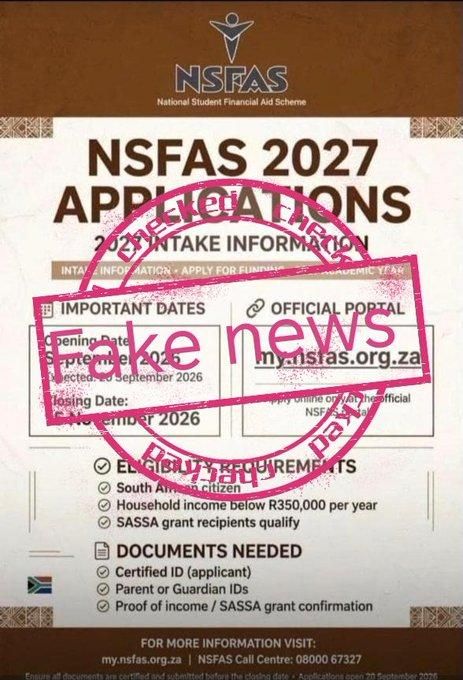
The National Student Financial Aid Scheme (NSFAS) has issued an urgent and emphatic warning to prospective applicants, students, and parents about a wave of false information circulating on social media regarding future application dates and funding details. In an official statement, the financial aid body said that claims promising early registration, altered funding terms, or unofficial application schedules are unverified, misleading, and should not be trusted. NSFAS officials urged members of the public to exercise extreme caution and to verify and double-check any information before taking action or sharing content online. The warning comes as thousands of students in South Africa rely on NSFAS to fund their studies at public universities and TVET colleges, making them a prime target for misinformation and fraud. According to NSFAS, the spread of these false claims could cause serious harm, including missed application windows, financial loss, identity theft, and the disclosure of sensitive personal information. The scheme stressed that no one should act on any information that does not come directly from official NSFAS platforms, and that all official announcements regarding application windows, eligibility criteria, and funding processes are communicated exclusively through verified channels.
The scheme’s statement specifically addressed the nature of the false information currently being shared, highlighting that some social media posts claim to reveal early application dates or promise applicants that they can secure funding before the official process begins. Other posts reportedly suggest that NSFAS has changed its funding terms or that new categories of students can now apply under different rules. NSFAS made it clear that such claims are fabricated and have no basis in the official application process. The financial aid body warned that these deceptive messages often lead to phishing attempts, scam websites, and fraudulent pages designed to steal usernames, passwords, and other confidential information. In some cases, applicants may be asked to click on external registration forms, join WhatsApp broadcast links, or follow third-party accounts that claim to offer “guaranteed” funding. NSFAS emphasised that there is no such thing as a guaranteed application through unofficial channels, and that every student must go through the standard, free application process. The organisation said misinformation is particularly dangerous during this period because students are anxious and eager to find out when applications will open. Fraudsters exploit that anxiety by creating fake deadlines and fake opportunities, and by pressuring people to act quickly. NSFAS therefore urged everyone to pause, verify, and rely only on the official communication channels that the scheme uses.
To help students and parents identify authentic information, NSFAS listed its official platforms and made it clear that announcements are made solely through these verified sources. The official website is www.nsfas.org.za, and the scheme is present on social media under the following verified accounts: X (formerly Twitter) at @myNSFAS, Facebook at National Student Financial Aid Scheme, and Instagram at @myNSFAS. NSFAS said these are the only accounts that should be trusted, and warned that any other page, profile, or website claiming to represent the scheme should be treated as unverified and potentially fraudulent. The scheme also noted that official communication is sent directly to applicants through the myNSFAS online portal, as well as through secure email and SMS addresses linked to their applications. NSFAS does not use informal WhatsApp broadcasts, unsolicited messages, or third-party blogs to communicate important updates. The organisation cautioned that even when a social media page uses the NSFAS logo or name, it may still be a fake account created by criminals. Students should check for verification badges, official URLs, and consistency with the listed handles before accepting any information. The scheme emphasised that anyone who receives information that appears to be from NSFAS but is not through one of these official channels should disregard it and verify using the official website or one of the verified social media accounts.
NSFAS also took the opportunity to remind applicants of the core security guidelines that should always be followed when engaging with financial aid services. First and foremost, applying for NSFAS funding is completely free. The scheme does not charge any application fees, processing fees, or administrative charges, and it does not work with third-party agents who charge money for assistance. Any individual, organisation, or website demanding payment in exchange for help with an NSFAS application is committing fraud. NSFAS warned that some scammers approach students and parents in person or online, offering to “help” complete applications for a fee, or claiming to have inside connections that can speed up the process. These offers are false, and no payment can influence the outcome of an application. The scheme encouraged applicants to complete their own applications or seek free assistance only from trusted, official sources such as schools, universities, TVET colleges, or the NSFAS support channels themselves. Applicants should never feel pressured into paying for information that is freely available on the official website. Any request for money should be treated as a red flag and reported immediately. Furthermore, NSFAS reminded applicants that the application process is designed to be accessible to all qualifying students, and no agent or middleman is authorised to act on behalf of the scheme.
Another critical warning from NSFAS involved the protection of personal credentials. Applicants were told never to share sensitive information such as myNSFAS passwords, banking PINs, or One-Time Pins (OTPs) with unverified individuals, third-party websites, or even people who claim to be NSFAS staff members. NSFAS will never ask a student for their password or OTP through a phone call, email, SMS, or social media message. Sharing such information can lead to unauthorised access to the applicant’s account, personal identity theft, and financial loss. NSFAS also urged applicants to avoid clicking on external registration forms, WhatsApp broadcast links, or third-party social media pages that promise guaranteed funding. These links may lead to phishing websites that are designed to look like the real NSFAS portal but are actually built to steal login details and other personal data. Once a criminal has access to a student’s myNSFAS account, they could change banking details, redirect funds, or use personal information for fraudulent purposes. Students were encouraged to create strong and unique passwords for their myNSFAS accounts, to change passwords regularly, and to never use shared computers or public Wi-Fi when accessing their accounts. If an applicant suspects that their account has been compromised, they should log in immediately, change their password, and report the incident to NSFAS through official channels. Parents and guardians were also advised to remain vigilant and to guide young applicants who may be less experienced with online fraud.
Finally, NSFAS called on the public to play an active role in fighting fraud and misinformation by reporting suspicious activity. Students and others who encounter fake NSFAS platforms, fraudulent messages, or individuals requesting money for application assistance are encouraged to report them to the official Vuvuzela Fraud Hotline, which is dedicated to investigating and acting on allegations of corruption and fraud within the financial aid system. Reports can also be made directly to NSFAS through its established support channels on the official website and verified social media accounts. The scheme stressed that reporting scams is essential not only for protecting oneself but also for protecting other innocent applicants who might otherwise fall victim. NSFAS also asked members of the public not to repost or share unverified information on social media, since doing so can amplify false claims and create unnecessary panic. The organisation said it remains committed to ensuring that the application process is fair, transparent, and secure, and that it will continue to communicate with the public in an open and honest manner. In the meantime, students and parents are urged to wait patiently for official announcements, to keep checking the official NSFAS website, and to ignore any information that cannot be confirmed through trusted sources. By remaining vigilant and informed, said NSFAS, applicants can protect themselves from fraud, avoid falling victim to misinformation, and ensure that their applications are submitted properly when the official window finally opens.