


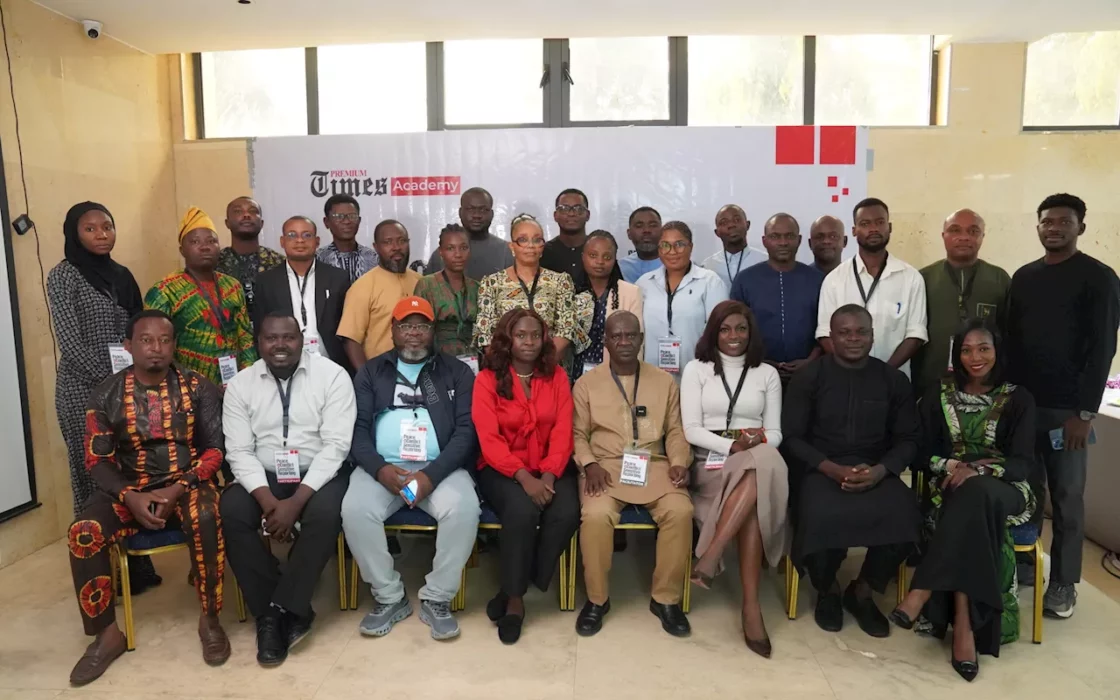
Experts Urge Nigerian Journalists to Become ‘Gate-Checkers’ in Digital Age
By Sumaila Ogbaje, News Agency of Nigeria (NAN)
Nigerian journalism is facing a credibility challenge that increasingly originates outside the newsroom, on WhatsApp, X, TikTok and other digital platforms. For reporters, speed without verification can damage a newsroom’s credibility, expose media organisations to legal action, and in conflict-sensitive environments contribute to communal tensions. Recently, the Premium Times Academy and conflict scholars facilitated a seminar that underscored this stark reality. The sessions brought together media experts and academics including Dayo Aiyetan of the International Centre for Investigative Reporting; Musikilu Mojeed, Idris Akinbajo and Dapo Olorunyomi of PREMIUM TIMES; Prof. Isaac Olawale Albert; Oluwaseyi Ayeni; Joan Hassan; and Silas Jonathan. They all shared a central message: modern journalists must evolve from traditional information gatekeepers into active “gate-checkers.” The distinction is crucial. A gatekeeper decides what news enters the public sphere; a gate-checker must also examine, verify and, when necessary, stop information already in circulation. This means verifying claims before amplifying them, questioning identity-based framing and understanding the conflict context in which stories are received. The seminar offered concrete protocols for a media environment where algorithms reward emotion, artificial intelligence can fabricate convincing evidence, and misinformation can trigger violence. Participants were told that being first brings brief rewards, but being right builds lasting credibility. In Nigeria, where ethnic, religious and political fault lines make careless reporting dangerous, the injunction is not academic; it is a matter of public safety.
One of the strongest warnings focused on ethnic profiling in news reporting. The ICIR presentation compared two headlines: “Fulani man arrested for kidnapping” and “Man arrested for kidnapping.” The crime and arrest remain the same; only the ethnic description has changed. Profiling, the presentation said, is treating a personal characteristic as a shortcut for judging an individual. It becomes dangerous when ethnicity is used to suggest collective blame, criminality or dangerousness. In Nigeria, where ethnicity intersects with politics, land, elections, farmer-herder conflicts and resource control, careless framing can amplify tensions far beyond the original report. Facilitators said mentioning ethnicity could be legitimate where it is directly relevant to the story, necessary for identification or supported by evidence. But it becomes profiling when repeated references turn an individual into a representation of an entire ethnic group. Before publication, journalists were encouraged to ask five questions: Is the ethnic identity relevant? What evidence supports its inclusion? Could its inclusion be interpreted as collective blame? Does it deserve headline prominence? Would the story be written the same way if the individual belonged to another ethnic group? The underlying principle is simple: report the person, not the stereotype; evidence should take precedence over identity. This is especially relevant in a multi-ethnic society where a single stigmatising story can harden boundaries and make reconciliation more difficult. Journalists were reminded that headlines are often the only part of a story many people read, making prejudicial framing especially harmful. By applying these questions, reporters can avoid the cumulative effect of ethnic profiling, in which one group comes to be persistently associated with crime or violence in the public mind.
Another major challenge is the increasing reliance on social media as a source of breaking news. Oluwaseyi Ayeni warned that although significant breaking stories now emerge first on social media, user-generated content remains subject to ownership rights and ethical considerations. “A public post is not automatically public property, while a screenshot is not necessarily a verified source,” Ayeni said. Three major risks were highlighted: copyright, privacy and defamation. Journalists were advised to obtain permission before using photographs, videos or other user-generated material and preserve evidence of such permission. Attribution alone does not necessarily resolve copyright concerns. Privacy considerations also matter, particularly when reporting on minors, victims, protesters and grieving families. Defamation is another risk: republishing an unverified social media allegation of fraud, rape, corruption or other wrongdoing may attract legal consequences. The recommended newsroom protocol was the “ACCEPT” test: verify the author; establish the context; obtain consent; consider ethical implications; establish that the material is not manipulated, recycled or AI-generated; and ensure the information can be defended with evidence. Silas Jonathan, a facilitator on fact-checking and digital verification, examined the growing challenge of artificial intelligence. AI tools have reduced the barrier to producing convincing fake photographs, cloned voices and manipulated videos. Examples include the fake Joe Biden robocall in the 2024 New Hampshire primary, fabricated audio involving a Slovak political figure during the 2023 election and synthetic images depicting Donald Trump with Black voters. Jonathan cautioned against relying solely on AI detectors, saying they provide probabilities rather than conclusive proof and can falsely label genuine material as AI-generated. More reliable questions are: Is the material authentic? Who created it? When and where did it originate? What narrative does it promote? Visual indicators such as distorted hands, garbled text and inconsistent shadows can help, but their reliability may decline as tools improve. The durable approach is establishing provenance and corroborating information independently. The recommended workflow is to pause, save and archive the material, trace its earliest version, corroborate location and time independently, then decide whether to publish, hold or debunk it. Free tools recommended include Google Reverse Image Search, Lens, InVID and FotoForensics.
Data from the Centre for Journalism Innovation and Development on crises in Jos showed that fear-inducing narratives generated about 53,800 interactions, compared with 11,600 for conspiracy claims—underscoring how emotional content travels faster and further than factual information. Idris Akinbajo and Prof. Isaac Albert urged journalists to broaden their understanding of conflict and avoid focusing only on its violent manifestations. They noted that journalists often concentrate on final stages of conflict while paying insufficient attention to latent and emerging stages, where early warning and preventive reporting may be possible. Albert defined conflict as a difference of opinion or diverging interests involving thought processes, realities and needs. Conflict is not inherently dysfunctional, but can become destructive when handled adversarially. Journalists were encouraged to distinguish between different forms of conflict—stakeholder, geographic, causative, intensity and time dimensions—and understand the distinction between insurgency and terrorism. Principles of conflict-sensitive journalism include seeking truth, minimising harm, maintaining independence and remaining accountable. Practical recommendations include understanding the conflict before reporting it, assessing how coverage could affect it, explaining reasons behind actions, and presenting conflict as a process rather than a single event. Journalists should avoid presenting conflicts as involving only two sides and should recognise complexity and internal differences within groups. They should ask deeper questions: What is the conflict about? What are its underlying causes? Who is fuelling it? Who is working to prevent violence? The recommended reporting process involves developing the story idea, doing background research, developing a hypothesis, mapping sources, preparing a pitch, conducting field reporting, organising materials, comparing findings with initial research and writing strictly from evidence. This approach moves journalism away from episodic, event-driven coverage toward a more analytical, prevention-oriented practice. It also challenges the assumption that balance simply means giving equal space to two adversaries; false equivalence can distort public understanding. In a hotly contested media environment, the ability to report conflicts before violence erupts is an invaluable early-warning function.
Musikilu Mojeed, Editor-in-Chief of Premium Times, stressed the importance of reliable data in humanitarian reporting. Reliable data can save lives, expose gaps and test official claims. But journalists must interrogate statistics rather than reproduce them uncritically. Key questions include: Who produced the figures? What definitions were used? What methodology was applied? What interests could influence the data? Are there competing figures? Recommended sources include NEMA, the National Commission for Refugees, Migrants and Internally Displaced Persons, the North-East Development Commission, the National Bureau of Statistics, the Budget Office, the Open Treasury Portal, UNOCHA, UNHCR, IOM, ACLED, the Uppsala Conflict Data Programme, Amnesty International and Human Rights Watch. Dapo Olorunyomi, Publisher of Premium Times, provided historical examples of how media narratives interact with political and communal tensions. He distinguished between a report, which tells what happened; a story, which explains what happened to someone and why it matters; and a narrative, which shapes the broader meaning attached to events over time. In Rwanda, Radio Télévision Libre des Mille Collines used dehumanising language against Tutsis and contributed to the environment surrounding the 1994 genocide. The International Criminal Tribunal for Rwanda convicted media figures, including Jean-Bosco Barayagwiza and Hassan Ngeze, for incitement and related crimes. In Kenya, the 2007 post-election violence killed more than 1,000 people; radio broadcasts were examined in discussions about inflammatory political communication. In Sierra Leone, politically aligned radio stations during conflict and elections reflected political polarisation. The examples highlight recurring risks: dehumanisation, amplification of political rhetoric without adequate verification, the vulnerability of highly influential broadcast platforms and weak regulation. These historical parallels are sobering for Nigeria. Although social media has changed how messages are distributed, the underlying dynamics remain. A rumour that once reached a neighbourhood can now reach millions within minutes. Journalists must consider not only the immediate accuracy of an article but how repeated frames create a meta-narrative that may outlive any single correction.
Joan Hassan described fake news and hate speech as mutually reinforcing threats to social cohesion, capable of deepening polarisation and undermining public trust. The Code of Ethics of the Nigerian Press Council, the Nigeria Broadcasting Code and relevant provisions of the Cybercrimes Act 2024 provide standards and legal obligations relating to responsible reporting and harmful information. In short, the main lesson is simple: digital journalism demands both speed and discipline. Being first brings brief rewards, but being right builds lasting credibility. For Nigerian journalists navigating today’s complex information environment, experts say the golden rule remains: be fast, but verify first. The seminar’s practical guidance can be distilled into a few habits: pause before publishing; verify authorship and provenance; question identity labels; map conflict dynamics; interrogate statistics; and maintain the highest ethical standards. It also calls on news organisations to invest in training, digital verification tools and editorial systems that support careful reporting. In an age of information overload, the public is not served by more speed alone. It is served by trusted institutions that can distinguish fact from fabrication, context from conspiracy, and identification from stereotype. That service is the renewed mission of the Nigerian journalist. The seminar made clear that failure to adapt carries steep costs: lawsuits, lost reputations and, in the worst cases, bloodshed. But the opportunity is equally great. By embracing the role of gate-checkers, Nigerian journalists can help counter disinformation, mediate conflict with wisdom and restore trust between media and society. It is not easy work; it requires time, resources and moral courage. But there is no alternative. In a democracy, newsrooms that abandon verification in pursuit of virality abandon their reason for existence. Newsrooms that commit to accuracy, ethical sourcing and conflict sensitivity can become powerful forces for accountability and peace. As one expert put it, in today’s digital wild west, the reporter’s most important tool is a disciplined mind. The eyes may see a video first; the disciplined mind asks where it came from. The fingers may type a headline quickly; the disciplined mind asks whether it will inflame or inform. That is the essence of the gate-checker: not a gatekeeper who blocks information, but a skilled navigator who lets accurate, verified and just reporting pass through the gates of public discourse while flagging and stopping the rest. Be fast, but verify first. (NANFeatures)