


Amman Hosts High-Level Seminar on Countering Targeted Disinformation and Strengthening National Media Resilience
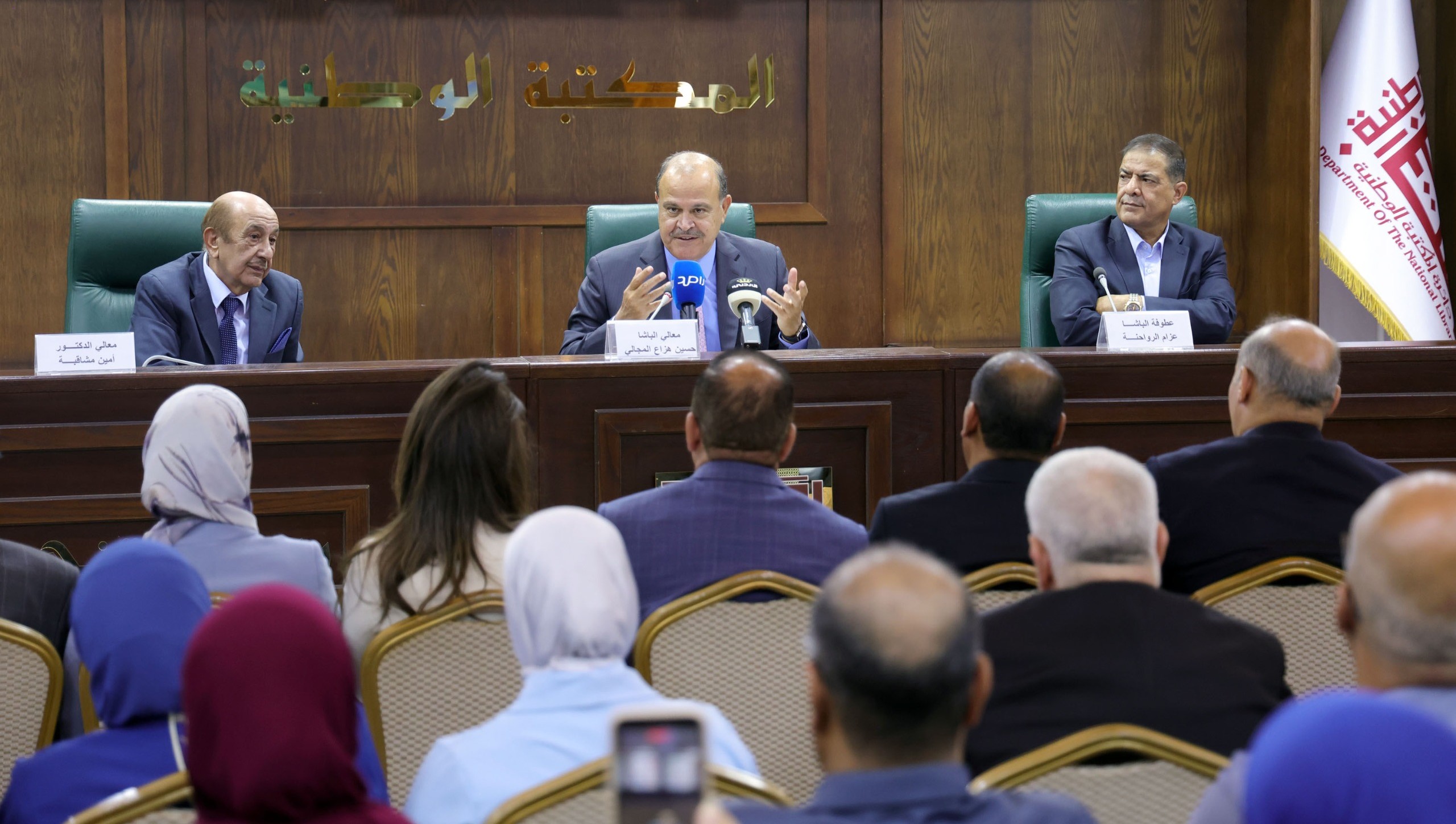
AMMAN — A pivotal seminar titled “Strategy to Counter Targeted Disinformation Against Jordan via Social Media” convened on Monday at the Department of the National Library, drawing together senior government officials, retired military leaders, media professionals, and policy researchers in a concerted effort to fortify the Kingdom’s defenses against the rising tide of online falsehoods. Organized in collaboration with the Amman Institute for Modernization and Political Studies, the event sought to move beyond abstract concerns about fake news and instead develop concrete mechanisms for verifying information, bolstering public awareness, and preempting coordinated digital assaults on Jordan’s national stability. The gathering was inaugurated by National Library Director General Firas Al-Darabeh, who welcomed participants and underscored the library’s evolving role as a guardian of factual knowledge in an era of information chaos. The seminar was moderated by former Minister Amin Mashaqbeh, a seasoned political figure, while the keynote addresses were delivered by former Interior Minister Hussein Hazza Majali and retired Major General Azzam Al-Rawahneh—both of whom brought decades of experience in state security and governance to the discussion. Their presence signaled that the issue of disinformation is no longer confined to the digital sphere but is now recognized as a critical component of national defense and social cohesion.
The opening sessions set a grave tone as Majali, who served as interior minister during several turbulent periods, framed disinformation as an existential challenge exacerbated by the volatile geopolitical landscape surrounding Jordan. He argued that the Kingdom, strategically situated amid conflicts in Palestine, Iraq, Syria, and the broader Gulf region, has become a prime target for campaigns that exploit regional tensions to erode public trust in state institutions. Majali detailed the sophisticated tools employed by adversaries, including the deployment of fake social media accounts that artificially amplify divisive narratives, the recycling of archival video footage stripped of context to falsely attribute events to current situations, and the alarming rise of deepfake artificial intelligence technology that can fabricate realistic videos of public figures uttering statements they never made. “The most dangerous form of disinformation is not the random rumor but that which is deliberate, programmed, and systematic,” Majali asserted, warning that these coordinated efforts are designed to manipulate public sentiment, provoke sectarian tensions, and undermine confidence in the country’s leadership. He stressed that such campaigns often exploit existing information vacuums, spreading rapidly before official sources have a chance to respond, thereby creating a narrative vacuum that is difficult to reverse. To counter this, Majali called for the establishment of a comprehensive national framework that would not only react to falsehoods but also proactively educate the public on the machinery of state, civic rights, and national principles, ensuring that citizens are equipped to recognize and reject manipulation.
Building on Majali’s warnings, the former minister emphasized that the primary line of defense in the fight against disinformation is not technology alone, but the Jordanian citizenry itself. He envisioned a multi-layered educational strategy that begins in the family, extends through schools and universities, and is reinforced by religious institutions—both mosques and churches—as well as by influential digital content creators. “Political stability relies on cultivating informed citizens who understand national principles,” Majali argued, calling for a holistic approach that integrates media literacy into curricula and promotes critical thinking from an early age. He noted that families play a crucial role in discussing current events with accurate context, while schools and universities must teach students how to verify sources and differentiate between opinion and fact. Religious leaders, he added, have a moral obligation to counter hate speech and rumor-mongering that often masquerades as religious zeal. Furthermore, Majali urged digital content creators and social media influencers to recognize their immense responsibility, as they possess the reach to either amplify falsehoods or serve as credible voices for truth. He proposed the creation of official rapid-response units within government ministries that would issue immediate clarifications during crises, thereby filling the information vacuum before disinformation can take hold. The former minister also called for greater transparency in state decision-making, arguing that an open government inherently reduces the space for conspiracy theories and malicious speculation. By empowering citizens through education and ensuring swift, credible official communication, Majali contended, Jordan could build a resilient society that is resistant to external manipulation efforts.
In the next keynote address, retired Major General Azzam Al-Rawahneh offered a historical perspective, reminding the audience that media manipulation is not a new phenomenon but rather an age-old tactic that has evolved in sophistication with modern digital tools. He drew parallels to wartime propaganda, Cold War-era misinformation, and the use of print and broadcast media to sway public opinion in previous decades. However, Al-Rawahneh argued that the current digital landscape has democratized the creation and dissemination of falsehoods, allowing even small groups with malicious intent to achieve global reach with minimal cost. He stressed that countering fake news is not merely a matter of public relations but directly touches upon national security and social cohesion—the foundational pillars of a stable state. “When citizens lose faith in the veracity of information, they lose faith in each other and in the institutions that bind them together,” he warned. Al-Rawahneh highlighted the need to go beyond surface-level debunking and instead analyze the sources, funding, and geopolitical motives behind coordinated campaigns aimed at undermining state sovereignty. He called for inter-agency cooperation between security services, media regulators, and tech companies to identify and neutralize bot networks and troll farms, which are often state-sponsored or financed by foreign actors seeking to destabilize the region. He also recalled the historical role of literature, arts, schools, and religious institutions in forging Jordan’s national identity—a cultural bulwark that he argued has been dangerously neglected in recent years. By reviving and strengthening these institutions, Jordan can reinforce an authentic national narrative that is more resistant to external falsehoods. Al-Rawahneh urged participants not to approach disinformation as a technical issue alone but as a strategic battlefield where political, cultural, and security dimensions intersect.
The seminar’s discussions then turned toward the future and the accelerating pace of technological change, particularly the rapid advancements in generative artificial intelligence and deepfake technology. Participants concluded that these tools present a quantum leap in the scale and sophistication of disinformation, making it increasingly difficult for even trained eyes to distinguish authentic audio and video from fabricated content. Consequently, experts at the event argued that Jordan must shift from reactive media policies—which focus on debunking false claims after they have already spread—to proactive strategies centered on three key pillars: media literacy, real-time digital monitoring, and public transparency. Media literacy was deemed essential as a first line of defense, equipping citizens with the skills to question and verify content before sharing. Real-time digital monitoring was proposed as a means to detect emerging disinformation trends early, allowing authorities to respond preemptively and track the spread of false narratives across platforms. Public transparency, meanwhile, was highlighted as the most effective antidote to suspicion and rumor, as an open government that shares timely and accurate information leaves less room for malicious invention. The participants also recommended the establishment of a national observatory or task force that would collaborate with international partners and tech companies to map disinformation networks, identify their sponsors, and expose their methods. Such an entity could serve as a clearinghouse for verified information during crises, issuing alerts to the public and coordinating with social media platforms to remove malicious content. Additionally, they called for legal reforms to hold propagators of harmful disinformation accountable, while ensuring that such measures do not infringe upon legitimate freedom of expression. The consensus was clear: Jordan must be proactive, adaptive, and educational in its approach, rather than perpetually defensive.
In its concluding remarks, the seminar underscored the shared responsibility of all societal actors in safeguarding the nation’s information environment. The discussions moved beyond the immediate threat of fake news to contemplate the broader implications for democratic governance, social trust, and national resilience in the face of external pressure. Participants agreed that Jordan’s stability in the coming years will depend significantly on its ability to insulate public discourse from manipulation and to foster a citizenry that is both vigilant and well-informed. The presence of former security officials alongside media professionals and educators signaled a growing cross-sectoral recognition that this issue requires a unified response. The Amman Institute for Modernization and Political Studies, as a co-organizer, pledged to follow up on the seminar’s recommendations by developing a concrete action plan and proposing policy reforms to the relevant authorities. Former Minister Mashaqbeh closed the event by thanking all attendees and emphasizing that the battle against disinformation is a continuous process, not a one-time effort. He called on universities to incorporate media and digital literacy courses into their programs, on journalists to adhere to the highest ethical standards, and on citizens to verify before sharing. As Jordan navigates a complex regional landscape, this seminar served as a clarion call to treat disinformation with the seriousness it deserves—as a threat to national security, social harmony, and the very fabric of democratic society. The collective consensus was that only through education, cooperation, and unwavering commitment to truth can Jordan effectively turn the tide against this modern weapon, ensuring that the country remains resilient in the face of those who seek to exploit the open spaces of the digital age.