


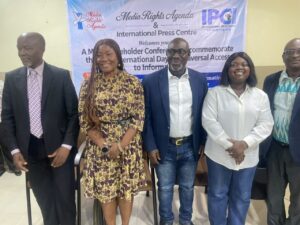
Media Rights Agenda, IPC Urge Transparency and Gender-Responsive FOI Implementation at IDUAI 2026
The Media Rights Agenda (MRA), in collaboration with the International Press Centre (IPC), has called for greater transparency in the age of disinformation as the world marked the International Day for Universal Access to Information (IDUAI), observed annually on 28 September. At the 2026 IDUAI observance on Monday, the organizations also urged a gender-responsive implementation of Nigeria’s Freedom of Information (FOI) Act so that women and other vulnerable groups can effectively access public information. The event, themed “Freedom of Information (FOI) in the Age of Disinformation: Why Transparency Matters More Than Ever,” brought together civil society organizations and legal practitioners to examine the challenges affecting access to public information and the role of transparency in combating disinformation. Speakers at the event stressed that the right to information is not merely a legal formality but a fundamental pillar of democratic governance, public accountability, and informed citizenship. They noted that in an era where misinformation and disinformation spread rapidly through digital platforms, the ability of citizens to obtain accurate, timely, and reliable information from public institutions is more critical than ever. The gathering also highlighted the need for deliberate efforts to remove barriers that prevent women, rural communities, persons with disabilities, and other marginalized groups from exercising their right to know. The event served as a platform for stakeholders to reflect on the implementation of Nigeria’s FOI Act, which was enacted in 2011, and to propose concrete measures for strengthening its enforcement. It also underscored the need for public institutions to embrace openness as a culture rather than treating information requests as threats to their operations. The 2026 observance came at a time when trust in institutions is declining in many parts of the world, and the organizers emphasized that transparency remains one of the most effective tools for rebuilding public confidence.
In his opening remarks, Mr. Lanre Arogundade, the Executive Director of the International Press Centre, noted that the programme was convened at a time when access to credible and verifiable information has become increasingly central to democratic governance, public accountability, and informed citizenship. He explained that even though information spreads faster and wider because of social media and other actors, the abundance of information does not necessarily translate into greater access to reliable public information. According to him, authoritative information is often difficult to obtain, delayed, incomplete, or inaccessible, and the resulting information vacuum can create fertile ground for speculation, misinformation, and disinformation. Arogundade encouraged participants to continue using the Freedom of Information Act to demand information for accountability’s sake. He also demanded that the law be applied effectively and that the procedure be available to those who need it. “We live in a period in which information travels faster, reaches wider audiences, and can be produced and amplified by more actors than ever before. Yet the abundance of information has not necessarily translated into greater access to reliable public information. Where authoritative information is difficult to obtain, delayed, incomplete, or inaccessible, the resulting information vacuum can create fertile ground for speculation, misinformation, and disinformation,” he said. He further argued that freedom of information should not be understood simply as a legal entitlement to request documents from public institutions. Rather, it is an essential component of accountable governance, informed citizenship, and credible public discourse. He reminded the audience that the Freedom of Information Act provides an important framework for citizens, journalists, civil society organizations, and other stakeholders to seek information held by public institutions. However, he cautioned that the existence of a law is only one part of the equation. Its democratic value ultimately depends on how effectively it is implemented and how accessible the process is to those who need to use it. His remarks set the tone for the day’s deliberations, emphasizing that the law must become a practical tool for citizens rather than a dormant document.
The discussion on gender-responsive FOI implementation was led by Ayomide Eweje, Programme Officer at MRA, who said that such an approach was necessary to address factors that may prevent different groups from exercising their right to information equally. “Gender-responsive FOI implementation is not about giving women more rights than men. It’s about identifying and addressing factors that may prevent people from exercising an existing right equally,” Ms. Eweje said. She noted that there was limited national data specifically measuring Nigerian women’s use of the FOI Act, and that women needed to be better informed about the law and how it could be used to demand accountability. She cited an all-women roundtable organized by the HumAngle Foundation in Abuja in October 2024 to address what it described as a gender gap in the use of the FOI Act. According to her, participants at that roundtable recommended increased awareness of the law through local languages, radio, and other accessible media, alongside greater institutional support and the integration of FOI into existing accountability initiatives. She stressed that a gender-responsive approach should consider whether different gender groups can access information rights equitably, whether public information reflects their different needs and experiences, and whether public institutions collect, store, and provide information in accessible ways. She added that the approach was not about treating women as a separate category of FOI applicants but about ensuring that the right to information is genuinely universal in practice. Also speaking, Dr. (Mrs.) Abiola Afolabi-Akiode, founding Executive Director of the Women Advocates Research and Documentation Centre (WARDC), said women and girls require targeted access to information to protect and claim their rights. Represented by WARDC’s Media and Communication Officer, Olaniyi Olaniyan, she identified sexual and reproductive health, maternal mortality prevention, gender-based violence support services, relevant laws and government programmes, justice mechanisms, and technology-facilitated violence as areas requiring urgent attention. “I would like to begin by saying that access to information is a fundamental thing that we should have. It has to be transparent. It has to be accountable, and participation and protection of human rights are quite essential to this,” she said.
Dr. Afolabi-Akiode urged civil society organizations to move beyond creating awareness about the FOI Act by tracking responses and non-responses to information requests. According to her, Nigeria’s FOI Act provides citizens with legal rights to request and access information held by public institutions, but the existence of the law does not automatically guarantee effective access. She cited the Federal Ministry of Justice’s 2023 FOI implementation report, which, according to her, showed that up to 90 percent of public institutions had failed to comply with their statutory reporting obligations since the enactment of the Act. This staggering figure, she said, reveals a systemic failure that goes beyond individual cases of non-compliance. She identified poor record-keeping, inadequate funding, bureaucracy, limited awareness among public officials, and delays in responding to requests as some of the challenges affecting implementation. She emphasized that without proper record management and adequate budgetary support, even the most willing public officials cannot effectively respond to information requests. She also noted that the culture of secrecy inherited from years of military rule remains deeply entrenched in many public institutions, and that changing this culture requires sustained advocacy, training, and leadership commitment. The speakers called for the automation of information systems in public institutions to reduce human interference and delay. They also recommended that the National Assembly should strengthen oversight of FOI implementation and hold public institutions accountable for failing to comply with the law. Civil society organizations, they said, should develop mechanisms to monitor compliance, document patterns of denial, and name and shame institutions that habitually refuse to release information. They also stressed the importance of legal aid and pro bono services to help citizens who cannot afford to go to court to enforce their FOI rights. The discussion underscored that transparency is not a favour to be granted by public officials but a right that citizens can legally demand.
In his submission, Mr. Alimi Adamu, a legal practitioner, highlighted the legal mechanisms for enforcing the FOI Act and the role of legal practitioners in compelling public institutions to comply. Mr. Adamu said Nigeria’s FOI framework is judicial-driven, noting that unlike countries with information commissioners, Nigeria relies on state and federal high courts to compel compliance. He explained that this places a heavy burden on citizens and civil society organizations, as litigation is often slow, expensive, and intimidating. He said the Supreme Court had settled disputes concerning the applicability of the Act to state governments and public-funded private entities, but administrative resistance remained a challenge. Even though the law is clear, many public institutions still refuse to release information, hoping that applicants will not have the resources or perseverance to go to court. He noted that the absence of an independent information commission means that there is no specialized body to investigate complaints, monitor compliance, or impose sanctions on erring institutions. He argued that the National Assembly should consider amending the FOI Act to establish an information commissioner or an equivalent independent oversight body to ease the burden on the courts. He also called on legal practitioners to take up more FOI cases in the public interest and to challenge unlawful denials through strategic litigation. He emphasized that lawyers have a professional obligation to uphold the rule of law and to defend the rights of citizens, including the right to information. He also urged judges to give speedy hearing to FOI cases, as delays in judicial processes often defeat the purpose of information requests. He highlighted that information is often time-sensitive, and by the time a court delivers judgment, the information may no longer be useful or relevant. He recommended the use of alternative dispute resolution mechanisms and pre-action notices to encourage public institutions to comply before matters reach the courts. His contribution provided a clear picture of the legal landscape and the obstacles that applicants face when seeking to enforce their right to information.
Ms. Anikeade Funke-Treasure, Executive Director of the Illuminate Nigeria Development Network, also highlighted the role of the FOI Act in combating digital misinformation and safeguarding journalistic integrity in Nigeria. She charged members of the public to start demanding accountability from the National Orientation Agency (NOA), as it is its primary responsibility to ensure that the information space is well sanitized by providing accessible information to the public. She stressed that the failure of NOA has created an information vacuum in society, a gap that must be filled urgently. In an age where false narratives spread rapidly through social media, she argued, official information from public institutions is a critical antidote to disinformation. Journalists, she said, rely on official records and public documents to verify facts and counter fake news. When such records are inaccessible, the media is forced to rely on unverified sources, thereby amplifying rumors and speculation. She therefore called for proactive disclosure of information by public institutions, rather than waiting for citizens to file FOI requests. She also urged the government to invest in public communication systems that are transparent, responsive, and accessible to all citizens, regardless of their location or educational background. The 2026 IDUAI event concluded with a strong consensus that transparency cannot be sacrificed in the fight against disinformation. The speakers agreed that while technology has made it easier to spread false information, it has also made it more urgent for governments and public institutions to open their books and open their doors. They called on the government to ensure that the FOI Act is not only preserved but strengthened, resourced, and enforced. They also called on citizens to embrace the culture of asking questions, demanding accountability, and participating actively in democratic governance. The organizations reaffirmed their commitment to continue advocating for open, transparent, and accountable governance in Nigeria and to support all efforts to make the right to information a lived reality for every Nigerian, particularly women, youth, and other marginalized groups. As the world navigates the complex information ecosystem of the digital age, the message from the event was clear: transparency matters more than ever, and freedom of information is a shield against the corrosive effects of disinformation.