


Okinawa Election Disinformation Prompts Calls for Stronger Safeguards
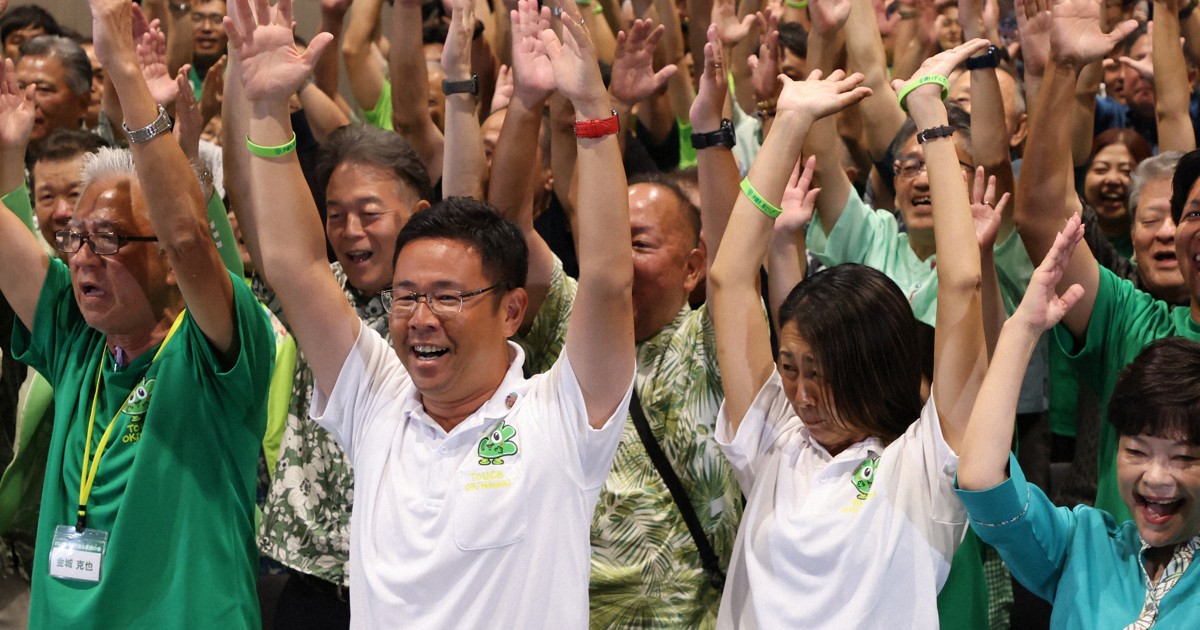
NAHA – Genta Koja, a political newcomer, was assured of victory in the Okinawa gubernatorial election on Sept. 13, 2026, defeating incumbent Denny Tamaki, who was seeking a third term. Koja raised his arms in a banzai cheer with supporters in Naha as the outcome became clear, while Tamaki, after reports of his loss, performed the traditional kachashi dance while holding a bouquet given to him by his supporters. The election was a significant political moment for Okinawa, but it also exposed a deepening problem in Japanese democracy: the spread of false and misleading information and defamatory attacks on social media during campaigns. In an editorial published after the vote, The Mainichi argued that this issue is becoming increasingly serious and that society cannot simply leave it in the hands of social media operators. The newspaper said it is necessary to constantly explore effective mechanisms to address the challenge, especially as online platforms become more central to how voters receive information and form opinions during election periods.
During the recent campaign in Okinawa, information of uncertain veracity flooded the internet, according to the editorial. The number of election-related posts on X, formerly known as Twitter, far exceeded the number during the Miyagi gubernatorial election in October 2025, when online abuse had already been rampant. The overwhelming majority of election-related posts in the Okinawa race reportedly came from outside the prefecture, suggesting that external actors were attempting to influence a local contest. Media organizations that analyzed the online discourse found that there were more negative posts about Tamaki than about Koja. Some content went far beyond normal political criticism and crossed clear ethical lines. One notable example was an artificial intelligence-generated video depicting a man resembling Tamaki being run over by a road roller. Such content is deeply harmful. The editorial emphasized that social media is now an important tool for voters to gather information about candidates and policies. If false information runs rampant and people cast their votes believing it to be true, the fairness of elections will inevitably be undermined. At the same time, if candidates and their supporters become hostile toward one another, calm and substantive debate becomes impossible. The Okinawa election demonstrated that the problem is not hypothetical; it is already affecting the quality of public discourse in Japan.
Out of this sense of urgency, two related laws were revised during the most recent session of the Diet. The first was the Public Offices Election Act. The revised law places a responsibility on social media users not to spread false information about candidates. It also requires images and videos created using generative AI to be labeled as such, so that voters can recognize content that has been artificially produced or manipulated. The second was the Information Distribution Platform Act. The revised law requires social media companies to take measures to mitigate the harmful effects of false and misleading information, and to disclose the status of those measures once a year. These legislative changes were intended to address the growing influence of online platforms in elections and to create a framework for accountability. However, the editorial pointed out that neither law carries penalties. Both rely heavily on the platform operators themselves to implement meaningful safeguards. Lawmakers deliberately avoided strict regulations out of consideration for freedom of expression, which is a fundamental constitutional value in Japan. As a result, the legal framework is largely voluntary and depends on the goodwill and capacity of social media companies, many of which are based outside Japan and have their own rules and incentives.
The revised laws are scheduled to come into effect in March next year, and the regulations will apply to the unified local elections that take place in the spring. That timing will provide an early and important test of whether the new rules are effective in curbing the spread of misinformation. The editorial cautioned that if the laws prove ineffective, tougher measures will be required. One particularly promising area of intervention is the economic model that drives disinformation. The spread of false information is heavily influenced by the so-called attention economy, in which revenue is generated based on the number of views and the amount of time users spend looking at content. Outrage-inducing posts tend to perform better in this system, regardless of whether they are true or false. The editorial suggested that requiring monetization to be suspended, even if only during election periods, is a strong option. Such a measure would reduce the financial incentive for spreading disinformation precisely when it poses the greatest danger to democratic processes. The editorial also said that Japan should study systems used in South Korea and France to monitor and crack down on false information. Both countries have developed mechanisms to respond to online disinformation during campaigns, and Japan can learn from their experiences while considering methods suited to its own legal and political context.
There is a delicate balance to be maintained between regulation and freedom of expression. Japan’s constitution protects freedom of speech, and any overly broad restrictions could chill legitimate political speech. The new laws reflect this caution, but they may also prove insufficient to deal with the speed and scale of online misinformation. The editorial argued that rather than leaving the issues entirely to social media operators, it is necessary to explore new mechanisms on a continuing basis. This could include enhanced transparency from platforms about political advertising and the spread of viral content, stronger cooperation with independent fact-checking organizations, and greater investment in media literacy education for voters. It could also include clearer and faster procedures for candidates to report defamation or election-related disinformation and have harmful content removed. Because much of the misinformation in the Okinawa election reportedly originated from outside the prefecture, international cooperation is also indispensable. No single country can fully solve the problem alone, and Japan will need to engage with other nations and with global platform companies to develop common standards. The challenge is not whether to regulate, but how to regulate effectively without undermining the very democratic values that elections are meant to protect. The Okinawa race showed that malicious actors can use social media to inject confusion and hostility into even a local election, and that the tools to counter them are still underdeveloped.
In the end, the editorial concluded, a range of measures must be taken to protect the fairness of elections, which form the foundations of democracy. Social media has brought important benefits to political communication, allowing candidates to reach voters directly and allowing citizens to participate more easily in public discussion. But the same platforms can be used to spread lies, incite hatred, and erode trust in democratic institutions. The Okinawa gubernatorial election should serve as a warning to all of Japan. If false information continues to flourish with impunity, voters will lose confidence in the electoral process, and the legitimacy of elected governments will be called into question. The Mainichi’s editorial insisted that society must not become accustomed to this state of affairs. Lawmakers, platform companies, media organizations, and citizens all have roles to play in ensuring that elections remain free and fair. The new laws are an important first step, but they are not a final solution. Constant vigilance and continuous exploration of effective mechanisms will be required. As the next unified local elections approach, Japan will have an opportunity to show whether it can rise to this challenge and protect the integrity of its democracy in an age of digital disinformation.