


Iraq’s Digital Frontlines: Regional Conflict Fuels Online Hate, Disinformation and Threats, Monitors Warn
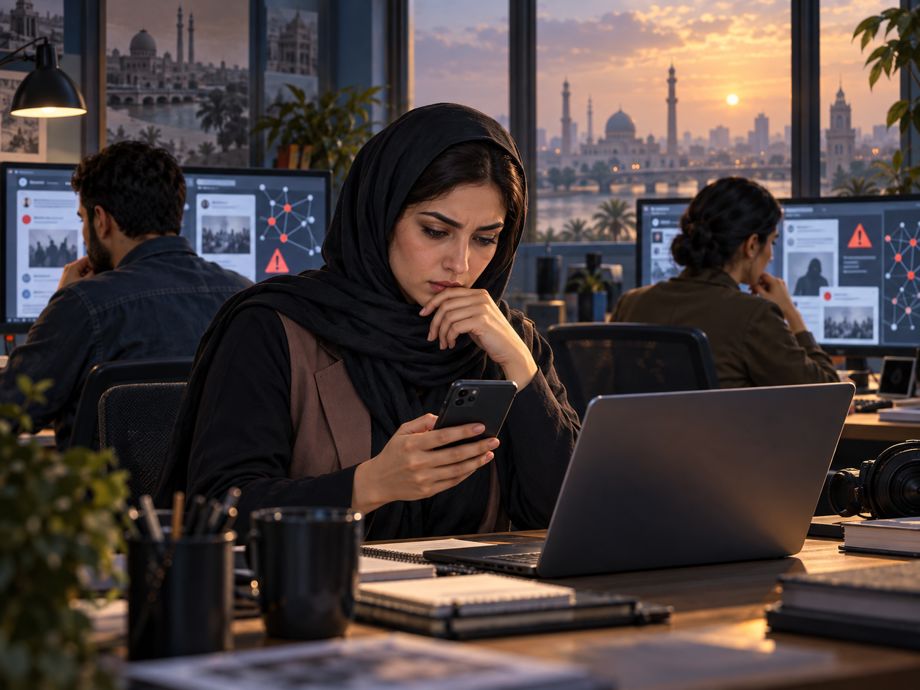
The regional war involving Iran has spilled into Iraq’s digital spaces, bringing a surge of hate speech, misleading information, and targeted harassment that is putting journalists and other public voices under growing pressure. Following the conflict’s escalation in late February, Iraqi media organizations, academics, and civil society groups mobilized to track harmful posts and examine how regional tensions were being used to deepen divisions inside the country. These organizations belong to a coalition supported by UNESCO through its European Union-funded Social Media 4 Peace project, which has operated in Iraq since 2025. Their work addresses a difficult challenge: responding to online abuse and manipulation through measures that respect freedom of expression and people’s access to information. In a country already marked by political fractures, armed group influence, and fragile institutions, the digital dimension of the regional conflict has become a new battlefield. Monitors warn that online harm is not merely a virtual echo of violence on the ground; it is an active mechanism for shaping public perception, silencing critics, and mobilizing communities along sectarian, ethnic, and political lines. The stakes are especially high for journalists, who find themselves targets of coordinated intimidation campaigns while trying to report on one of the most volatile crises in the region. Women face an even heavier burden, with digital abuse taking forms designed to drive them out of public conversation altogether. The UNESCO-backed coalition’s monitoring initiative is therefore not just an academic exercise; it is an urgent intervention to document harm, protect vulnerable voices, and propose practical safeguards that can preserve the integrity of Iraq’s information environment during a period of extreme regional stress.
Five organizations led the monitoring effort: ANAT for Media Development, the Iraqi Digital Reporting Platform for Female Journalists, Journalists Home in the Kurdistan Region of Iraq, the Iraqi Centre for Strategic Analytics, and the Media Monitoring Centre. Between 5 and 29 March 2026, the team reviewed thousands of social media posts and closely analysed 713 cases of harmful content, drawn primarily from Facebook, which remains the dominant platform for public discourse in Iraq. Researchers combined manual observation with keyword searches and reports from affected users, giving people experiencing online harm a direct way to contribute evidence. A dedicated reporting platform was integrated into the coalition’s website, helping the team investigate patterns of disinformation, hate speech, threats, and attacks against journalists during a period of rapidly escalating tensions. The methodology was designed to capture both the scale and the texture of online abuse: not just how many posts were harmful, but who was producing them, what narratives they carried, how they spread across networks, and which groups were being singled out for attack. By inviting direct reports from users, the coalition also tried to understand the lived experience of those on the receiving end, including journalists, activists, and ordinary citizens who found themselves caught in the crossfire of political warfare. The heavy reliance on Facebook reflects a broader reality in Iraq, where the platform serves as a primary source of news, a space for political debate, and a battlefield for rival factions trying to control the story. The coalition’s decision to make its findings public is part of a larger effort to hold purveyors of hate and disinformation accountable, even when they operate behind anonymous accounts or coordinated networks. Crucially, the monitoring period captured a moment of intense regional escalation, meaning the data reflects how quickly online harm can spiral when geopolitical tensions are high. The researchers hope that their evidence base will allow Iraqi institutions, civil society groups, and international partners to respond with precision rather than panic, targeting the most dangerous forms of content without undermining broader rights to free expression and open inquiry.
The monitoring identified an intensification of hate speech, incitement, and accusations of treason, alongside a shift in how the war was discussed. Online narratives increasingly used the regional conflict to mobilize domestic actors around disputes over weapons, the United States’ role, the influence of armed groups, and Iraq’s political future, drawing religious themes and historical memory into those arguments. This is a significant finding: the war was not simply being reported on in Iraq; it was being repurposed as a weapon in domestic political struggles. Accounts that appeared to be discussing regional events were often, in reality, using those events to attack local rivals, discredit political opponents, or rally support for particular factions. Repeated wording across accounts, closely synchronized posts, and the recycling of videos, allegations, and hashtags suggested that some campaigns involved organized or partly organized activity. The researchers did not establish proof of centralized control, a distinction that matters when assessing who might be directing these narratives and what legal or policy responses might be appropriate. Their findings indicate that Iraq’s digital spaces were doing more than reflecting regional events; they were bringing those events into domestic struggles over power, identity, and public opinion. For example, debates over the presence of armed factions, the role of American forces, and the future of Iraq’s political order were increasingly framed in the language of religious duty, historical grievance, and national betrayal. Accusations of treason became a common tool to discredit anyone who questioned any side’s narrative. This confluence of regional and domestic grievances creates a highly combustible environment, where a single incendiary post can inflame tensions far beyond the digital realm. The coalition’s decision to highlight the organized, or partly organized, nature of many campaigns is particularly important because it complicates the idea that online harm is simply spontaneous anger. Instead, the evidence suggests that some actors are deliberately manufacturing outrage, exploiting algorithms to amplify divisive content, and using social media to accomplish what street-level mobilization might otherwise require. At the same time, the researchers’ caution about centralized control underscores the methodological challenges of proving coordination in a space where anonymity, fake accounts, and cross-border influences are widespread. Even without conclusive evidence of a single mastermind, the pattern of coordinated behavior raises serious questions about the integrity of Iraq’s information environment and the vulnerability of its democratic processes.
The coalition called for more responsive, real-time monitoring and practical protection mechanisms as journalists, analysts, and content creators faced increased targeting. Its findings also showed disproportionate digital violence against women, highlighting the need for interventions that directly address technology-facilitated gender-based violence and the particular forms of harassment women encounter online. For female journalists in Iraq, the risks are compounded: they are attacked not only for their work but also in deeply gendered terms, including threats of sexual violence, weaponized photographs, and campaigns to undermine their credibility. Such abuse has a chilling effect, pushing women out of public debate and limiting the diversity of voices that can safely contribute to Iraq’s media landscape. The coalition’s emphasis on real-time monitoring reflects the limitations of retrospective analysis: when a journalist is facing a coordinated online mob, waiting days or weeks to document the abuse is not enough. Practical protection mechanisms might include rapid-response legal support, digital security guidance, and partnerships with platforms to remove the most dangerous content quickly. Yet any such measures must be carefully calibrated to respect freedom of expression, which the coalition recognizes as a cornerstone of a healthy society. The group also pointed to growing volumes of disinformation and AI-generated content, which have made stronger, more widely available verification capacity another priority. Deepfakes, manipulated images, and automated accounts are becoming harder to detect, and the skills required to identify them are not evenly distributed across Iraq’s media ecosystem. Audience behaviour also plays a part in spreading harmful material, with emotional reactions helping posts reach more people, making media and information literacy essential to helping users assess what they read, watch and share. This is a crucial insight: even the most sophisticated platform regulations will fail if users themselves do not have the tools to question what they see. The coalition’s recommendations therefore span multiple levels, from individual education to institutional capacity, from platform accountability to legal reform, reflecting the complexity of the challenge. The emphasis on media literacy is especially timely in an era when misinformation can spread across a country in minutes, often with greater speed and reach than corrective information. By empowering ordinary citizens to recognize manipulation, Iraq can build a more resilient public sphere, one that is less susceptible to the inflammatory narratives that have deepened divisions in the past.
UNESCO plans to expand media and information literacy initiatives, safety training for journalists and content creators, and support for fact-checking through Social Media 4 Peace. Local partners contribute knowledge of Iraq’s communities, political tensions, and cultural context, helping ground this work in people’s lived experiences. The coalition’s broader purpose is to build an evidence-based, human rights-centred response to online harm, connecting Iraq with similar project initiatives in Indonesia, Kenya, Bosnia and Herzegovina, Colombia, South Africa and Kyrgyzstan. This international dimension is important because the challenges facing Iraq are not unique. Countries across the global south and beyond are grappling with how to protect civic space from digital manipulation without resorting to heavy-handed censorship. By sharing lessons, tools, and best practices, the Social Media 4 Peace network allows local actors to learn from one another while adapting solutions to their own contexts. In Iraq, UNESCO’s support is designed to strengthen the capacity of local institutions rather than impose external models. The organization’s role is to provide resources, training, and a platform for dialogue, while Iraqi partners lead the work on the ground. This approach recognizes that sustainable solutions must come from within communities that understand the nuances of local power dynamics and cultural sensitivities. It also ensures that interventions are grounded in human rights principles, including the right to freedom of opinion and expression, which are often invoked by governments attempting to justify suppression of dissent under the guise of combating disinformation. The coalition’s careful balance between documenting harm and protecting free expression offers a model for other societies facing similar pressures. Its work demonstrates that it is possible to take online abuse seriously without using that concern as a pretext for authoritarian control. Instead, the response can be built around education, transparency, support for vulnerable groups, and cooperation with platforms, all while holding malicious actors accountable. By connecting Iraq to a larger network of countries, UNESCO is helping to build a global knowledge base on how to respond to digital threats in ways that strengthen, rather than weaken, democratic institutions.
The implications of this monitoring project extend far beyond the immediate crisis. Iraq is at a critical juncture, where the outcome of the regional war could reshape its political landscape for years to come. The digital battlefield, as the coalition’s findings show, is where many of those battles will be fought. The spread of hate speech, incitement, and organized disinformation threatens to erode the already fragile trust between Iraq’s communities and its institutions. It also imposes a heavy toll on the journalists and activists who risk their safety to inform the public and hold power accountable. Their resilience, however, is matched by the determination of civil society groups to push back against manipulation. The monitoring coalition’s decision to publish its findings is a reminder that information is a weapon that can be used for defense as well as attack. By making visible the patterns of online harm, the coalition strips away the veil of anonymity that abusers rely on and gives the public an opportunity to recognize the tactics of manipulation. It also provides an evidence base for future policy discussions, both in Iraq and internationally, about how to protect digital spaces from those who would use them to divide, destabilize, and destroy. As the regional situation continues to evolve, the need for vigilant, rights-respecting monitoring will only grow. The work of the coalition, supported by UNESCO and the European Union, is a model of how to meet that need: collaborative, empirical, and firmly rooted in a commitment to human dignity and democratic pluralism. Whether Iraq’s digital spaces become arenas of constructive debate or battlegrounds of toxic manipulation will depend, in large part, on whether local, national, and international actors take the findings seriously and act on them with urgency. The monitoring period may have ended, but the challenges it documented remain, and the responsibility to address them is collective.