


After the Flood Came the Lies: How Hurricane Helene’s Disinformation Crisis Changed Disaster Communication in North Carolina
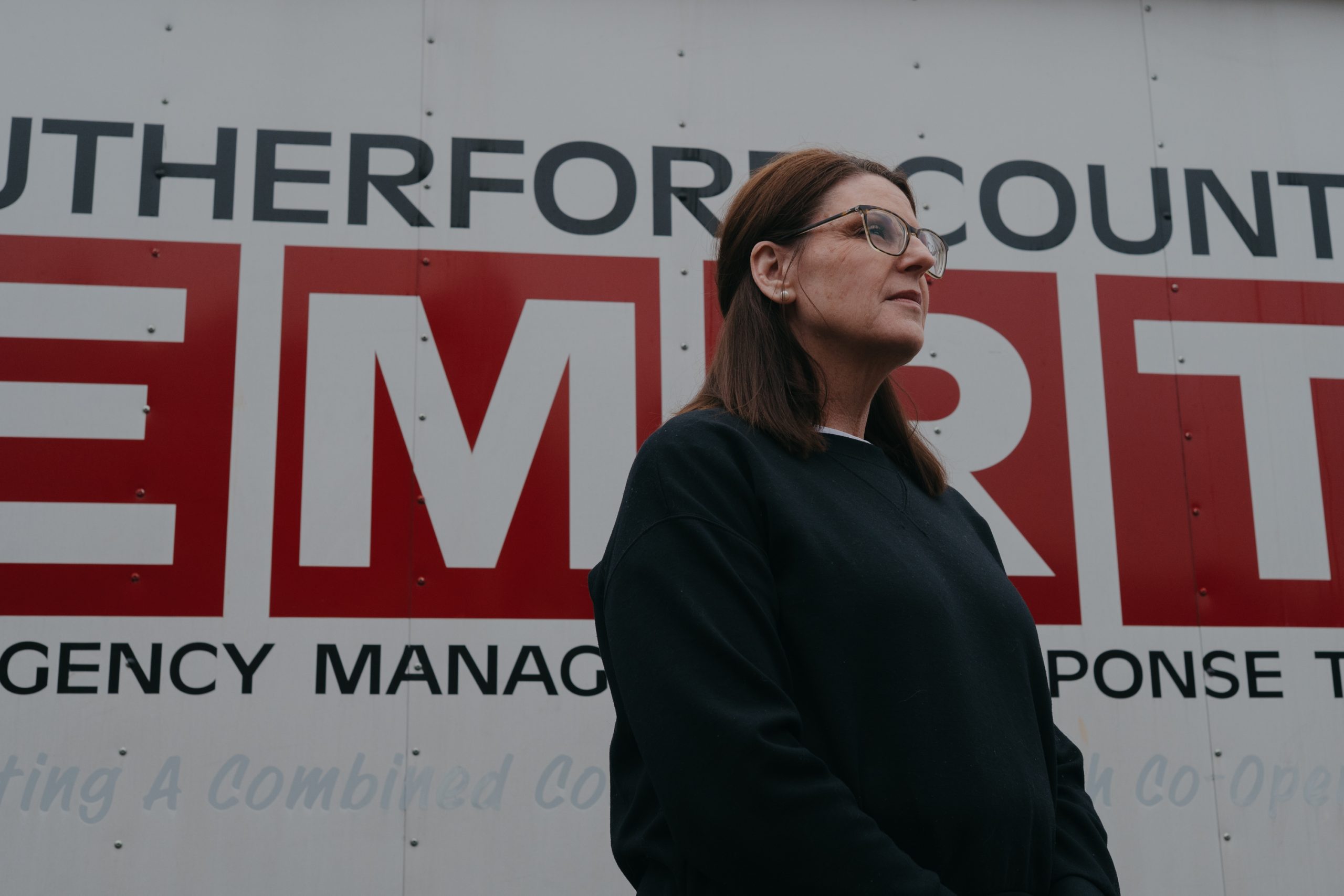
In the first days after Hurricane Helene devastated Western North Carolina in late September 2024, Kerry Giles found herself at the center of a chaotic and rapidly unfolding emergency. Helene had roared ashore in Florida before tearing up the coast and slamming into the mountains, dumping up to 30 inches of rain and whipping the region with gusts as high as 100 miles per hour. Mudslides and overflowing rivers destroyed mountain roads and hillside homes, transforming a region often spared the worst of tropical storms into catastrophic ground zero. Giles, the public transit director for Rutherford County, one of the hardest-hit counties in the state, was jolted awake in the middle of the night on September 27 by the county emergency manager, who asked whether she could authorize vans to evacuate trapped residents. Later that morning, at around 11 a.m., the same manager asked her to answer phones at the county’s Emergency Operations Center, handle a crush of media inquiries, and relay rescue information to the community. A tree had fallen on her house, and downed oaks in her front yard had barricaded her inside, but her answer was absolute: “If you can get me out, I will come.” Within hours, 911 operators had received more than 500 missing persons requests. Downed cell towers, widespread power outages, and destroyed infrastructure made it impossible for people to reach loved ones, including Giles’s own daughter in Boone, for hours. Giles set up a streamlined email inbox the next morning before being pulled into evacuation efforts in Lake Lure. Eventually, the local sheriff’s office and FBI took over missing persons cases, allowing Giles to focus her energy on serving as the county’s public information officer, or PIO—the only one Rutherford County had. But by October 3, when she finally stole a moment to let her dog out on her back deck, she discovered an entirely new front in the disaster: social media was awash with conspiracy theories, including accusations that federal agents had told residents their land was being seized and that Chimney Rock was about to be bulldozed. Giles snapped a photo of her face, puffy with tears, and sent it to her husband. “I knew how exhausting it could be to keep putting accurate information out when people had already decided not to trust it,” she told The Assembly, recalling her experience as a PIO during the COVID-19 pandemic. “The thought of facing that again while our community was already hurting so badly was overwhelming.”
The disinformation that spread in the aftermath of Helene was not merely confused rumor—much of it was deliberate, coordinated falsehoods designed to undermine confidence in emergency management agencies. One of the most viral examples traced back to an X user named Chris Martenson, who posted on the evening of October 2 a detailed account supposedly from an unnamed North Carolina resident. The post claimed that officials had organized a meeting with Chimney Rock residents to inform them the town was being seized and bulldozed “bodies and all,” possibly to access lithium deposits. It also alleged that officials had not recovered the bodies of storm victims, that truckers had reported slashed tires, and that people were being robbed at gunpoint during supply runs. Snopes, FEMA, and multiple public officials quickly dismantled these claims. A meeting had indeed occurred in Chimney Rock on October 2, but Giles, who attended, said it was for residents to voice concerns and discuss infrastructure repair. Bulldozers were present—but to clear roads, not level buildings. No lithium is mined in Rutherford County, which recorded four confirmed storm-related deaths. Nevertheless, Martenson’s original X post amassed more than 3 million views in a week, spreading through Facebook groups, troll accounts peddling weather conspiracy memes, U.S.-based misinformation aggregators, and eventually Russian disinformation sites, according to a dossier compiled by Bryan Giemza, a professor of humanities at Texas Tech University and former director of the Southern Historical Collection at UNC-Chapel Hill. Martenson—who holds a Duke doctorate in neurotoxicology and runs the subscription-based fringe site Peak Prosperity—later walked back the post on his blog, admitting there was no evidence to “confirm those claims,” but he defended his initial decision to publish. Disinformation of this kind usually has a purpose, and in the hypercharged political atmosphere of a key swing state, it often centered on casting doubt on government response. Former President Donald Trump accused federal agencies of withholding aid to Republicans and claimed FEMA had diverted funds to immigrants. Former N.C. Lieutenant Governor Mark Robinson asserted that President Joe Biden had said the federal government had “no more supplies” for residents. Marjorie Taylor Greene and others even argued the federal government had engineered the hurricane to harm Republican areas. The effect was pernicious, as Brian Haines, a senior external affairs specialist for N.C. Emergency Management who worked as a PIO during Helene, explained: “You had a lot of conflicting messages between politicos, one side of the fence saying one thing, the other side saying another thing. That, I think, caused a lot of issues, especially when you were hearing from prominent politicians that FEMA was not there. But FEMA was there; we were [in] daily contact with them.”
The vulnerability of Western North Carolina to both natural disasters and false information cannot be overstated. Geographically isolated towns, fragile communications infrastructure, and a longstanding cultural ethos of rural self-sufficiency all made the region fertile ground for rumor and distrust. Sarah Jackson, an assistant professor in the Emergency and Disaster Management Program at Western Carolina University, said rural communities often see themselves as independent and not needing support—until a catastrophic disaster forces them to rely on exactly the institutions they may be predisposed to question. “Rural folks commonly think of themselves as independent, not needing support and help. But then in a catastrophic disaster like this, you have to,” she said. Jackson’s research on official warning messages during Helene found additional problems: urgent alerts from agencies like the National Weather Service went out quickly and to the right places, but at times contained unclear wording, contradictory instructions, or no timeframes, adding to the confusion. The North Carolina Department of Public Safety’s own after-action review acknowledged the crisis, noting that “well-meaning individuals sharing incorrect information, coupled with coordinated disinformation efforts, undermined public confidence in official communication channels.” That report also admitted that “the need to continuously address and correct misinformation redirected substantial staff time and resources away from other critical response activities.” For PIOs like Giles and Haines, the job became vastly more complex. On top of standard duties, they had to convince a skeptical, information-starved public that help was actually on the way, while simultaneously tracking and rebutting an endless stream of falsehoods. Giemza observed that agencies were caught flat-footed: “The [government] authorities would say, ‘We’re flat footed, we weren’t ready for all that, we were seeing all this crazy stuff as it unfolded in real time.’ Then they had to chase it, and it’s simply not a part of their playbook.” Giles, who was the sole PIO in Rutherford County, spent hours responding to comments on Facebook, combing through pages, and messaging residents directly—all while managing two daily briefings and updating a resource page. The psychological toll was real. She feared having to fight misinformation again while her community was already so deeply wounded.
One of Helene’s greatest lessons was that traditional communication channels could not keep pace with the flood of disinformation. Press releases and official statements often inspired as much skepticism as reassurance, if people read them at all. So agencies got creative, shifting toward social media, local radio, and on-the-ground messaging to penetrate the communications blackout. Radio became a lifeline, since residents could still tune in through battery-powered devices or car stereos. Jackson, who lives in Waynesville, described how a “boombox radio” she and her husband had rescued from a roadside junk pile in 2019 became essential. Using cheap D-cell batteries she had stockpiled before the hurricane, she listened to 24-hour station broadcasts and residents calling in to share where food and water could be found. In one memorable instance, a caller mentioned that OnStar was providing free internet to compatible GM vehicles in disaster zones—information that allowed Jackson to reconnect to the wider world for the first time in days. In-person messaging became vital as well. State agencies posted updates on bulletin boards outside churches, grocery stores, and firehouses in communities without connectivity, and sent PIOs into the field to answer questions directly. Social media and the internet proved the most profound revelation. Giles and Haines both emphasized the importance of video for broadcasting real-time information and using platforms like Facebook and X. NCDPS and FEMA partnered with trusted local nonprofits, faith leaders, and influencers to share accurate information through established community channels. FEMA also coordinated with Starlink, the satellite internet service operated by SpaceX, to restore connectivity in affected areas, boosted by private donations. Agencies stood up websites dedicated to fact-checking disinformation in real time, with staff monitoring social media and flagging rumors as they emerged. “There’s this conduit of information that we can really be pushing out that is more than just press releases and phone calls and talking to reporters,” Haines said. “We can really be reaching the public directly through these venues.” FEMA’s associate administrator for external affairs, Victoria Barton, explained that while “the federal government does not have a face,” it can and must collaborate with trusted local governments and community leaders to share information through channels that people actually believe. That approach—meeting people where they are, with messengers they trust—became the central principle of post-Helene communication strategy.
Two years after the storm, officials say those desperate improvisations have matured into a more robust, proactive approach to countering disinformation. Barton cited a series of wildfires in Georgia this spring where FEMA’s social media team noticed false posts claiming the agency had recalled firefighters and resources. She quickly asked the regional office to investigate; the claims were deemed false, and resources were confirmed on site. The regional administrator and state emergency manager then conducted interviews with local press, allowing residents to see officials actively working to help. Barton said she saw “considerable” improvement in public confidence within days. Giles, meanwhile, has trained her emergency management team to share photos and reels during floods and thunderstorms this summer, recognizing the power of visual proof during Helene. Haines said N.C. Emergency Management now posts videos depicting “the work that goes into everyday activities,” such as hazardous materials response and search-and-rescue operations, to demonstrate that “the government is working for the residents of North Carolina.” He also noted that local partners now report rumors to the state as soon as they spot them, while Homeland Security analysts feed information about potential disinformation efforts into the system. Local PIO capabilities have expanded substantially. Giles and Haines attended a summit this summer to connect with PIOs from local governments across the state and learn counter-disinformation strategies. N.C. Emergency Management has established a joint information system with a Microsoft Teams channel where PIOs can share disinformation sightings and request help from counterparts in other counties if they become overwhelmed—an acknowledgment of just how isolated Giles felt in 2024. FEMA has prepared messaging toolkits to help local governments craft fast, effective statements, and works closely with the Cybersecurity and Infrastructure Security Agency to identify foreign disinformation sources. The NCDPS after-action report stressed the need for regular exercises to test agencies’ ability to monitor social media and correct falsehoods, ensuring that “PIOs maintain proficiency in these critical skills.” It also recommended embedding journalists in training activities, organizing open houses with agency officials, and engaging with local leaders online to build public trust before disaster strikes. “In [a] crisis, these stakeholders can serve as both trusted messengers who help dispel rumors or disinformation and trusted advisors providing valuable information on public sentiment, community needs, and access to other network influencers,” the report said. Giles agreed: “I feel like we are so much more prepared than we were two years ago. [I] just hope we never have to exercise those skills.”
Yet even with these improvements, the deeper problem remains profoundly difficult—and perhaps unsolvable. Disinformation is endemic to the digital age, and agencies can only do so much to inoculate the public against it. Giemza acknowledged that strategies like “pre-bunking,” which teach people how to recognize disinformation, are sound in theory but nearly impossible in practice: it is impossible to predict which rumors and fears will emerge, especially in a resource-starved and information-starved environment like Western North Carolina after Helene. The effectiveness of any countermeasure ultimately depends on a public willing to assume good faith from institutions—a fragile assumption when the power is out, the only road out of town is gone, and political figures profit from amplifying suspicion. “It’s just a massive social problem in terms of information, media, and civic literacy in our society,” Giemza said. “As long as it’s profitable, and profitable for politicians and manipulators of public sentiment, it’s not going to go anywhere.” Jackson echoed the sentiment, noting that rural communities may be especially susceptible, but that the broader crisis of trust affects everyone. Still, if disinformation is inevitable, so too is the fight against it. Giles, standing in the ruins of what used to be a quiet county communications office, now sees herself as a first responder for truth. The photo she snapped of her tear-streaked face remains a reminder of how overwhelming that burden can feel. But she and her counterparts across the state continue to show up, answer the calls, and post the updates, hoping that when the next disaster comes, people will remember who was there for them. Haines summed up the enduring mission simply: “We’re here to help. That’s probably the biggest thing we can do—is just to build that trust.” In the end, the story of Helene’s aftermath is not just about floodwaters and landslides, but about the battle for belief in the spaces where rumored bulldozers haunt a town that was never going to be erased. The storm passed, but the war against the lies that followed it continues—and the lessons of those harrowing weeks in 2024 are now woven into the very fabric of how North Carolina prepares for the next catastrophe.