


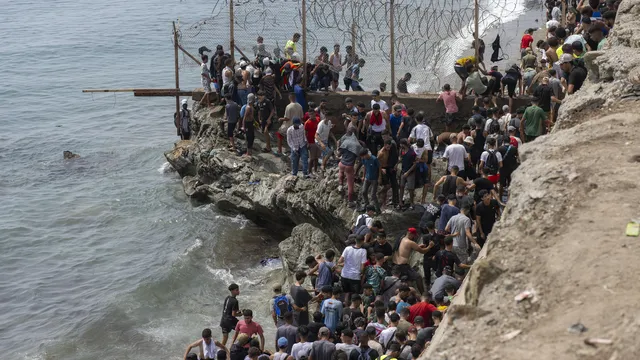
The recent, unprecedented surge of migrants into the Spanish North African enclave of Ceuta has been unmasked as a calculated, coordinated operation fueled by a sophisticated disinformation campaign. Since July 30, official Spanish figures indicate that 72,000 individuals attempted to reach the territory, with the vast majority braving the dangerous Mediterranean waters by swimming around maritime barriers. The human cost of this manufactured crisis has been devastating: Spanish authorities have recovered 78 bodies, while Morocco has reported 11 deaths, marking one of the most tragic humanitarian incidents in the region’s recent history.
Security analysts and technology experts have moved to deconstruct the mechanisms behind the surge, identifying social media as the primary weapon used to incite the influx. A report by Chema Gil of the University of Murcia highlights an online campaign that garnered 11 million views in a matter of weeks, effectively weaponizing digital platforms to manipulate vulnerable populations. Independent investigations by the technology firm Golden Owl have concluded “with a high degree of confidence” that the event was not a spontaneous movement of people, but a deliberately organized operation designed to overwhelm the border.
The catalyst for this mass movement was a viral rumor that “the Ceuta border is open,” a false narrative that spread rapidly across Facebook and WhatsApp. Social media expert Marcelino Madrigal noted that there were clear indicators in the digital ecosystem that a crisis was brewing long before the first arrivals hit the water. While the original source of the disinformation remains elusive, analysts point to the use of mass-diffusion algorithms and unidentifiable accounts, which worked in tandem to ensure the rumor reached as many people as possible, effectively engineering a humanitarian catastrophe through digital manipulation.
At the heart of the disinformation was the strategic distortion of a Spanish Supreme Court ruling. While the court had clarified that irregular migrants intercepted on the high seas are entitled to specific legal procedures—distinct from the immediate summary returns permitted at physical land borders—bad actors twisted this into a message that the border was entirely open for entry. Law experts, including Antonio Benitez Ostos and Laura Maria Medina Ferreras, have emphasized that the court never revoked the state’s power to return migrants; it merely mandated that human rights guarantees be upheld during the legal process.
In the wake of the crisis, the Spanish government has navigated a complex diplomatic landscape, with Prime Minister Pedro Sanchez attributing the surge to human trafficking networks while carefully avoiding direct public condemnation of Morocco. To bolster border security, Spain has since installed new floating barriers. Lawyers suggest that these structures may legally facilitate future border containment, provided they fall within the specific legal frameworks regarding interdiction. However, the move has done little to ease the underlying tensions, as analysts warn that these measures are merely reactive to a persistent and evolving threat.
Looking ahead, experts fear that the Ceuta incident is merely a template for future exploitation of digital vulnerabilities. Marcelino Madrigal warned that as new posts emerge calling for further mass crossings throughout August, the cycle of disinformation shows no sign of abating. The failure of major social media platforms to effectively moderate or debunk the inflammatory content in real-time has drawn sharp criticism, with experts cautioning that similar manufactured migrant surges could be exported to any border region in the world. As the investigation continues, the event serves as a grim reminder of how digital misinformation can be leveraged to trigger geopolitical instability and tragic loss of life.