


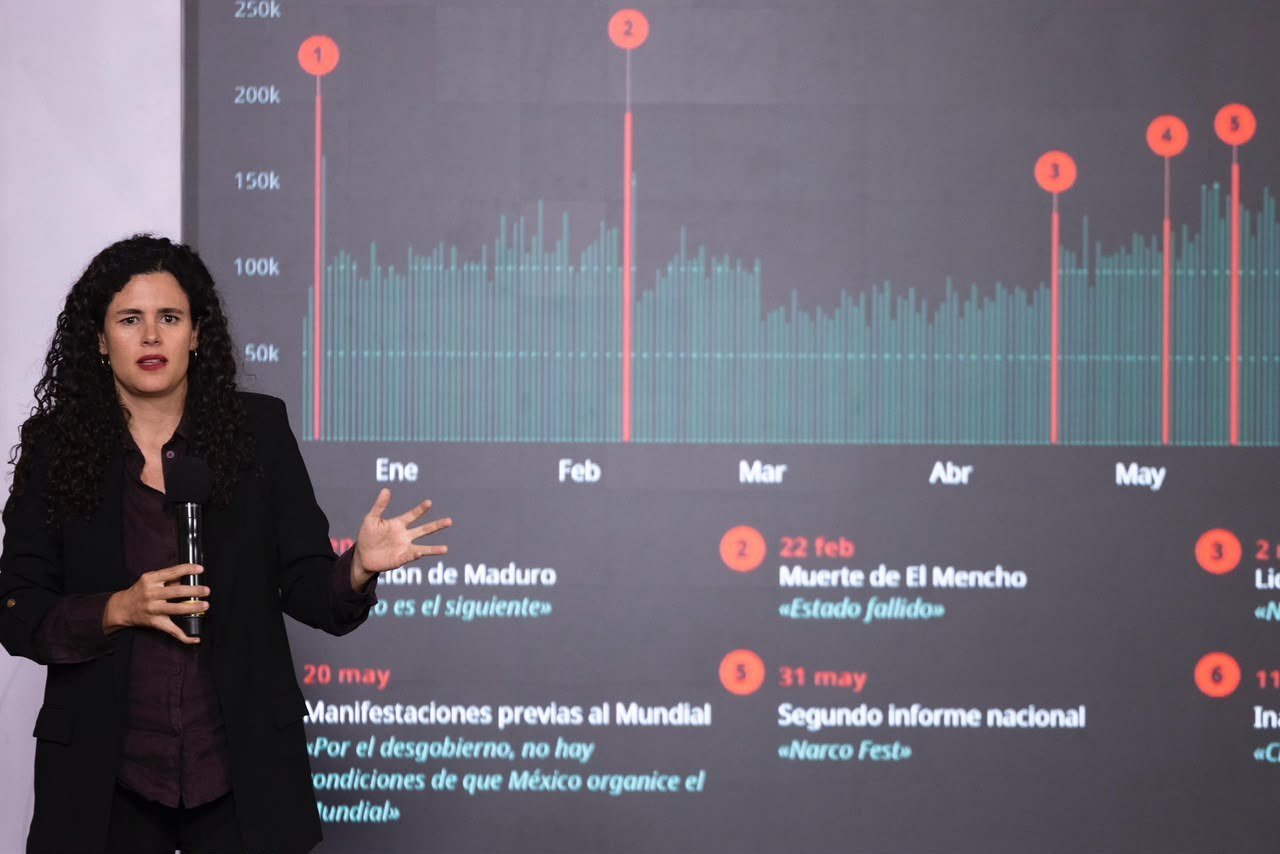
The Presidency of Mexico has revealed the existence of an alleged digital amplification network designed to attack President Claudia Sheinbaum Pardo and the political project known as the Fourth Transformation, according to an analysis presented by the head of the Legal Counsel of the Presidency, Luisa María Alcalde Luján. The official presented the findings on August 12, 2026, during a “Right of Reply” press conference at the National Palace, describing a coordinated structure involving opposition political figures, media personalities, anonymous users, and more than half a million automated or bot-like accounts. In total, the analysis identified 560,520 accounts that would have generated approximately 22.7 million posts between January 1 and August 8, 2026, all seemingly dedicated to amplifying negative narratives against the government. Alcalde Luján insisted that this network is not organic, but rather a carefully designed mechanism for manufacturing the impression of widespread public opposition, using specific hashtags, recurring themes, and coordinated posting schedules. She stressed that the government is not compiling a “blacklist” or engaging in censorship, but rather exposing an “analysis of the digital ecosystem of artificial trend amplification.” The presentation immediately drew fierce criticism from journalists, political figures, and civil society organizations named in the report, with the Miguel Agustín Pro Juárez Center and several communicators describing the data as “fascist lists.” President Sheinbaum, however, defended the report at her morning press conference on August 14, dismissing comparisons to authoritarian regimes and insisting that under her administration “the greatest freedom of expression in history” is exercised, while asking: “Who is being censored? Who? No one.”
The first layer of the alleged network, according to the Legal Counsel’s presentation, consists of 54 accounts belonging to media outlets and political commentators, which together accumulated 282,866 posts during the seven-month period under analysis. These accounts are considered the point of origin for a large part of the messaging that later circulates through the other layers of the structure. Among those named in this category are Atypical TV, Bibiana Belsasso, Adela Micha, Ciro Gómez Leyva, Dolia Estévez, Javier Negre, ADN40, Azteca Noticias, El Universal, Joaquín López-Dóriga, La Derecha Diario, Carlos Loret de Mola, Aristegui Noticias, Denise Dresser, and Javier Alatorre. According to Luisa María Alcalde, the role of these first-stage accounts is to generate or legitimize content through tailored news coverage, opinion columns, commentary, supposed investigative reports, and the dissemination of viewpoints that are later picked up by other users on social media. “Their importance is that they originate the message,” Alcalde Luján stated during the press conference. The federal interpretation holds that these outlets and communicators act as the initial spark for narratives that are then repackaged, politicized, and massively amplified by lower-tier accounts, transforming a single report or opinion into what appears to be a broad social conversation. The presentation included digital maps and examples showing how a story originating in these channels can quickly move through the various levels of the ecosystem, gaining intensity and hostile language as it spreads.
The second layer of the network is made up of 32 accounts linked to political figures, to which more than 67,000 posts were attributed. At this stage, the Legal Counsel explained, the messages are picked up, endorsed, and given a political slant before moving on to subsequent circulation. These accounts “mainly pick up, endorse, and politicize the information they gather from layer one,” Alcalde said. Among the politicians and public figures mentioned are Alejandro Moreno, Felipe Calderón, Javier Lozano, Maru Campos, Rubén Moreira, Jorge Romero, Lilly Téllez, Margarita Zavala, Ricardo Anaya, Vicente Fox, Claudio X. González, Marko Cortés, Ricardo Salinas Pliego, Kenia López, Lorenzo Córdova, Xóchitl Gálvez, Damián Zepeda, Laura Ballestero, Luisa Gutiérrez, Lía Limón, Mauricio Tabe, Santiago Taboada, Annia Gómez, Enrique de la Madrid, Gabriel Quadri, Jorge Triana, Federico Döring, and Guadalupe Acosta Naranjo. The third layer, according to the analysis, consists of 34 accounts identified as “attack” accounts or trolls, which would have accumulated more than 200,000 posts. These accounts are described as “in charge of repackaging and distributing the message,” taking content generated at previous levels, reformulating it with confrontational and often aggressive language, and then spreading it among a much larger number of users. As examples, Alcalde Luján cited the accounts Melissa Bely, La Abuela García, José Díaz, Jorge García Orozco, and Don Metralleta, noting that they show patterns of intense and practically continuous activity throughout the day. The case of Melissa Bely was highlighted as particularly significant: the account is said to represent what amounts to 30 percent of the daily movement of the entire ring of 560,000 accounts, with the most interaction with bots, starting its activity at 6:00 a.m., posting 36 times a day, and dedicating 96 percent of its posts to attacking the President and the Fourth Transformation, using nicknames, “scandal” or “boom” phrases, and other outrage-generating tactics.
The fourth and largest layer is the so-called “amplification ring,” consisting of 560,520 accounts that would have generated around 22 million posts during the period analyzed. This layer has no identifiable human users behind it in the traditional sense; rather, according to the federal government, these are profiles that display behavior compatible with automated accounts or bots, repeating and multiplying messages that originated in the previous layers. Alcalde was careful to clarify that a high posting frequency by itself does not constitute definitive proof that an account is a bot, but she argued that the overall pattern—including simultaneous activity, name changes, repeated use of certain hashtags, mass production of memes and videos, and a high concentration of posts against President Sheinbaum—supports the hypothesis of a coordinated and partly automated amplification machinery. The practical effect, she warned, is a “perception effect”: a narrative initially placed by a media outlet, commentator, or political figure aligned with the opposition can be picked up by attack accounts and subsequently reproduced thousands or millions of times, making any conversation appear to have far greater public traction than it actually does. Among the main narratives identified by the government are accusations of an alleged “narco-government,” claims about so-called “fiscal huachicol” (fuel-tax fraud), assertions of an alleged “authoritarian regime,” and content related to pressures or “foreign intervention.” The Legal Counsel explained that these concepts are recurrent, adapted to different political events, and are used to generate a circuit of amplification in which it becomes difficult for the average user to distinguish the original message from the thousands of automated or coordinated reproductions that follow.
In response to questions from Contralínea about whether the government would attempt to follow the money trail behind such a vast structure—given that maintaining an operation of this scale would require significant resources for account management, content production, automation tools, technological infrastructure, and advertising—Luisa María Alcalde stated that for now the objective is not to present an investigation into financing, but to expose the phenomenon and allow the population to identify such mechanisms. She acknowledged that identifying the resources and the actors who might eventually be behind these structures would be a different path, but maintained that at this stage the aim is only to generate tools so that people do not mistake an artificially amplified trend for a genuine social conversation. When pressed on institutional responsibility, Alcalde referred to the National Electoral Institute (INE), noting that it “always audits the resources of the political parties” and that financing a disinformation scheme of this nature would not be permitted, but that such an inquiry falls under the exclusive authority of the electoral body. She added that the government’s intention is to expose the phenomenon and create a space for joint reflection, saying: “Because it is very important that we all know that when we talk about bots, it’s not that one says: ‘no, no, don’t worry, there are no people behind them.’ No. It is proven; we can show you how these accounts work, and that they have been increasing.”
On a separate matter raised by Contralínea, the Legal Counsel was asked whether the federal government or the Legal Counsel itself had considered expanding obligations not only for print media but also for digital media and social media accounts, in order to clearly differentiate information, opinion, and advertising, and whether audiences might have mechanisms to file complaints when disinformation is spread in a context where journalistic content, political opinions, advertising, and artificially generated messages circulate on the same platforms. Alcalde responded that expanding guidelines to other types of media has not been contemplated, saying “there isn’t even that intention for now.” She explained that the government is currently focused on establishing guidelines derived from a law passed in 2025, and denied any immediate intention to expand those obligations. The official also addressed what she called “false narratives” that have circulated around those guidelines, asserting that some confusion has already been clarified through statements from the industry itself. She drew a distinction between print and audiovisual media, noting that in the case of newspapers, it is easier to identify the difference between advertising, informational content, and opinion because traditionally there are differentiated spaces for each. The broader context of the controversy remains unresolved: communicators and NGOs continue to denounce the government’s presentation as an intimidation tactic, while the presidency defends it as a transparent, scientific analysis of the digital ecosystem intended to safeguard public debate from artificial manipulation. President Sheinbaum has categorically rejected the accusation that her administration is creating lists to silence dissent, insisting that no one is being censored and that the analysis is part of a necessary effort to expose how social media can be weaponized to distort political reality. The debate now centers on where to draw the line between legitimate criticism, coordinated political campaigning, and automated disinformation—and on what role, if any, the state should play in policing that boundary.