


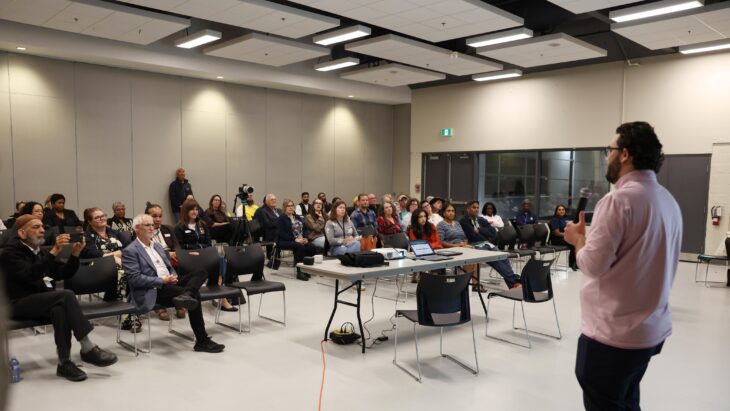
CLARINGTON, Ont. — Residents, municipal officials, Durham Regional Police officers, and representatives from local faith and community organizations gathered at the Garnet B. Rickard Recreation Complex in Bowmanville on Wednesday night for “Together, We Are Clarington: A Community Conversation,” an event aimed at confronting hate, countering disinformation, and strengthening the sense of belonging in one of Durham Region’s fastest-growing municipalities, located just east of Toronto. The gathering was organized by the Municipality of Clarington, Durham Region, the Clarington Library, Museums and Archives, and Victim Services of Durham Region, and it drew people from across the area — including Bowmanville, Courtice, and the neighbouring community of Newcastle — for an evening of discussion, resource-sharing, and direct dialogue. Some attendees came to learn about hate and disinformation; others came to share their personal experiences of discrimination and to connect with people they might not otherwise have the chance to know. The program included discussions on the difference between hate incidents and hate crimes, how to report hate, how to recognize false or misleading information, and how to have respectful conversations with people when they disagree. In the venue’s common areas, community organizations and faith groups set up information tables where residents could learn about local services, supports, and volunteer opportunities, making the event both an educational experience and a reminder that community safety depends on everyday relationships between neighbours.
Nirosha Balakumar, supervisor of equity, diversity and inclusion for the Municipality of Clarington and one of the event’s organizers, said the goal was to bring people together while celebrating the diversity of the community. “Canada is made up of a huge group of folks from different cultures, faith backgrounds, races, religions, and I think it’s really important that we continue to understand how can we live together in peace and harmony, and how do we support one another in our community,” Balakumar said. She stressed that the need for these conversations has existed for many years and remains important as communities continue to change and grow. Balakumar also announced the second phase of the “Together, We Are Clarington” campaign, which includes an online space where residents can share stories or photos about local acts of kindness. The campaign, she said, is about recognizing the small moments of compassion that happen every day — between neighbours, teachers, students, friends, colleagues, business owners, and community members. “It could be your neighbor, it could be a teacher, a student, a friend, a colleague, a business owner,” she said. Balakumar said the campaign is built on a simple but powerful idea: kindness and humanity do not belong to any one race, religion, or culture. “I think what’s really important for us to remember is that kindness and humanity doesn’t have a certain race or faith background. We are all human, and we can all extend acts of kindness to one another,” she said.
Clarington Mayor Adrian Foster said events like this are necessary because residents need opportunities to know their neighbours on a personal level, not just through stereotypes or online interactions. “We need to know our neighbors on a human basis,” Foster said. “We need to not be judging on background. We need to not be judging on possibly race or creed.” Foster warned that hate can have effects that reach far beyond the person directly targeted. When someone is threatened, harassed, or demeaned because of their religion, race, gender, sexual orientation, or another aspect of their identity, the fear can ripple through the entire community. People can become afraid, uncomfortable, or feel they do not belong. He said residents should not become used to hateful graffiti or other acts targeting people because of their religion or identity, and he pointed to the municipality’s message: “Hate has no home in Clarington.” The mayor also raised concerns about disinformation, particularly the speed at which false or misleading claims can spread online. “People start believing the myth as opposed to the fact,” he said. Regional Coun. Willie Woo, who has lived in Newcastle, a community on the eastern side of Clarington, for 72 years, echoed the mayor’s concerns. Woo said he has watched Clarington change dramatically over his lifetime, with people from many different cultural, religious, and linguistic backgrounds now calling the municipality home. He encouraged residents to question information they see or hear, especially on social media, and to make an effort to understand perspectives different from their own.
For some residents, the event was also an opportunity to reflect on the positive side of diversity. Monifa Miller, who has lived in Courtice since 2006 or 2007, said she has seen significant growth and increasing diversity in her community. “I love the idea of just having diversity because it just gives us diversity of thought, gives us great food, gives us, you know, a lot of opportunity,” Miller said. She said newcomers bring valuable skills, help support the local economy, and strengthen the community in a variety of ways. “I think it’s only a benefit,” she said. Zaihan Rashid, representing the Islamic Centre of Bowmanville, said community education and direct contact between residents are important ways to reduce misunderstandings. The Islamic Centre has participated in community events and held open houses to allow residents to learn more about its activities and meet members of its congregation. Rashid said Islamophobia remains a concern in Durham Region, and he pointed to several incidents in recent years, including graffiti and acts involving members of the Muslim community. Responding to hate, he said, requires more than one approach. Increasing information, increasing awareness, educating people, sharing spaces, and allowing residents to see what faith communities actually do are all important pieces of the puzzle. He also highlighted the role of media and social media in shaping public opinion, as well as the importance of partnerships between faith and community organizations. “Neighbors ought to talk to neighbors,” Rashid said. “It can’t just be online. It has to be on site as well.”
The Jewish community was represented by Koren Kassirer, a Bowmanville resident and vice-president of Oshawa Synagogue Beth Zion. Kassirer, who is a board member of Clarington’s diversity advisory committee and the anti-hate coalition in Durham, said building relationships between communities is one of the most effective ways to respond to hate. “The best way to combat hate is to build bridges between communities because really when there’s an attack against one of us, it’s an attack against all of us,” Kassirer said. She spoke about her own work with Muslim community members, including her family’s experience sponsoring a Syrian refugee family about a decade ago. That experience, she said, helped her see the power of personal relationships to break down fear and misunderstanding. Meeting people from different religious and cultural backgrounds, sharing meals, listening to their stories, and working together on common goals can reduce prejudice in ways that arguments cannot. “People are people,” she said. For Kassirer, the event was an example of the kind of bridge-building that can make a community resilient in the face of hate. Her presence, alongside Muslim, Christian, and other faith representatives, showed that interfaith friendships are not abstract ideals but lived relationships. She said that when one community is attacked, the bonds of solidarity make it possible for others to stand with them — and that is what makes hate less likely to take root.
Durham Regional Police Service Supt. Sean Sitaram also spoke, giving residents a clear picture of how to recognize and report hate-motivated incidents. He explained that a hate incident may involve harmful or offensive behaviour motivated by bias or prejudice but may not meet the legal definition of a criminal offence. A hate crime, on the other hand, is a criminal offence motivated by hatred toward an identifiable group — including race, national or ethnic origin, language, religion, sex, age, mental or physical disability, sexual orientation, or gender identity and expression. Sitaram said residents should call 911 if a hate-motivated crime is happening or if there is an immediate safety concern. He also highlighted the importance of community engagement, including police presentations, Community Safety Days, and other programs designed to help residents connect with officers and learn about local safety resources. The Region of Durham, in partnership with Victim Services of Durham Region, launched a community-based hate reporting program in January 2026. The program allows people to confidentially report hate incidents, including incidents that may not meet the threshold of a criminal offence, and it also accepts anonymous and witness reports. According to the Region, hate-motivated crimes and incidents increased by 77 per cent in Durham between 2023 and 2024, and officials say hate activity remains significantly under-reported. That statistic underscores the importance of events such as “Together, We Are Clarington,” which give residents the knowledge and confidence to speak up, support victims, and reject disinformation. The evening ended with a shared message from leaders, faith representatives, and residents: kindness and connection are what define a community, and everyone has a role to play in making sure hate has no home in Clarington.