


Paragraph 1
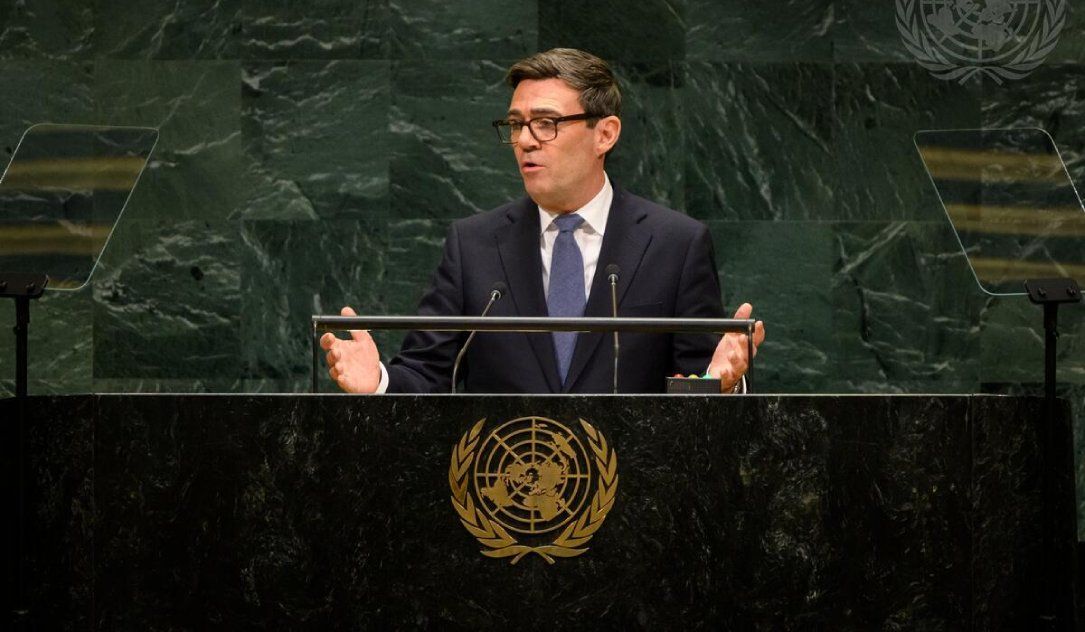
British Prime Minister Andy Burnham announced Tuesday that he has ordered security chiefs to begin work on a new national centre designed to “detect, attribute and disrupt” hostile state disinformation, using his first address to the United Nations General Assembly to frame the fight against information warfare as a core pillar of global collective security. Speaking in New York, Burnham said the United Kingdom would not only build a more robust domestic response but would also share its knowledge with allied nations, many of which are facing sophisticated foreign influence operations for the first time. “As more elections approach across Europe, more nations are grappling with these issues – some for the first time,” he said. “So we’re ready to share our understanding of how these actors work, and how we can respond — because this is vital for our collective security and resilience.” The proposed body, which Burnham called the National Centre for Information Defence, is expected to consolidate work that is currently spread across several government departments, though the prime minister gave few details about its ultimate structure, staffing, or statutory powers. The Cabinet Office is understood to be leading the initial planning phase, with intelligence agencies, other government departments, law enforcement bodies, and social media companies all involved in determining how the centre could operate in practice. A spokesperson for the prime minister’s office said more information would be released in due course, but the announcement itself signals a significant shift in how the British government intends to confront what it increasingly describes as an existential threat to democratic institutions and social cohesion. The choice of the United Nations as the venue was deliberate, allowing Burnham to position the United Kingdom as a leader in the international effort to counter hostile state influence, while also acknowledging that no single country can defend itself alone in an information environment that crosses borders instantly and anonymously.
Paragraph 2
The announcement arrives at a moment of heightened alarm across Europe about the scale and brazenness of Russian hybrid warfare. European governments have increasingly described Russian cyberattacks, sabotage, and influence operations not as isolated incidents but as components of a broader, coordinated campaign designed to weaken Western societies from within. Earlier this year, Britain and the European Union imposed sanctions on Russian cyber and disinformation actors, including a media outlet accused of interfering in elections in Moldova and Armenia. The threat is also evolving rapidly through technology. Experts fear that artificial intelligence is dramatically lowering the cost of running influence operations, enabling state-linked actors to generate and spread convincing disinformation at scale with limited human oversight. The New York Times reported last week that state-linked actors in Iran and China, along with a private Israeli firm, have begun using largely autonomous AI systems to run influence campaigns that require minimal human involvement. Sophie Williams-Dunning, a research analyst at the Royal United Services Institute think tank, told Recorded Future News that Britain “has been overdue a more coherent strategic response to this threat.” She noted that “the threat environment has vastly changed, and the government’s response has so far been split across several departments.” However, she also cautioned that there is “a real difference between a centre inside the Cabinet Office and an agency accountable to Parliament,” and expressed hope that the new body would be “the foundation for the latter, not one more unit similar in resourcing to the ones already out there.” Joe Devanny, a senior lecturer at King’s College London, echoed that uncertainty, writing that a new centre “can mean a lot of different things, from largely rebadging existing effort, to a significant rethink of your approach.” He said it was unclear where on that spectrum the new body would sit, and whether the detailed decisions about its remit and capabilities had already been worked out behind closed doors.
Paragraph 3
In his speech, Burnham sought to make the threat concrete by detailing what he called the “Moscow playbook,” accusing Russian agencies of deploying bots and fake websites, falsifying newspaper articles, copying the branding of 28 British organizations — including universities and the BBC — and amplifying far-right narratives to exploit social divisions. He also linked the government’s new focus on community resilience to recent riots in Belfast and Southampton, which have been partially attributed to foreign agitation and disinformation aimed at inflaming sectarian and ethnic tensions. “The Kremlin spends around £1.3 billion ($1.7 billion) each year on manipulating information,” said the prime minister. “We’re talking about an insidious campaign that reaches into people’s homes and twists what they feel about their own country and community – creating a narrative of decline, stoking division and sowing despair.” Burnham argued that Britain had “given too much ground” over the past decade to those seeking to promote what he called a “negative, corrosive narrative” about the country. He then struck a defiant tone: “Well, no more. We are going to face the new decade in a different way — with our eyes wide open. We are going to be much prouder in standing up for our values and the rule of law.” This language suggests that the new centre will not be limited to passive monitoring or public fact-checking, but will involve an active effort to counter hostile narratives and disrupt the networks that spread them. By explicitly mentioning far-right amplification, Burnham also acknowledged that foreign actors often do not create divisions from scratch but rather seek to magnify existing grievances and ideological conflicts. The reference to community resilience indicates that the government recognises the need to work with civil society, local leaders, and media literacy programmes to build public immunity to disinformation, rather than relying solely on state-centred countermeasures that can appear heavy-handed or politically motivated.
Paragraph 4
The legal and operational context for the new centre is complex. Britain has already created a criminal offence specifically aimed at foreign interference under the National Security Act 2023, but Williams-Dunning said that offence has proved difficult to use so far. “There’s a high evidentiary threshold, particularly on proving foreign orchestration,” she said. “That’s one reason the offence has been hard to use so far. One of the first tasks for this centre will be finding a way to actually implement it.” Beyond criminal prosecution, British authorities have previously used a range of tools against foreign influence networks, including sanctions, domain seizures, law enforcement action, and regulatory powers. These authorities are spread across a wide range of government bodies, from the Foreign Office to the Treasury, and one of the main arguments for a centralised body is to coordinate these tools more effectively. The government has also used offensive cyber capabilities against hostile propaganda networks in the past, notably against Islamic State propaganda, with those powers now sitting under the National Cyber Force. Burnham’s reference to “disruption” suggests that the new centre could eventually have a mandate to take more proactive measures against disinformation operations, such as taking down fake accounts, exposing the identity of operators, or degrading the digital infrastructure used to spread content. However, it is not yet clear what disruption would mean in practice for the National Centre for Information Defence, nor what legal powers it would have to carry out such actions. The balance between effective disruption and respect for civil liberties, freedom of speech, and privacy will be a central challenge, particularly given concerns about the state deciding what is true or false. Williams-Dunning’s emphasis on the need for parliamentary accountability reflects a broader anxiety among civil liberties groups and academics that a powerful new agency could overreach.
Paragraph 5
Internationally, there are several models that the United Kingdom could look to. France and Sweden both have agencies tasked with countering foreign disinformation and influence operations. France’s Viginum, created in 2021, offers one model for a dedicated body focused specifically on foreign information operations. Its deputy head, Anne-Sophie Dhiver, told Recorded Future News last year that Viginum acts only against foreign operations involving fake accounts, bots, or other coordinated inauthentic behaviour. She said it does not investigate domestic actors or determine whether individual claims are true, being wary of provoking comparisons to George Orwell’s Ministry of Truth — an allegation that has been made about Britain’s existing units. Williams-Dunning said Viginum’s approach was narrower than what Burnham has described. “Viginum doesn’t have an explicit mandate for disruption — its main effort is coordination, detection and public attribution, including debunking and prebunking,” she said. Burnham’s “language around this centre suggests something closer to defending forward,” she added. The concept of “defending forward” implies that the state should not simply wait for disinformation to appear and then respond, but should actively seek to expose and undermine hostile operations before they can have an impact. This could involve greater cooperation with social media platforms to identify and remove fake accounts, pre-emptive publication of intelligence about foreign interference, and the use of cyber tools to disrupt the infrastructure of influence operations. But it also raises difficult questions about transparency and the potential for abuse. A centre that actively disrupts foreign operations could be seen as engaging in its own form of information warfare, and it would need clear rules of engagement and oversight to maintain public trust. The comparison with Viginum is instructive because it highlights the trade-off between a narrow, defensive agency that focuses on detection and attribution, and a broader, more assertive body that is empowered to take direct action against hostile actors.
Paragraph 6
As the British government moves forward with the National Centre for Information Defence, many details remain unresolved. It is unclear whether the new body will be a relatively small unit inside the Cabinet Office, largely rebadging existing efforts, or a substantial new agency with its own budget, staff, and legal powers. Devanny’s observation that a new centre can mean anything from rebadging to a significant rethink underscores the need for clarity. The choice will have significant implications for accountability, as an executive body operating under ministerial control would face less parliamentary scrutiny than an independent agency with a statutory mandate. Williams-Dunning’s hope that the centre would be the foundation for a parliamentary-accountable agency reflects a broader expectation among experts that the government needs to move beyond the current fragmented approach and create a permanent, well-resourced institution. The centre’s relationship with social media companies will also be crucial, given that most disinformation spreads through commercial platforms. Whether it will have powers to compel companies to act, or whether it will rely on voluntary cooperation, remains unknown. For now, the announcement is best understood as a political signal that the United Kingdom intends to take hostile state disinformation far more seriously than it has in the past. Burnham’s rhetoric about opening Britain’s eyes, standing up for values, and refusing to accept a narrative of decline suggests a government that wants to be seen as both robust and resilient. As more elections approach across Europe, and as AI continues to lower the barrier to entry for influence operations, the need for such a centre is likely to grow. But the success of the initiative will depend on whether it is given the resources, powers, and independence necessary to make a real difference, and whether it can navigate the difficult balance between protecting democracy and upholding the democratic values it is meant to defend.