


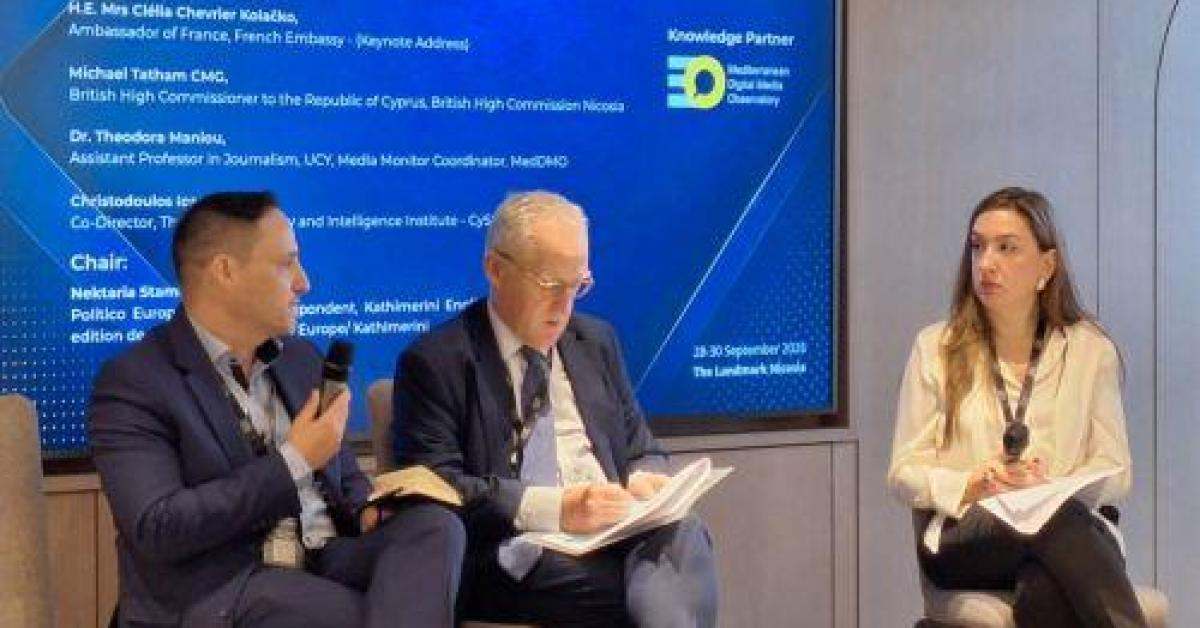
Disinformation Is Transnational Problem Requiring Transnational Response, Cyprus Forum Told
Disinformation is a transnational problem and requires a transnational response, British High Commissioner Michael Tatham said on Saturday, as he joined French Ambassador Clelia Chevrier Kolacko and Christodoulos Ioannou, co-founder of the Cyprus Security and Intelligence Institute (CySII), for a discussion on ‘Disinformation as a Democratic Security Threat: From Detection to Public Response’ at the Cyprus Forum in Nicosia. The session, one of the most anticipated events of the annual forum, brought together diplomats, security experts and members of the public to examine how democracies can defend themselves against a threat that increasingly permeates every aspect of the public sphere. Throughout the discussion, it was repeatedly underlined that disinformation poses a serious threat to democracy and that no country can confront it alone; rather, it must be tackled through sustained international cooperation. Tatham, who was the first to speak, set the tone by arguing that the problem is not confined to any single state or region, and that the response must therefore be equally global in scope. The discussion explored not only the mechanics of disinformation but also the political vulnerabilities that make societies susceptible to manipulation, and the practical steps that governments, institutions and citizens can take to build resilience against it.
The British High Commissioner said that there are three areas on which “we should focus” in order to “ensure that we are actually tackling the problem,” and he began by recalling that around ten years ago, the problem was only just beginning to be recognised and only a small number of people were addressing it. “We must acknowledge it and ensure that it forms part of the international agenda and is treated as a priority,” he said. This first point, he explained, is about moving disinformation from the margins to the centre of international political discourse, so that it receives the same attention as other transnational threats such as terrorism or organised crime. His second point concerned cooperation between states, and here he was particularly emphatic about the power of collective denunciation. “When we denounce disinformation by state actors, we are much stronger when we do so together,” he said. “This makes us a more difficult target for retaliation and, at the same time, reinforces the message.” The third point he highlighted was the development of international frameworks for cooperation, noting that many countries are already establishing governmental and intergovernmental mechanisms at the national level, but that similar work must also be carried out at the international level if the response is to be effective. Tatham then added a fourth element, which he described as support for countries facing disinformation campaigns. He cited the 2024 elections in Moldova as an example, describing the country as particularly vulnerable to Russian disinformation and noting that the United Kingdom and other countries had provided support to expose disinformation and counter attempts to interfere with democratic electoral processes. “The more countries with shared democratic values are willing to cooperate in this area, the better,” he said, adding that “we are more effective when democracies with shared values cooperate, share knowledge and take joint action.”
The French Ambassador, Clelia Chevrier Kolacko, then offered a detailed account of the French approach to tackling disinformation, which she said is a priority for France, just as it is for the European Union. She argued that raising public awareness of the threat is in itself a response to disinformation, and she warned that the phenomenon is a reality that affects even issues that may at first glance seem trivial, posing a threat to democracies and societies. “It therefore requires a strong, organised and collective response,” she said. The French approach, she explained, is based on four guiding principles: transparency, targeted action against inauthentic activities and holding perpetrators to account, responding with factual evidence, and upholding an ethical ‘red line’ by refraining from deliberately spreading false information, even when opponents employ such tactics. “The first response is, therefore, to recognise disinformation, expose it and trace it back to its country of origin,” she said. She detailed the institutional machinery that France has built since 2021, including a dedicated inter-ministerial unit that carries out monitoring and technical analysis, enabling authorities to take action and communicate effectively. She also said that a new department has been set up within the Ministry of Foreign Affairs, which has developed monitoring mechanisms across different time zones to ensure 24-hour surveillance. As a second measure, she noted that an account has been set up to address content that damages France’s image, with the aim of enabling an immediate response to cases of information manipulation, protecting France’s diplomatic initiatives in real time, and deterring those who now realise that their attacks may backfire. Another measure, she said, is the recording of events, and she highlighted as a fourth measure the effort to strengthen the resilience of the public and institutions through public information, media literacy in schools, and professional training for teachers, journalists and public officials. She also highlighted support for independent media, investigative journalism, documentaries and new forms of content, particularly those aimed at young people, emphasising that “journalists act as an antidote to the ‘pandemic’ of disinformation that threatens our democracies and permeates every aspect of the public sphere. That is why we support them.” She concluded by saying that all these measures have been consolidated into a French national strategy to combat information manipulation, with the aim of strengthening society’s resilience, regulating platforms and artificial intelligence, strengthening the state’s operational capacity, and cooperating with allies. In conclusion, she emphasised the importance of collective action by Europe and its allies in the face of threats and the manipulation of information.
Turning to the link between disinformation, the economic crisis, the pandemic and politics, Christodoulos Ioannou argued that there is a clear political dimension to the problem, as disinformation targets the political system and democratic structures. “It exploits political vulnerabilities in order to influence politicians through their electoral base,” he said, while also noting that disinformation can amplify marginal political voices that would otherwise have little traction. Ioannou, whose work at the Cyprus Security and Intelligence Institute focuses on the intersection of security and information, said that the economic crisis and the pandemic did not create the phenomenon of disinformation, but rather reinforced it and created fertile ground for its spread. He referred specifically to the period of vaccination during the pandemic, as well as to periods of economic crisis in Greece and Cyprus, during which “marginalised movements gained significant visibility by capitalising on social mistrust towards government and state structures.” His remarks suggested that disinformation is not merely a technical problem to be solved by better algorithms or fact-checking, but a deeply political phenomenon that thrives on grievance, mistrust and social division. By exploiting real societal fault lines, he argued, disinformation actors are able to deepen polarisation and undermine faith in democratic institutions. The political dimension is therefore central to understanding why disinformation spreads, and any effective response must take into account the underlying vulnerabilities that make citizens susceptible to manipulative narratives. Ioannou’s contribution added a valuable perspective to the discussion, moving beyond the institutional and diplomatic responses described by the British and French ambassadors to consider the social and psychological mechanisms that disinformation exploits.
Tatham returned to the theme of vulnerabilities when he responded to a question about the economic crisis and the pandemic, agreeing with Ioannou that both provided fertile ground for the spread of disinformation. He added that those spreading disinformation often seek to undermine national cohesion by exploiting issues that are already controversial or sensitive. As a prime example, he cited the pandemic, during which fears surrounding vaccinations were exploited and false information was spread about the effectiveness or risks of vaccines. He also pointed to migration as another classic issue used to create division, “where we see disinformation exaggerating the nature of the threat and exploiting people’s fears and concerns.” In a phrase that captured the broader challenge, Tatham said that “misinformation exploits our vulnerabilities,” and he argued that one aspect of the democratic response to this phenomenon is to identify and address these vulnerabilities, so as to limit the fertile ground for those who seek to spread disinformation. This observation tied together many of the threads of the discussion: disinformation is not simply a foreign threat, but a process that interacts with domestic social and political weaknesses. The British High Commissioner’s remarks suggested that building resilience requires not only international cooperation and institutional vigilance, but also a willingness to confront uncomfortable questions about social trust, inequality and the health of democratic discourse. By acknowledging that disinformation exploits real fears and concerns, rather than simply inventing them from nothing, Tatham pointed toward a more nuanced understanding of the problem, one that recognises the need to address the root causes as well as the symptoms.
The discussion at the Cyprus Forum made clear that disinformation is one of the defining democratic security threats of the digital age, and that the response must be as multifaceted as the threat itself. The British High Commissioner’s call for a transnational response, the French Ambassador’s detailed account of national and European mechanisms, and Ioannou’s emphasis on political vulnerabilities together painted a comprehensive picture of the challenge and the tools available to meet it. Tatham’s closing remarks, in which he stressed that democracies are more effective when they cooperate, share knowledge and take joint action, were echoed by Chevrier Kolacko’s insistence on the importance of collective action by Europe and its allies. Both diplomats were united in the view that disinformation cannot be countered by any single country alone, and that the defence of democratic institutions requires a coordinated, values-based approach. Ioannou’s contribution served as a reminder that institutional responses must be accompanied by a broader effort to rebuild trust and address the social divisions that disinformation exploits. As the session drew to a close, there was a clear sense of urgency, but also a sense of optimism, that the tools and strategies to counter disinformation exist, and that the international community, working together, can defend the democratic space against those who seek to undermine it. The Cyprus Forum, by providing a platform for such discussions, underlined the importance of continued dialogue and cooperation among democracies in the face of a threat that shows no signs of abating.