


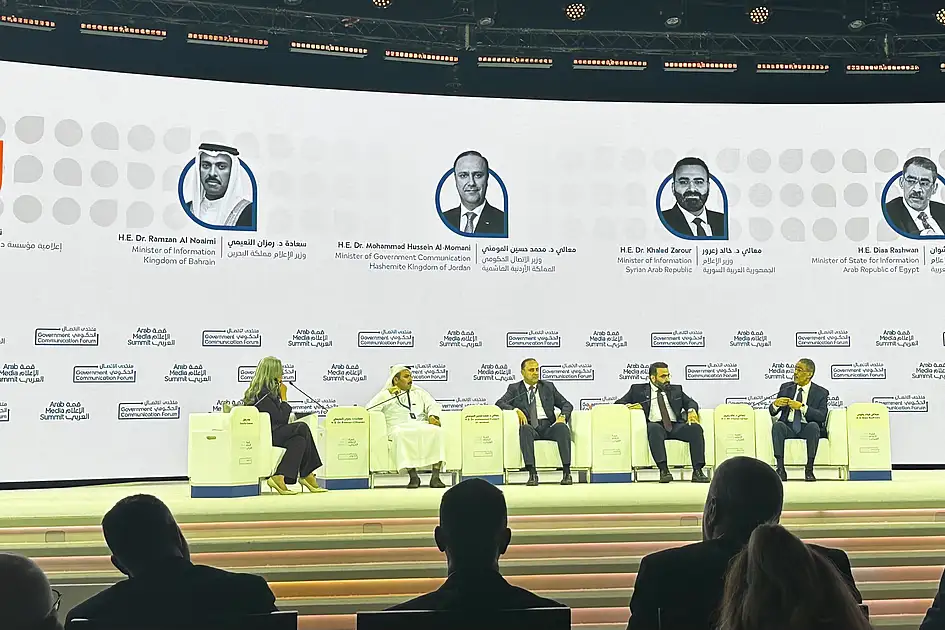
At the Arab Media Summit in Dubai, Bahrain’s Minister of Information, Ramzan Al Noaimi, warned that the recent wave of false reports that accompanied Iran’s attacks on the region had exposed how dangerously vulnerable the public can be to unverified information. Speaking at a ministers’ roundtable on the changing role of media, Al Noaimi said that people who lived through the attacks had seen first-hand how many false reports emerged at a time when accurate information was essential for personal safety. He said the experience highlighted a growing credibility gap between official media and some international platforms on which people had previously relied for news. Institutions that were present, prepared and organised to provide information were able, he argued, to strengthen public trust, while others appeared to be absent or caught off-balance by the speed of events. The Bahraini minister’s remarks were among the most direct at a session that was otherwise dominated by cautious institutional language, and they placed the problem of misinformation at the centre of the Arab media agenda. He argued that official sources cannot assume that their authority is enough. They must be visibly present, genuinely prepared and capable of responding quickly. The lesson was not that governments should impose a single version of events; it was that they must make their version convincing and useful to citizens who are bombarded by competing claims. In a digital environment where social media can amplify falsehoods within seconds, he said, the value of an official source rests in its accuracy, reliability and ability to remain calm under intense pressure. The summit, held in Dubai, brought together senior media executives, regulators, editors and policymakers from across the Arab world. The ministerial roundtable was designed to explore how governments and news organisations can respond to a media landscape in which audiences have moved away from conventional television and print outlets and toward social media feeds, messaging applications and digital news portals. Al Noaimi’s intervention set the tone for a debate that kept returning to the same question: in a moment of crisis, why do people trust some sources and not others? He said the answer lay not in technology but in the relationships that media organisations build with audiences long before a crisis begins. A broadcaster that has spent years reporting accurately is much more likely to be believed in an emergency than an outlet that has repeatedly been caught publicising false stories.
Al Noaimi said the credibility gap between official media and international platforms was not a natural feature of the information age, but the result of years of failing to adapt. People who turned to official channels and found them slow, invisible or repetitive gradually shifted to sources that appeared faster and more open, even if they were less reliable. The attacks, he said, revealed the consequences of that shift. Rumours and false reports spread through messaging groups and social media pages, causing confusion and alarm. Some audiences initially believed them because they had lost the habit of checking official sources. The crisis, however, also created a chance to reverse that trend. Institutions that had prepared in advance, and had journalists ready to verify and publish information, became essential points of reference. Their reporting carried weight because they had been present before, during and after the events. Al Noaimi did not name the countries or platforms involved in the false reporting, but his warning was clearly addressed to the entire regional media ecosystem. He said it was no longer enough for governments to have a news agency or a state channel; these institutions must be modern, dynamic and credible in the eyes of the public. They must also be allowed to do their work effectively. The minister’s remarks seemed to push back against the idea that official media is inherently less trustworthy. In his view, official media has a crucial role to play in moments of emergency, but it can only play that role if it is genuinely committed to journalistic quality. Otherwise, he warned, the public will continue to rely on unofficial sources, including those with no editorial standards at all.
Jordan’s Minister of Government Communication, Mohamed Hussein Al Momani, said building trust begins with providing information professionally, placing it in its correct context and explaining it properly. He argued that media institutions, including official, semi-official and private organisations, need sufficient space to carry out their journalistic work independently and to make editorial decisions themselves. These remarks were significant in a region where many governments exercise varying degrees of control over news outlets and where journalists often face restrictions. Al Momani did not call for deregulation, but he insisted that trust cannot be built solely through official statements or public relations campaigns. Journalists need room to verify facts, ask difficult questions and present information in a way that makes sense to audiences. He went on to warn of a growing “information chaos”, a phrase that captured the mixture of politically motivated propaganda, commercial clickbait, rumour and genuine error that now circulates online. He also spoke of “wars over narratives”, noting that regional conflicts are increasingly fought through hashtags and breaking news alerts as much as on battlefields. In that environment, he said, media organisations need to present their own narratives in convincing ways and through formats suited to different audiences. A single press release or a ministerial briefing is not enough. Official media must learn to tell stories that appeal to younger audiences, to answer questions directly, and to provide the context that turns raw information into understanding. Al Momani stressed that social media is now an essential part of how information is communicated, not an optional footnote. Governments can either engage with it seriously or leave the space to sources that are not accountable. He also noted that traditional official statements alone no longer reach people. The challenge is not only to produce good information but to ensure it reaches audiences in a form they trust and understand. This requires investment in digital skills, social media teams and journalists who are trained to explain complex policy issues in accessible language.
Syria’s Minister of Information, Khaled Al-Shaar, offered a perspective from a country that has experienced years of conflict, and whose media environment has been shaped by war, displacement and international isolation. He said his country was working to strengthen trust in its media sector, including by developing the legislative environment protecting media freedom. This was a carefully phrased comment, but it addressed a critical issue: legal frameworks can either support or undermine journalistic credibility. If rules are arbitrary and opaque, he suggested, the public will not trust the media. If institutions are protected and journalists can operate without fear of reprisal, confidence is likely to grow. Al-Shaar also said that speed alone cannot determine whether information is trusted. Credibility must accompany rapid communication. In an age of breaking news alerts, there is a temptation to publish first and correct later. But corrections cannot repair the damage caused by false information in a crisis. Journalists must therefore be trained to verify facts quickly and to explain their confidence in what they are reporting. He said official media has a responsibility not only to provide information but to explain it in its proper context. A raw report or a statement from a spokesman may be accurate, but it can still be misunderstood unless audiences are told what the events mean, what led to them and what consequences are likely. Al-Shaar said Syria was also working to develop specialised forms of journalism for areas such as economics, sport and politics. Generalist reporting, he argued, is no longer sufficient. Audiences want insight and expertise. The minister also addressed longstanding perceptions about Syria and its media, saying that changing these narratives was part of the broader transformation under way in the country. He did not offer specifics, but his comments suggested a recognition that official media cannot thrive on propaganda alone. It must earn trust through accuracy, context and professionalism. In his view, the transformation of the Syrian media sector must accompany the political transformation of the country. If people are to have confidence in the state, they must first have confidence in the information the state publishes.
Egypt’s Minister of State for Information, Diaa Rashwan, turned the discussion to the structural weaknesses that allow misinformation to flourish. He said that the weakness of traditional media in some Arab countries had allowed social media pages to take on a larger role in producing and circulating news. This was a particularly pointed remark coming from Egypt, where the state has built powerful media institutions but where independent voices have faced severe restrictions. Rashwan said the spread of false information is not simply a result of malicious actors; it is also a result of institutional absence. When established news outlets are hollow, marginalised or distrusted, people turn to whatever is available. Social media pages, often run by anonymous individuals or partisan groups, fill the vacuum and publish material that ranges from partially accurate reports to rumours and outright falsehoods. He did not advocate shutting down those platforms, but he said the only reliable solution is to strengthen traditional media and make it more attractive to audiences. That means investing in newsrooms, training journalists, ensuring that official outlets are not merely mouthpieces and allowing them to report the truth even when it is uncomfortable. The minister also discussed the role of government and media institutions during major crises, including wars and the Covid-19 pandemic. In both cases, he said, audiences turned increasingly to official sources for information because the consequences of relying on rumours were too severe. During the pandemic, a false health claim could cost lives; during a war, a false report about troop movements or damage could cause panic. Official media, he argued, should see these crises as opportunities to demonstrate their value. If they can provide clear, authoritative guidance in an emergency, the public will remember that when a new crisis arrives. The Egyptian minister’s remarks underscored a central theme of the session: misinformation is not a new species of information that can be killed with technical fixes; it is an old problem made worse by institutional decay. The solution lies in building stronger, more independent and more professional media, not in weakening them further.
The roundtable was held as part of a wider discussion at the Arab Media Summit on how media institutions can maintain public trust as audiences increasingly receive news through social media and digital platforms. The ministers did not arrive at a single strategy, but a clear consensus emerged: the credibility of official media must be built through transparency, professionalism and responsiveness. Participants acknowledged that this is easier to state than to achieve. Official media often operates under political constraints, and ministers themselves are part of governments that face criticism for their records on press freedom. Yet the tone of the session was remarkably open. The discussion also addressed practical steps media organisations can take. They must adopt clear editorial standards, verify information before publication, correct errors promptly and make transparent corrections that the public can see. They must understand how different communities consume news and develop content that works not only on traditional television but also on digital platforms, messaging apps and social networks. They must collaborate with fact-checkers and civil society groups and ensure their journalists have the skills to distinguish credible sources from dubious ones. They should also recognise that the public often distrusts official media not because of any single failure, but because of a long history of omissions and propaganda. Rebuilding that trust will take time. Al Noaimi’s account of the Iranian strikes showed just how quickly that trust can be exploited by false information. The challenge for the region’s information ministries, he suggested, is to make official media the first instinct of the public rather than the last resort. This is not a technological challenge but an institutional and cultural one. It requires leaders to accept that media credibility cannot be commanded from above. It grows from the bottom up, one story at a time, and it is sustained only by continued honesty. For governments that are used to controlling information, it demands a measure of openness that can be uncomfortable. But as the ministers acknowledged, in a world where no one is forced to watch the evening news, the only way to win an audience is to deserve it. The session ended with an implicit call to action. Information chaos will not end by decree. False reports will continue to circulate. The responsibility of official media is to be so reliable that the public knows where to turn when the next crisis breaks. In a time of war, pandemic and disinformation, that is not simply a professional ambition; it is a matter of public safety.