


By Savanna Craig, Staff Reporter
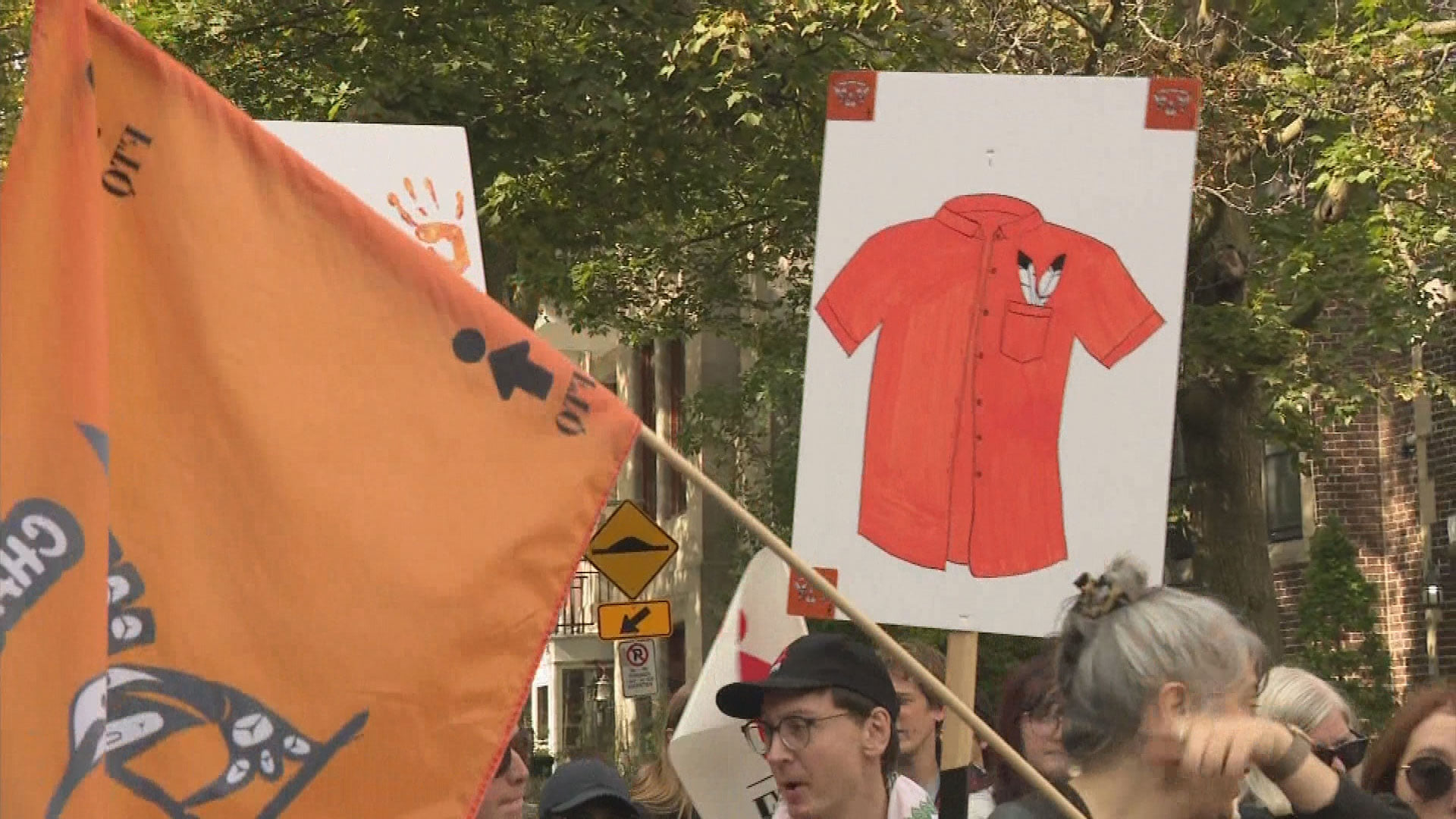
MONTREAL — Thousands of people filled the streets of downtown Montreal on the National Day for Truth and Reconciliation, their voices carrying a mixture of sorrow, anger, hope, and defiance. The annual march, which has become a cornerstone of the city’s observance of Sept. 30, took on particular weight this year as denialism about Canada’s residential school system continues to spread in various corners of the country. Participants walked under a sea of orange shirts and held signs bearing the names of missing children, the dates of unmarked grave discoveries, and messages demanding full implementation of the Truth and Reconciliation Commission’s Calls to Action. The atmosphere was heavy but determined, as survivors, Elders, Indigenous youth, and non-Indigenous allies moved together from the urban core toward a gathering space for speeches, drumming, and moments of quiet reflection. The march was not simply a ritual; it was a visible assertion that the truths of this country’s colonial history cannot be erased, revised, or minimized. As one organizer put it, “We are still here. We are still healing. And we will not let you forget what happened.”
The National Day for Truth and Reconciliation was established in response to one of the TRC’s 94 Calls to Action, which called for a federal holiday to commemorate the history and legacy of the residential school system. That system, which operated for more than a century, forcibly removed Indigenous children from their families and communities. At least 150,000 children were placed in these church-run, government-funded schools, where many suffered physical, sexual, and emotional abuse, malnutrition, neglect, and the loss of their languages and cultures. The federal government has acknowledged that at least 6,000 children died, though many survivors and researchers believe the true number is far higher. The discovery of unmarked graves at former school sites, beginning with the Kamloops Indian Residential School in 2021 and followed by Marieval, Cowessess, and others, horrified the country and reignited public demand for accountability. Yet instead of universal action, these discoveries also triggered a disturbing backlash. Denialism—rooted in conspiracy theories, revisionist history, and a refusal to accept overwhelming documentation and survivor testimony—has become a persistent undercurrent in public discourse. Online, in some political circles, and even in certain school board debates, voices have emerged claiming the residential school deaths were exaggerated or that the discoveries of unmarked graves are somehow fabricated. The Montreal march, in this context, was not only a remembrance but a counteraction against that wave of denial.
Attendees spoke passionately about why they felt compelled to march, and their words painted a picture of a movement that is both grieving and resolute. Marie-Cécile Nadeau, an Anishinaabe woman from Kitigan Zibi who now lives in Montreal, walked alongside her daughter and granddaughter. “My mother attended a residential school,” she said, her voice steady. “She never spoke about it for years. When she finally did, she cried like a child. So when I hear people say these things did not happen, I feel a rage I cannot describe. But I also feel hope because so many people are here today, standing with us.” Another marcher, a young non-Indigenous student named Thomas Gagnon, said he only learned the full history of residential schools after graduating high school. “That’s a problem,” he said. “I grew up in Quebec, and we barely talked about Indigenous history. I’m here today because I want the next generation to know the truth. I want to be an ally, not just in September but all year long.” A middle-aged woman holding a sign reading “I stand with survivors” said she had attended the march for the past three years, each time learning something new. “People talk about reconciliation like it’s a catchphrase,” she said. “But it’s a responsibility. It’s about listening, learning, and taking action.”
The march itself was a blend of ceremony and protest. It began with a pipe ceremony and prayer led by Indigenous Elders, who called on participants to remember the children who never came home. The crowd then moved through the streets, drums beating in a steady rhythm that seemed to echo the heartbeat of the earth. Along the route, people in vehicles honked in support, and some residents stood on balconies waving orange flags. At the endpoint, a large park had been transformed into a gathering space with teepees, information booths, and tables where survivors were available to speak with the public. Volunteers distributed orange ribbons and educational materials, while artists painted a large mural depicting Indigenous children being reclaimed by their ancestors. Organizers stressed that the march was just one part of the day’s events. “Reconciliation is not a one-day affair,” said Émilie Parent, one of the coordinators. “This is a time for reflection, but it must also be a time for action. We need clean drinking water in Indigenous communities. We need proper housing, health care, and education. We need to protect Indigenous women, girls, and Two-Spirit people. These are not separate issues. They are all connected to the legacy of residential schools.”
Several Indigenous leaders and survivors addressed the crowd, their words often bringing the gathering to hush. A survivor named Joseph Gray, who attended the Amos residential school in northern Quebec, spoke about the intergenerational impact of the system. “They tried to kill the Indian in the child,” he said. “But they could not do it. We are still here, but we are wounded. And our wounds are passed down to our children if we do not heal. We need your help to heal.” Another speaker, a young Mohawk woman from Kahnawà:ke, challenged the crowd to move beyond symbolic gestures. “Wearing an orange shirt is not enough,” she said. “I want to see your votes, your donations, your time. I want to see land back in the hands of Indigenous nations. I want to see clean water. I want to see our missing children found and honoured. That is reconciliation.” Federal and provincial politicians were also in attendance, though some were met with mixed reactions. While many marchers appreciated their presence, others were critical, pointing out that government action has lagged far behind rhetoric. The TRC’s Calls to Action, most notably the ones dealing with child welfare, missing children, and the United Nations Declaration on the Rights of Indigenous Peoples, remain largely unfulfilled. Activists reminded the crowd that hundreds of residential school survivors died without seeing any meaningful accountability.
As the afternoon wore on, the mood remained resolute. The march drew people of all ages, backgrounds, and beliefs, united in a shared commitment to truth and justice. For many, the presence of denialism made the day’s message even more urgent. “Denialism is a form of violence,” said one attendee, a professor of Indigenous studies at McGill University who asked not to be named. “It retraumatizes survivors and their families. It dismisses their pain. It attempts to erase the evidence. So when we say we remember, we are also saying that the truth exists, and it cannot be changed.” Another participant, an Inuit woman originally from Nunavik, noted that the conversation around residential schools has expanded in recent years to include other forms of colonial oppression, including the Sixties Scoop, forced sterilization, and the ongoing child welfare system that continues to remove Indigenous children at alarming rates. “The residential school system did not end in 1996,” she said. “It changed its form. We still have children being taken from their families. We still have communities struggling. The work is not done.” Her words were met with applause, a reminder that the movement is not trapped in the past, but firmly focused on the future.
By the end of the day, as the sun began to set over Montreal, the marchers had dispersed, but the energy and commitment they carried with them lingered in the air. The annual march is more than a moment of collective memory; it is a call to action that does not end when the crowds go home. Survivors and their families continue to need support, communities continue to need resources, and the public continues to need education. The fight against denialism, too, is an ongoing one. It requires every Canadian to confront uncomfortable truths, to challenge false narratives, and to recognize that reconciliation is not a concession but a responsibility. As one young woman at the march put it, “I am not here because of guilt. I am here because justice matters. And I will keep showing up until we see real change.” That sentiment seemed to capture the spirit of the day. Montreal’s streets may have returned to their usual bustle the next morning, but the echoes of drums, prayers, and determined voices remain. The path to reconciliation is long, and it is not linear. But days like this one, filled with grief and hope in equal measure, prove that there is a collective will to walk it together—one step, one truth, one act of solidarity at a time. The children who never came home will not be forgotten, and the promise that reconciliation is not just possible but necessary lives on in the hearts of all those who marched.