


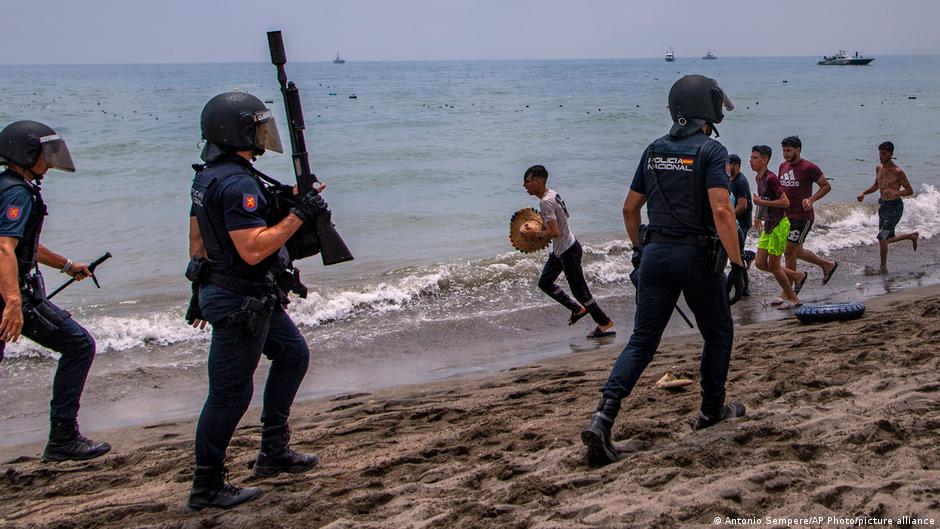
In late July, a catastrophic humanitarian crisis unfolded at the border of Spain’s North African exclave of Ceuta, where tens of thousands of individuals attempted to cross from Morocco. The surge resulted in dozens of tragic drownings and crowd-related fatalities, sparking intense international scrutiny. European, Spanish, and Moroccan officials have largely attributed this unprecedented movement to a wave of misinformation circulating on social media, exacerbated by the activities of human trafficking networks.
The catalyst for the disinformation appears to be a distorted interpretation of a recent Spanish Supreme Court ruling. Several weeks prior to the crisis, the Court determined that migrants arriving by sea are not subject to the same “fast-track” deportation procedures as those intercepted while breaching official land border infrastructure, such as fences. This ruling, while limited in its legal scope, was misrepresented online as a “historic” decision that allegedly granted irregular migrants an automatic right to stay in Spain, creating a perception of an open-border policy.
Fact-checkers have confirmed that these social media claims are profoundly misleading. The Supreme Court ruling does not provide a blanket ban on deportations; rather, it mandates that migrants arriving by sea must be processed individually to ensure procedural legal guarantees, distinguishing them from those intercepted at physical barriers. The decision actually allows the Spanish government to install new physical barriers at sea—a measure Madrid has since implemented to close the perceived legal loophole—refuting the online narrative that deportations have been rendered impossible.
The spread of this misinformation was systematic, with numerous accounts on platforms like Facebook, Telegram, and TikTok sharing near-identical, deceptive narratives. Many posts stripped the ruling of its legal context, with some influencers explicitly claiming that the Spanish navy was now forbidden from returning anyone who reached the coast by swimming. By omitting the necessity of individual legal processing and focusing solely on the restriction of immediate returns, these digital actors successfully convinced thousands that a legal gateway to residency had been opened.
Despite the impact of these online falsehoods, experts suggest that social media alone cannot account for the massive scale of the crisis. Lorenzo Piccoli, a professor of migration governance, noted that the movement of tens of thousands of people in such a concentrated timeframe is historically anomalous and suggests a level of logistical coordination or a deliberate lack of intervention by authorities. While online claims may have served as a trigger, they fail to explain the sheer volume of individuals reaching the border simultaneously, fueling suspicion that the crisis was facilitated by geopolitical friction.
Ultimately, the event has become a flashpoint for political tensions between Madrid and Rabat. While Spanish leadership has criticized the exploitation of misinformation by trafficking networks, the incident has also invited questions regarding Morocco’s role in border enforcement. Analysts conclude that even if the Moroccan government did not explicitly manufacture the movement, its failure to prevent the mass gathering indicates a strategic allowance of the chaos, highlighting how vulnerable migration patterns are to both coordinated disinformation campaigns and geopolitical maneuvering.