


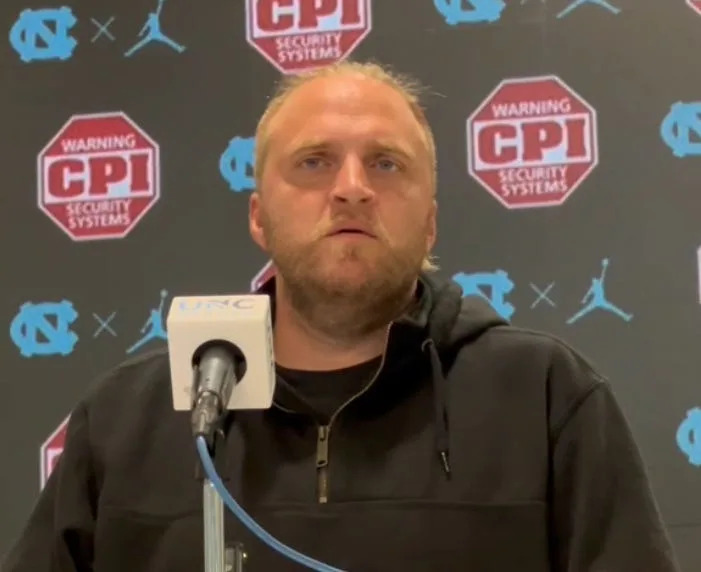
Steve Belichick Resigns at North Carolina Amid Investigation; Tar Heels Face Clemson in Wake of Turmoil
Another day, another seismic development in Chapel Hill. The North Carolina Tar Heels football program, already reeling from the public revelation of an investigation into off-field misconduct and the resignation of its general manager, saw defensive coordinator Steve Belichick resign Thursday. Belichick had been on medical leave since Aug. 6, and he did not coach the Tar Heels through their first two games. The announcement came via ESPN’s Field Yates, who shared a statement from Jen Belichick, Steve’s wife. In the statement, Jen expressed gratitude for the family’s time in Chapel Hill and said they are proud of the influence they have had on the positive direction of the program. She noted that their priority will always be “to show up with a healthy and strong mind for ourselves and our 5 children.” She said there is misinformation and speculation about their own situation, but that prioritizing health is the most important thing you can do in life, and she strongly encouraged anyone in need of support to use their resources. The statement closed with a notable show of family loyalty: “We will always be Uncle Brian and Pop’s biggest supporters and have no doubt that the UNC defense is prepared to ball out. GO HEELS.” That reference to “Uncle Brian and Pop” was a rare public acknowledgment of the family web that has made the UNC staff unlike any other in college football. Brian Belichick, another of Bill Belichick’s sons, is also on the coaching staff. The resignation comes at a precarious moment for the Tar Heels, who are 2-0 and preparing to play Clemson on Saturday. Yet for all the positive momentum built by wins over TCU and Charlotte, the off-field situation is threatening to define their season. Steve’s departure means Bill Belichick must now face one of the most important games of the new era without one of his most trusted assistants.
Steve Belichick’s path to UNC was unconventional but made perfect sense in the context of the Belichick family. He spent years in the NFL under his father with the New England Patriots, eventually earning a reputation as a sharp, meticulous defensive assistant and playcaller. When Bill Belichick made the stunning decision to leave the NFL for the college game, Steve was one of the first people he wanted by his side. The program hired him as defensive coordinator, giving UNC one of the most intrinsically connected coaching relationships in the sport: a father and son working together to translate NFL concepts to the college level. Steve’s presence was seen as a major asset in recruiting and in installing the kind of pro-style defense that Bill Belichick has always preferred. His medical leave, announced just before the season began, was unexplained, and his subsequent resignation has left the Tar Heels to adjust their defensive staff in real time. The official line is that health is the priority, and there is no reason to doubt that. But in a program already under investigation for drug use, sexual misconduct and recruiting violations, every personnel move is viewed through a prism of suspicion. No one has publicly accused Steve Belichick of wrongdoing, and his wife’s statement is careful to say that the family is leaving for personal reasons. Still, the optics are difficult for UNC. It loses its defensive playcaller just as it enters the teeth of ACC play, and the explanation offered is necessarily vague because of the private nature of health decisions. The result is a vacuum of information that speculation will inevitably fill. Beyond game day, the loss of a Belichick on the recruiting trail could affect the program’s ability to sell defensive prospects on the NFL-style system. The remaining defensive staff will have to learn on the fly, because in college football, midseason staff changes can be devastating as players are still developing their understanding of the scheme.
The larger context is the investigation that has been hanging over the Tar Heels since before the season. A bombshell report, published in the weeks before Steve Belichick’s decision, revealed that the program is being examined for a range of alleged off-field activities, including drug use, sexual misconduct and recruiting violations. Those are extremely serious accusations. A program under NCAA investigation for recruiting violations faces potential scholarship reductions, postseason bans, and a stained reputation that can take a decade to repair. The probe has already claimed the general manager, whose resignation was one of the first indicators that the situation was more than just a minor compliance issue. The timing of the general manager’s departure, followed by Steve Belichick’s resignation, suggests that the findings may have implications far beyond the front office. NCAA investigations and university probes of this nature can take months, if not years, to complete, and they often spawn secondary investigations into whether coaches fostered a culture that allowed misconduct to happen. Because Bill Belichick is the head coach and the face of the program, scrutiny naturally falls on him. The original report did not reveal evidence directly linking him to the alleged misconduct, but the contractual structure of his deal has become a focal point. According to reports, his contract makes him responsible for every aspect of the football program. That includes the behavior of staff members, the recruiting process, and the overall workplace environment. If the probe uncovers violations that occurred under his watch, the university could potentially move to terminate him with cause. The immediate consequence is a continued cycle of rumor and counter-rumor that consumes the program’s public narrative, making it difficult for anyone on the staff to focus on football.
Bill Belichick’s contract, and the question of whether he could be dismissed with cause, is one of the most consequential issues in this entire drama. Details of the contract had already raised eyebrows when he was hired, because it handed him an extraordinary level of authority. He was hired not just as a coach but also as a de facto general manager, overseeing recruiting and football operations in a manner that resembles his NFL model. That control cuts both ways. If problems arise anywhere in the football program, the contract reportedly makes it hard for Belichick to deny responsibility. The legal concept of “with cause” termination is critical because it affects a coach’s financial package and reputation. A coach fired for cause typically forfeits guaranteed compensation, which in Belichick’s case could be enormous. But it also has a public meaning: it would effectively announce that the university found him personally culpable in some way. No one in the program is prepared to say that at this point. The investigation is still ongoing, and Steve Belichick’s resignation is not an admission of anything. It may be the result of a genuine medical issue, a reaction to the stress of the investigation, or simply a family deciding to step away from a situation that has become too toxic. But the combination of events has put Bill Belichick in an impossible position. He has to prepare for Clemson, replace two key staffers, rebuild trust with recruits and parents, and answer questions from the media about a topic he clearly dislikes: matters outside the white lines. There is also a personal dimension that the contract cannot capture. This is his son. Whatever the cause of Steve’s resignation, Bill is losing a trusted coordinator and a daily presence in the building at the same time. The great irony is that Bill Belichick has spent his entire career avoiding distractions and controlling the message. Now he finds himself at the center of a story he cannot control, with his own family’s name in the headlines.
On the field, the Tar Heels have been better than many expected. North Carolina enters the Clemson game with a 2-0 record after an upset victory over TCU in Week 0. The defense, despite the absence of Steve Belichick, has shown flashes of the discipline and execution that Bill Belichick is known for. The players have publicly said the right things, focusing on their preparation and ignoring the outside noise. But the noise is about to get much louder, because Clemson is not just another opponent. The Tigers are a perennial powerhouse, and they represent exactly the kind of challenge that could expose the effects of coaching turmoil. Clemson’s coaching staff has no doubt been watching the UNC news, and they may try to use the uncertainty against the Tar Heels by creating pre-snap confusion or attacking communication within the defense. If UNC struggles to get the defensive calls in on time, or if communication breaks down in critical moments, people will point to Steve Belichick’s absence. If the Tar Heels win, it will be a testament to the coaching staff’s depth and the program’s resilience. Saturday’s noon kickoff at Kenan Stadium is, in effect, the first real test of whether the Belichick project can succeed in college football under the weight of off-field chaos. Bill Belichick has repeatedly said that he did not come to North Carolina to simply field a competitive team; he came to build a program that could contend for championships. The next few games will determine whether that ambition is still realistic. Football teams are like families in many ways, and when a family member disappears, the whole unit shifts. The Tar Heels have had to shift quickly, and the Clemson game will show just how much disruption the defense can absorb.
Jen Belichick’s statement may offer the clearest explanation of what is happening behind the scenes. “Unfortunately there is misinformation and speculation about our own situation, but we believe prioritizing health as the most important thing you can do in this life and is invaluable compared to anything else,” she wrote. That is not the language of a family simply going through the motions. It is the language of people who feel that their well-being is at stake. Steve Belichick’s resignation, coming after a period of medical leave and in the middle of a program-wide investigation, has all the hallmarks of a difficult personal decision made to protect his family. It may also be the first sign that the pressure of coaching under his father, in a program with more questions than answers, took a real toll. Whatever the cause, UNC must move forward and do so quickly. The remaining staff, including Brian Belichick and other defensive assistants, will have to step up. The university administration will continue to monitor the investigation. The media will keep asking questions. And the players, who just want to play football, will have to tune out everything else for a few hours on Saturday. The Belichick era at North Carolina was always going to be a bold experiment with all the associated risk. Now it has become a test of survival. With Clemson on the schedule, the Tar Heels have an opportunity to prove that they are still capable of focusing on football. But the resignation of Steve Belichick is a reminder that off-field issues can change the trajectory of a season in an instant. Whether this is the beginning of a collapse or the hardest part of a recovery is entirely unclear. The program’s long-term future depends on the investigation, the decisions of the university administration, and the ability of a 70-year-old coaching legend to adapt to a new world without the support of one of his closest allies. For now, the Tar Heels are still 2-0, and they have a game to play.