


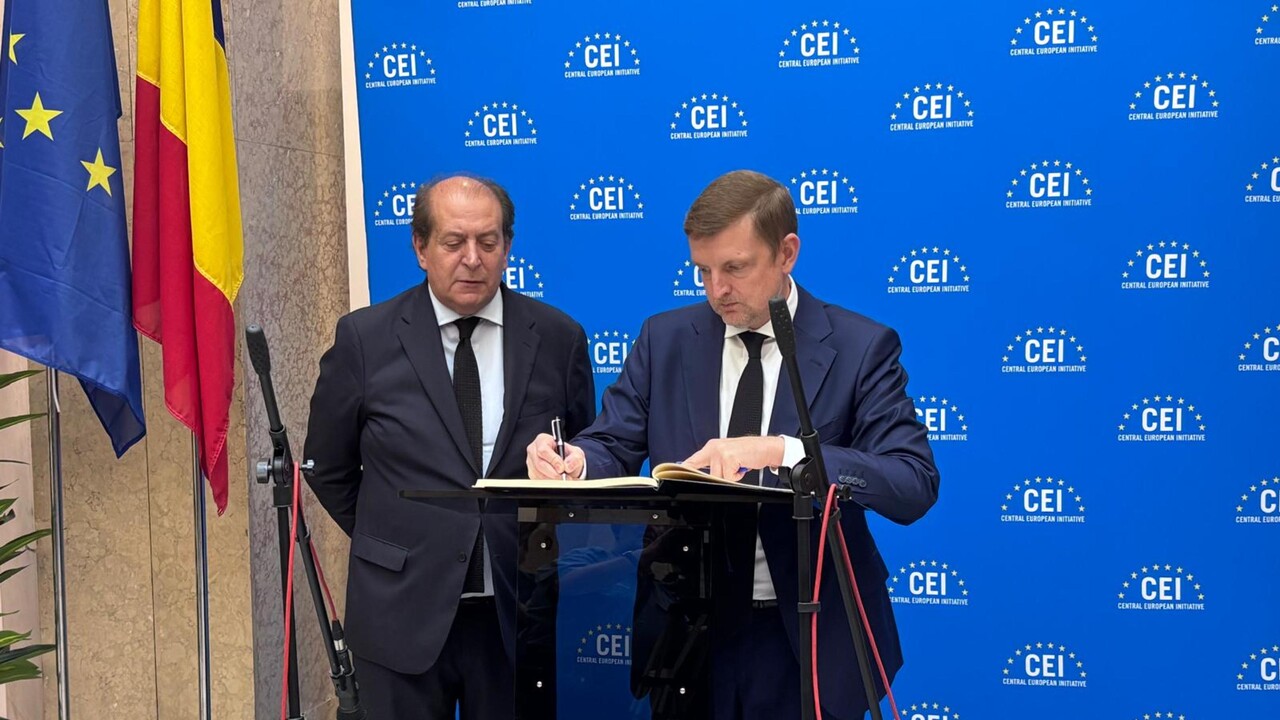
Ukraine’s Ambassador to Italy Warns Russia Seeks to ‘Tear Europe Apart from Within’ – AI-Powered Disinformation and Political Funding Threaten Upcoming EU Elections
TRIESTE – In a stark warning delivered at the Central European Initiative (CEI) General Secretariat headquarters in Trieste, Ukraine’s Ambassador to Italy, Ihor Brusylo, declared that Russia’s ambitions extend far beyond the conquest of Ukrainian territory. According to the ambassador, Moscow’s strategic calculus includes a deliberate plan to destabilize the European Union from the inside, exploiting perceived weak links and sowing discord among member states. “Russia also views the EU as a weak link,” said Brusylo, “and attacking Ukraine was not Russia’s only goal; another goal was to cause Europe to explode—to tear it apart from within.” The remarks come at a critical juncture, as multiple European nations prepare for pivotal electoral contests, and as the EU grapples with a unified response to the ongoing war in Ukraine. Brusylo’s statement underscores a growing concern among Eastern European diplomats that the Kremlin has shifted its hybrid warfare tactics from mere influence operations to active subversion of democratic processes across the continent.
The ambassador’s warning is particularly resonant given the geopolitical context. The CEI, an intergovernmental forum that includes Italy, Ukraine, and a number of Central and Eastern European states, has long been a platform for dialogue on regional stability. By choosing this venue, Brusylo aimed to highlight the shared vulnerability of European nations, both within and outside the EU. He stressed that the threat is not abstract but immediate, especially with the approaching electoral cycles in Italy, Poland, Spain, and France. “We must work together to provide a more concrete response to what is happening. As elections in Italy, Poland, Spain, and France approach, disinformation will spread even more. They will certainly do this using hybrid threats, subversive activities, and the entire arsenal at their disposal,” he added. His comments align with existing intelligence assessments from several European security services, which have reported a surge in pro-Russian propaganda, fake news websites, and coordinated social media campaigns designed to amplify social divisions, undermine trust in democratic institutions, and influence voter behavior.
Brusylo’s address went beyond general warnings, directly addressing a pernicious aspect of Russian interference: financial involvement with political parties. When questioned by journalists about whether Russia would intervene by funding specific parties, the ambassador gave a direct and unequivocal response: “I believe so.” He explained that Moscow rarely acts openly, preferring to operate through proxies and networks of influence. “They will keep doing it. They never act directly; instead, they use connections between various political parties, including this one. It’s a serious threat—one that you, too, should be more aware of.” This statement, delivered with emphasis, points to a sophisticated strategy of covert support for pro-Russian, anti-establishment, and Eurosceptic factions across Europe. Such funding might be channeled through obscure business deals, non-governmental organizations, or hidden bank accounts, making detection difficult. The ambassador’s willingness to name the risk in Trieste is seen as a deliberate attempt to put European citizens and politicians on alert before the upcoming electoral battles, which he warns will be a primary target for Moscow’s destabilization apparatus.
The broader implications of these assertions are significant for European security and governance. Over the past decade, several countries have already investigated suspected Russian interference. From the 2016 US presidential election to the Brexit referendum, intelligence agencies have documented attempts to manipulate public opinion via cyber-attacks, social media bots, and the selective leaking of sensitive information. More recently, European nations have exposed spy rings and foiled plots to assassinate defectors or disrupt critical infrastructure. However, the prospect of direct funding of political parties is considered an even more insidious threat, as it strikes at the heart of political legitimacy. If a political party is secretly subsidized by a foreign power, its elected representatives may owe allegiance to a hostile actor, thereby compromising national sovereignty. Moreover, the ambassador’s claim that Russia “never acts directly” underscores the difficulty of proving such interference, as funding is often laundered through a complex web of shell companies and intermediaries in third countries.
This warning arrives at a time when the European Union is already intensely divided over several issues, including migration, fiscal policy, and the extent of sanctions on Russia. The war in Ukraine has strained resources and created an energy crisis that has fueled inflation and public discontent. The Kremlin, by all accounts, intends to exploit these divisions. Italy, with its changeable political landscape, is particularly exposed. A recent election cycle saw the rise of a right-wing coalition led by Giorgia Meloni, who, despite her initial reputation for Euroscepticism, has so far maintained a tough line on Russia. Yet, other parties within the coalition have historically expressed sympathies toward Moscow. Similarly, France has seen the dramatic ascent of the far-right led by Marine Le Pen, who has previously acknowledged receiving loans from Russian entities. Spain, dealing with separatist tensions, and Poland, facing a rule-of-law dispute with the EU, are also fertile ground for disinformation campaigns. Brusylo’s reference to “including this one” – likely referring to a party in Italy – suggests that researchers and security services already have evidence of such connections, but lack the legal tools or political will to expose them fully.
In response to these mounting threats, the ambassador called for a collaborative and concrete counter-strategy. He emphasized that the CEI, as a forum connecting EU and non-EU countries, could serve as a linchpin for sharing intelligence and best practices. However, he also implied that the EU itself must strengthen its resilience, potentially by creating new legal frameworks to penalize foreign interference and by stepping up support for independent media and fact-checking organizations. The role of social media platforms in curbing fake accounts and coordinated inauthentic behavior is also crucial. The upcoming elections in Italy, Poland, Spain, and France will be a banner test. Voters must be equipped to discern truth from fabricated narratives, and political leaders must reject any support, financial or otherwise, that comes with strings attached to foreign hostile powers. Brusylo’s speech in Trieste was a wake-up call — a reminder that while Ukraine fights a hot war on the front lines, the entire European continent is a battleground for a different kind of aggression, one that targets the very fabric of democratic society. The ambassador’s concluding words, urging greater awareness, resonate deeply in a geopolitical environment where the lines between war and peace, politics and espionage, are increasingly blurred.