


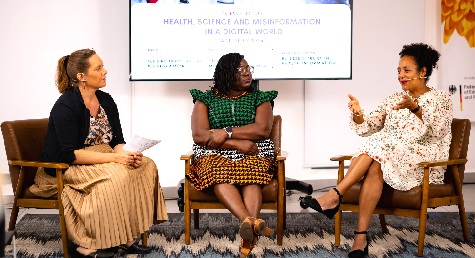
ACCRA — Experts from Ghana and Germany have called for a decisive strengthening of science journalism and the promotion of clear, accessible communication of scientific evidence to counter the growing spread of misinformation in the digital world. Speaking at a science lecture organised by the DAAD (German Academic Exchange Service) Regional Office in Accra on October 15, 2026, they warned that the increasing influence of social media algorithms, which often amplify sensational and emotionally charged content, now poses a serious threat to public trust in science and, in particular, to evidence-based medicine. The lecture, held under the theme “Fact or Fiction? Health, Science and Misinformation in a Digital World,” brought together researchers, medical experts, journalists and students to examine the scale of the disinformation challenge and to explore practical ways of strengthening public understanding of science and health-related issues. The event also sought to clarify the role of international cooperation in addressing health misinformation and in building stronger scientific capacity across countries, especially in regions where digital platforms have rapidly become the primary source of health information for many citizens. The gathering in Accra reflected a growing awareness among scientific institutions that the battle against misinformation cannot be won through laboratory research alone; it requires a coordinated effort to translate complex scientific findings into language that ordinary people can understand and trust.
The experts’ call comes at a time when the global information ecosystem has become deeply fragmented and, in many cases, hostile to scientific consensus. Digital platforms, driven by engagement-based algorithms, often reward content that provokes anger, fear or outrage, and this dynamic has been particularly damaging in the field of public health. During recent global health emergencies, false narratives about the origins of diseases, the efficacy of vaccines, and the safety of preventative measures have spread with alarming speed, frequently outpacing the efforts of scientists and public health authorities to correct them. The phenomenon, sometimes described as an “infodemic,” has led to vaccine hesitancy, resistance to public health guidelines, and a general erosion of confidence in medical institutions. In Ghana, as in many other countries, misinformation has circulated not only on mainstream social media platforms but also through encrypted messaging applications, making it difficult for officials to monitor or counter false claims in a timely manner. The experts at the Accra lecture noted that the consequences of this misinformation are not merely abstract concerns; they can mean the difference between patients seeking timely treatment and relying on dangerous home remedies, between communities accepting vaccination and remaining vulnerable to outbreaks, and between governments implementing evidence-based policies and succumbing to political pressure. This is why, they argued, the promotion of accurate, compelling and culturally relevant science communication must no longer be seen as a secondary activity or a desirable extra, but rather as a core component of public health infrastructure.
During the lecture, a panel debate was organised to address the respective responsibilities of governments, physicians and society at large in tackling falsehoods circulating through digital platforms. The discussion acknowledged that no single actor can solve the problem alone, and that a multi-layered approach is needed. Governments, the panellists said, have a duty to invest in independent public broadcasting, support regulatory frameworks that hold digital platforms accountable for harmful misinformation, and ensure that health agencies are equipped with trained communicators who can respond quickly and accurately to viral falsehoods. Physicians and other health professionals, in turn, have a responsibility to engage with their patients and communities beyond the confines of clinics and hospitals, using both traditional media and digital channels to share reliable information and to challenge misconceptions in an empathetic manner. Civil society organisations, religious leaders, teachers and community influencers also have an important role to play, as they are often trusted figures whose voices can break through the noise of algorithm-driven content. Importantly, the participants agreed that sustained cooperation between countries is necessary to address emerging health threats and to ensure that reliable scientific evidence informs public understanding and policy decisions. They mentioned an ongoing German-Ghanaian collaboration in virus research and pandemic prevention as one example of partnerships that could contribute to improved public health preparedness, particularly in the detection and tracking of emerging pathogens and in the development of local capacities for rapid response. This collaboration, they suggested, could be adapted and expanded to include communication and journalism components, so that the science generated by such partnerships reaches the public in a form that is both accurate and meaningful.
A key voice at the event was Prof. Marylyn Addo, a professor at the University Medical Centre Hamburg-Eppendorf in Germany, who spoke in detail about the dangers of algorithm-driven misinformation. She explained how digital platforms are designed to prioritise content that captures attention, often by appealing to emotions such as anger, fear and indignation, rather than content that is factually accurate but cognitively demanding. This design, she argued, creates an environment in which false or misleading health claims can go viral in a matter of hours, while carefully researched scientific data struggles to gain traction. Prof. Addo emphasised that this algorithmic reality must be understood by the scientific community, which has traditionally relied on peer-reviewed journals and conference presentations as its primary channels of communication. The public, however, does not consume information in this way, and so scientists must adapt their methods if they want to be heard. She called for stronger independent science journalism, describing it as a critical safeguard for democracy and public health. In this regard, she said, it is essential for journalists and researchers to work together on a regular basis, with journalists learning to interpret scientific studies critically and researchers learning to communicate their findings in clear, accessible and engaging language. Complex information such as the mechanics of vaccine development, the epidemiology of infectious diseases, or the statistical interpretation of clinical trials could and should be explained through compelling narratives and visuals that make these topics less intimidating for lay audiences. Prof. Addo added that effective science communication is also essential to rebuilding public confidence in scientific institutions, which in many countries has been weakened by years of polarised debates and deliberate disinformation campaigns. When people understand not only what scientists know but also how they know it, and when they hear from credible voices with honesty and humility, they are far more likely to make informed decisions about their own health and to support evidence-based policies that protect the wider community.
A complementary Ghanaian perspective was offered by Prof. Lydia Mosi, a professor at the University of Ghana, who stressed the importance of community-based research and collaboration with local actors in promoting trust in scientific evidence. Prof. Mosi argued that the credibility of science is not simply a matter of the quality of laboratory data; it is also shaped by the relationships that researchers build with the communities they serve. She emphasised the need to engage communities directly in the research process, rather than treating them as passive subjects from whom samples are collected and to whom findings are later distributed. One important way to do this, she said, is to work with local stakeholders, including traditional healers, religious leaders, teachers, and community health volunteers. These individuals often exert far greater influence over everyday health decisions than institutional scientists do, particularly in rural areas where access to formal health services may be limited. By inviting them into a respectful dialogue, researchers can begin to bridge the gap between scientific knowledge and community practices, and this can lead to more effective prevention strategies, better diagnoses, and higher acceptance of evidence-based medicine. Prof. Mosi noted that such collaboration is not about simply replacing one form of authority with another; rather, it is about building a shared foundation of understanding and trust. She also pointed out that health communication must be responsive to local contexts and concerns. This means using local languages, acknowledging cultural beliefs, and addressing the specific anxieties that people may have, whether these relate to the safety of vaccines, the side effects of treatment, or the wider social and economic circumstances that shape their health. For example, a national vaccination campaign that is informed by an understanding of why some communities hesitate will be far more effective than one that simply repeats generic slogans from the capital city. The same principle applies to public health alerts, which should be designed in ways that can be understood and acted upon by people with varying levels of formal education and with differing levels of access to technology.
Taken together, the messages from the Accra lecture point to a clear and urgent agenda for the coming years. First, there is an obvious need for investment in independent science journalism, including dedicated training programmes, fellowships and newsroom resources for reporters who specialise in health and science topics. Such investment would strengthen the capacity of media organisations to verify claims, expose falsehoods, and contextualise scientific developments in ways that are useful to the public. Second, universities and research institutions should make science communication a more prominent part of their mission, rewarding researchers for public engagement and providing them with the skills and support they need to communicate effectively. Third, governments and international bodies should recognise the importance of global cooperation in this area, since misinformation does not respect national borders, and regional collaborations such as the one between Germany and Ghana can serve as models for other partnerships. Fourth, social media companies must be encouraged to reconsider the ways in which their algorithms are designed and deployed, and to take greater responsibility for the public health and safety of their users. Finally, the voices of local communities and trusted intermediaries must be placed at the centre of communication strategies, ensuring that the response to misinformation is not a top-down monologue but a genuine conversation among equals. The experts who gathered in Accra were united in their conviction that the future of public health in a digital age depends not only on new discoveries and technologies, but also on a shared commitment to truth, transparency and mutual understanding. Governments, physicians, journalists and ordinary citizens all have a part to play in creating an information environment where reliable scientific evidence can compete fairly with fiction. By working together across borders and across sectors, they can build a more resilient society, one in which fact can indeed overcome fiction in the battle for hearts, minds and, ultimately, for the health of communities around the world.