


# EU Is Not Pressuring Ukraine to Conscript Women, Officials and Counter-Disinformation Centre Say
In recent weeks, social media users on X and Russian-language Telegram channels have been circulating a claim that the European Union is demanding Ukraine forcibly mobilise women to fight Russia’s invasion. The allegation is false, according to the Ukrainian Center for Countering Disinformation, a working body of the National Security and Defence Council of Ukraine. The claim originated from Russia’s Foreign Intelligence Agency, the SVR, which asserted without evidence that Brussels is pressuring Kyiv to conscript women. The same propaganda push also falsely attributed a statement to EU foreign policy chief Kaja Kallas, claiming she had called the hypothetical measure “a step in the right direction.” No such quote exists in any official EU source, and no reputable news outlet has reported that Brussels has made any such demand. The center has explicitly warned that pro-Russian propagandists are attempting to encourage the idea that Western media are pushing for female conscription in Ukraine, as part of a broader disinformation campaign aimed at damaging trust between Kyiv and its Western allies. The EU has repeatedly supported Ukraine’s sovereignty, and there is no evidence that European officials are attempting to dictate the details of Ukraine’s military mobilisation policy. On the contrary, EU officials have said that decisions about how to staff Ukraine’s armed forces must be made by Ukraine itself. The false narrative comes at a sensitive moment in the war, as Ukraine continues to face pressure on the battlefield and questions about its manpower. By inventing an EU demand, Moscow appears to be trying to portray the EU as an overbearing external actor, undermining the narrative of Western support. The SVR claim, amplified by social media, is part of a pattern of Russian information operations that have repeatedly used false quotes, fabricated news stories and manipulated genuine reporting to advance Kremlin interests. While social media users may have shared the claim sincerely, its origins are squarely in Russian state organs, and the evidence to support it is nonexistent.
The mechanism of the disinformation operation follows a familiar Russian pattern. The SVR issued a statement claiming that the EU was putting pressure on Kyiv to introduce compulsory military service for women. The claim was then picked up by Russian-language Telegram channels and cross-posted on X, where it quickly gained traction. The Center for Countering Disinformation, which monitors and exposes such narratives, said that the story was wholly invented. It noted that pro-Russian propagandists had simultaneously spread a second false claim: that Western media had launched a coordinated campaign in support of mobilising Ukrainian women. That component appears to have been built around a genuine article published by The Telegraph, which examined the experiences of women serving in Ukraine’s armed forces. Russian propaganda channels presented The Telegraph’s coverage as evidence of a Western plot. But the article did not advocate for female conscription. It included the personal view of one drone operator, identified as Katya, who said she found Israel’s conscription of both sexes inspiring and would like to see the same implemented in Ukraine. That sentiment is a single individual’s opinion, not a policy proposal by the newspaper, and still less a demand by the EU. The Center for Countering Disinformation has warned that Russian propagandists are deliberately distorting the article to manufacture a crisis in Ukraine-Western relations. The operation’s goal appears twofold: to create the impression that Ukraine has lost its demographic agency and is being directed by foreigners, and to cause resentment among Ukrainian women who might see EU policy as an imposition. Both narratives serve Moscow’s broader aim of weakening Ukraine’s internal cohesion and its confidence in European support. The false claim also aligns with longstanding Russian propaganda tropes portraying the West as ruthless and willing to fight “to the last Ukrainian.” By injecting gender into the story, propagandists hope to amplify emotional reactions and pressure Ukrainian decision-makers. Yet the underlying facts are clear: no EU institution, no EU leader and no senior EU diplomat has publicly demanded the conscription of Ukrainian women. There is no legislation in the Ukrainian parliament to compel women to serve, and no public plans to introduce such legislation. Ukrainian women remain free to volunteer, as many already have, but compulsory mobilisation of women is not under active consideration.
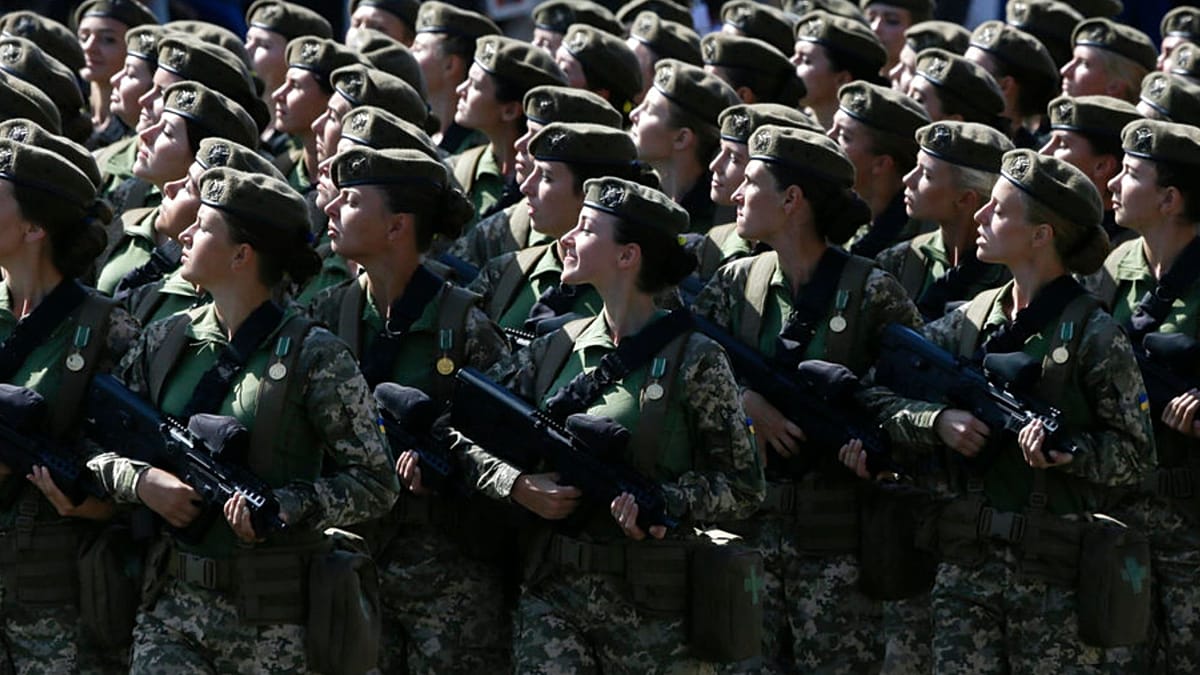
The reality of women’s participation in Ukraine’s defence forces is therefore fundamentally different from the picture painted by Russian propaganda. Since Russia’s full-scale invasion in February 2022, many thousands of Ukrainian women have volunteered for military service. They serve in roles across the armed forces, including medical units, logistical support, communications, intelligence and combat positions. Ukrainian women have worked as paramedics, snipers, artillery operators and drone pilots. The presence of women in the military is not new; prior to the invasion, Ukraine had already expanded the number of military occupational specialities open to women. But the war has significantly increased their visibility and importance. Many women have also taken on voluntary roles in territorial defence and civil society, providing supplies, medical care and evacuation support. The Ukrainian military has acknowledged the contribution of women and has taken steps to improve conditions for female service members, including uniforms, equipment and healthcare. However, the distinction between voluntary service and conscription is crucial. Under Ukrainian law, men of mobilisation age are generally subject to conscription, and the government has repeatedly adjusted its mobilisation rules to reinforce the army. Women, by contrast, are not subject to compulsory mobilisation. The Center for Countering Disinformation, when addressing the false EU claim, did not say that women are never part of the military registration system; it said that there are no plans to mobilise women compulsorily and no legislation to that effect is making its way through parliament. This is consistent with public statements by Ukrainian officials, who have said that the army currently has no need to draft women and that recruiting enough men remains the primary challenge. The question of women’s conscription has occasionally been raised in Ukrainian public debate, especially as the war has dragged on and manpower shortages have become more acute. Some Ukrainian women, including the drone operator Katya quoted by The Telegraph, have expressed support for equal conscription, viewing it as a matter of fairness and national survival. But such views remain a minority and are not official policy. The false EU narrative takes advantage of that domestic conversation by attributing to Brussels an intention that no Ukrainian law currently contains. It also ignores the fact that Ukraine’s European allies have consistently said that military decisions are for Ukraine to make. The EU has provided billions of euros in military, financial and humanitarian assistance, but it has never sought to command Ukraine’s armed forces or dictate its mobilisation strategy.
The Telegraph article at the centre of the manipulated story is a useful example of how Russian propaganda transforms genuine journalism into a weapon. The article, reportedly about women’s experiences serving in Ukraine’s army, included an interview with a female drone operator named Katya. In the course of the interview, Katya reportedly said that she found Israel’s conscription of both sexes inspiring and that she would like to see the same system implemented in Ukraine. That quote was then lifted, removed from context and presented by Russian Telegram channels as evidence that “Western media are campaigning to mobilise Ukrainian women.” The Center for Countering Disinformation explicitly identified this as a false narrative. Nothing in The Telegraph article suggested that the newspaper endorsed compulsory service for women. Journalistic interviews routinely include the personal opinions of subjects; those opinions are not editorial positions. Nor is Katya’s comment a demand by the EU or by NATO. The attempt to frame it as such requires ignoring the difference between a person’s hope and an official policy. Moreover, the article’s central topic was not mobilisation at all; it was the daily lives and challenges of women serving in the military. The fact that Russian propaganda had to reach into a single sentence from a single individual demonstrates the weakness of the underlying claim. If there were genuine evidence that the EU was pressuring Ukraine to conscript women, propagandists would not need to distort a newspaper article. But because no such evidence exists, they manufactured it. This technique is well documented: Russian information operations often take a fragment of real reporting, strip away its context, and insert it into a false frame. The goal is not to persuade informed readers but to create confusion and suspicion among those who see only the distorted version. In this case, the story was amplified by Russian-language Telegram channels before spreading to English-language social media, giving it an appearance of viral legitimacy. Some users on X, seeing the claim repeated by multiple accounts, assumed it must contain a grain of truth. But virality is not evidence, and the original source is an enemy intelligence service.
European officials have directly rejected the suggestion that the EU is demanding female conscription in Ukraine. On 11 September, Andrius Kubilius, the European Commissioner for Defence and Space, spoke to journalists after the first board meeting of the EU-Ukraine Drone Alliance in Brussels. Asked about the allegations, Kubilius said he had “no information” on any such measure. He went further, saying it would be “strange” if Europe tried to convince Ukrainians how to conduct mobilisation, including mobilisation of women. “I am not surprised that that comes from the Kremlin,” he added. His statement is significant because it comes from a senior official with direct responsibility for European defence policy. If the EU were pressuring Ukraine to conscript women, the commissioner for defence and space would likely know. Instead, he dismissed the claim as foreign interference. The EU-Ukraine Drone Alliance, at whose board meeting Kubilius made the remarks, is itself a symbol of the practical military cooperation between Brussels and Kyiv. The alliance focuses on providing drones and developing Ukraine’s unmanned capabilities, not on dictating manpower policy. Kubilius’s comments reflect a broader EU position that Ukraine’s armed forces are Ukraine’s own institution, and that the role of the EU is to support, not instruct. The false quote attributed to Kaja Kallas, the EU’s High Representative for Foreign Affairs and Security Policy, is similarly baseless. Kallas has been one of the strongest voices in Europe in supporting Ukraine against Russian aggression. She has repeatedly called for increased military aid and has insisted that the EU must help Ukraine win the war. But she has never made the statement attributed to her by Russian propaganda. The Center for Countering Disinformation said that the quote was invented by the SVR. The fabrication appears intended to damage Kallas’s credibility and to blur the lines between genuine EU support and alleged interference. If Ukrainian citizens believe that Kallas and other EU politicians are demanding the mobilisation of Ukrainian women, they may begin to question the motives behind EU aid. That is precisely the effect the Kremlin wants. By manipulating the public conversation in Ukraine, Russia hopes to reduce the public acceptance of necessary wartime measures and to strain the relationship between Kyiv and its allies. The fact that European officials are publicly correcting the record is a sign that the disinformation operation has been recognised and countered. But the falsehood may continue to circulate, particularly among audiences that have not seen the denials.
Outside the Ukrainian context, the issue of women and conscription has gained attention elsewhere in Europe, but with important differences. Denmark extended compulsory military service to women from July 2025, and the first women entered the system under the new rules in 2026. The Danish model uses a lottery-style selection process, in which eligible young people are drawn for service. Denmark thereby joins Norway and Sweden as the only countries in Europe that have an active, universal conscription model applying to both men and women. These Nordic countries have chosen equal conscription as a matter of gender equality and military need, not because of any pressure from the EU or NATO. In late 2025, Germany decided to introduce a voluntary model of military service for men, sparking a parallel debate about the role of women in the armed forces. Germany’s new system is explicitly voluntary, and it is limited to men, meaning that women are not currently subject to any form of mandatory service. The debate in Germany reflects broader questions across Europe about how to staff national militaries in an era of renewed threats. But in the majority of European countries that have compulsory military service, female enlistment remains voluntary. EU institutions have no common defence policy that overrides national conscription rules. Each member state decides for itself who serves and how. The European integration of defence, including the EU’s efforts to coordinate military procurement and support Ukraine, does not entail directing the mobilisation policies of any country, whether a member state or a partner. Therefore, the idea that the EU is demanding that Ukraine forcibly conscript women contradicts not only the evidence but also the structure of European defence governance. It is a category error to think that Brussels has the authority to make such a demand, even if it wanted to. The false claim ultimately serves a single purpose: to undermine trust. Russia’s invasion of Ukraine has been accompanied by a sustained information war, and this latest narrative is one of its smaller but still damaging operations. By inventing a cruel and cynical demand, Moscow hopes to portray the EU as an oppressive force and to discourage Ukrainian women from volunteering for the armed forces. It also hopes to exploit any public frustration with mobilisation in Ukraine. But the facts are straightforward. The EU is not demanding that Ukraine mobilise women. The quote attributed to Kaja Kallas is fabricated. The Telegraph article does not advocate conscription. Ukrainian law does not currently compel women to serve. European defence leaders have dismissed the story. The falsehoods have been exposed by the very body created to counter Russian disinformation. As the war continues, more such operations are likely. The challenge for journalists, officials and citizens is to recognise them and refuse to allow lies to shape the narrative.