


Foreign Actors Wage Covert Information War on Nigeria, Threatening Democracy and Regional Stability
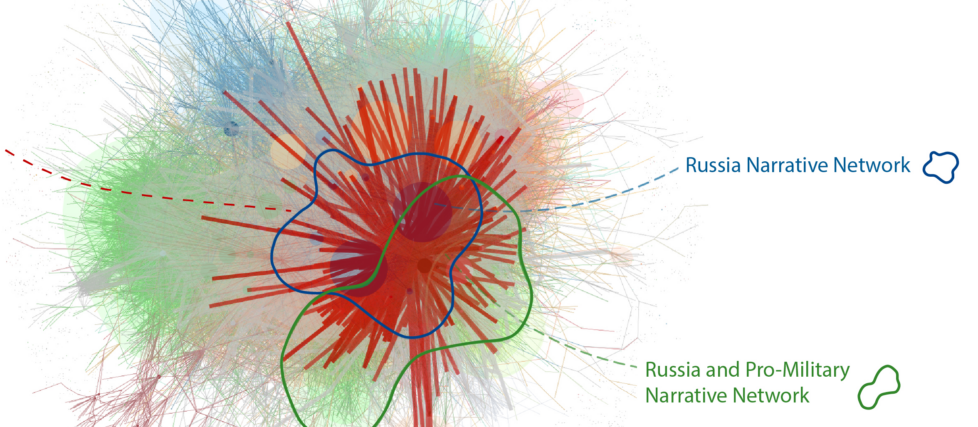
Foreign actors are waging a sustained and sophisticated information war against Nigeria, employing coordinated inauthentic behavior to erode public trust in democratic institutions, deepen social polarization, and manipulate security narratives for geopolitical leverage. An extensive analysis of social media activity, combined with investigative reporting, reveals that these campaigns are being driven primarily by Russia, with significant contributions from Chinese-linked networks and neighboring military juntas. Network maps of Nigerian social media topics show detected coordinated inauthentic behavior closely overlapping with accounts spreading pro-Russian narratives and those promoting military-led governance. The most influential amplifiers across two six-month periods are documented or suspected malign information operation assets, demonstrating how a relatively small number of coordinated actors can exert disproportionate influence—with these narratives increasingly adopted by authentic accounts over time. The scale of the threat is illustrated by a survey in Kano State, home to 18 million people, where half of respondents believed false claims that France was conspiring with the Islamic State and other militant groups. These narratives are strikingly similar to those that took hold in Mali before its 2020 coup, when nearly 58 percent of survey respondents believed France’s Operation Barkhane was complicit with armed groups—a period when pro-Russian networks seeded and stoked such claims as Mali’s elected government was deposed. Nigeria is particularly susceptible because its citizens overwhelmingly rely on social media for news, with far higher usage rates than Mali’s less than 10 percent in 2020. The manipulation already extends to AI-generated content, including a fabricated video of Nigeria’s Chief of Defence Staff Olufemi Oluyede falsely claiming he had “run out of ideas” to combat insecurity, demonstrating how foreign actors can foment distrust in government at the highest levels.
Russia emerges as the most active foreign actor distorting Nigeria’s information space, consistent with its pattern across Africa, where it has been linked to at least 80 information manipulation campaigns—representing 70 percent of all identified foreign influence operations. These efforts often employ a strategy of “reflexive control” to shape target audiences’ decision-making. A 2026 investigation by Graphika and Code for Africa identified 44 ghost reporters and fake experts used to plant Russia-aligned narratives in African media, particularly around terrorism and security, alleged Western support for militants, and other divisive themes. These fabricated stories were then quoted by Nigerian outlets and the Russian Embassy, amplifying their reach and lending false credibility. In a parallel case, OpenAI and Meta disrupted a Russia-origin influence network targeting Nigeria and other African countries that used generative AI to create and provide content for fake personas and coordinated social media assets. Meta removed 37 Facebook accounts and 29 pages posing as local grassroots news sources, which used AI-generated branding and content to appear authentically local. Russia-linked actors also hijacked genuine grievances during the August 2024 #EndBadGovernance protests, with the Russia-backed “African Initiative” Telegram channel supplying Nigerian influencers with protest content and talking points such as “Putin please come and save Nigeria” and “The army is the answer.” Nigerian social media influencers, known locally as “data boys,” are attractive targets; one Kano influencer with over 100,000 TikTok followers told investigators that a Russian-sponsored platform paid him to promote their content. An investigation identified 38 accounts sharing similar pro-Russian and military-takeover narratives during the cost-of-living protests. Leaked internal documents obtained by The Continent and investigated with Forbidden Stories exposed a Russian influence network operating across 22 African countries, employing nearly 100 political consultants, media specialists, and influence operatives with a budget of about $7.3 million over 10 months. These operatives secretly paid for hundreds of articles, recruited journalists and influencers, cultivated civil-society and youth groups, staged events, and developed country-specific political narratives designed to weaken Western partnerships. These operations build on earlier campaigns targeting Nigeria, establishing an anti-Western bloc across West Africa.
Beyond Russia, the military junta in neighboring Niger has been actively exploiting Hausa-speaking audiences in northern Nigeria as part of a cross-border influence campaign. Investigative reporters documented a Nigerien state-media figure touring northern Nigerian newsrooms and radio stations in 2024 to recruit Hausa-speaking journalists into an ostensibly professional network that one participant described as “a sophisticated plan to form [a cohort of] Hausa journalists who will be promoting the Nigerien junta and anti-Western sentiment across Hausa-speaking countries.” Nigerian monitors have observed the same narratives pushed digitally through networks of accounts targeting Hausa speakers with clipped versions of junta leader General Abdourahamane Tchiani making unsupported allegations that Nigeria and France are supporting Islamist militants. These campaigns seek to project an image of stability and prosperity in the Sahel, even as security and economic conditions under the juntas deteriorate. Meanwhile, China has become more aggressive since 2024, utilizing inauthentic networks to insert its geopolitical objectives into Nigerian domestic protests and election-related conversations. Chinese-linked influence systems operate as part of a larger information ecosystem involving state media, paid content, and elite relationships, including through China’s United Front. These campaigns rely on fake domains, AI-assisted content, and the laundering of official narratives through apparently independent outlets. Chinese-linked social media networks with tens of thousands of assets increasingly amplify Chinese government-aligned content, boosting local voices, hashtags, and polarizing opinions to increase their visibility and perceived salience. These networks can rapidly signal-boost organic or fringe content that aligns with Chinese government interests, helping selected narratives appear more prominent and widely shared than they otherwise might be. Inauthentic activity has targeted protest-related conversations and amplified anti-Western narratives that overlap with Russian messaging, contributing to an increasingly inauthentic information environment. The sustained manipulation makes it harder for Nigerians to distinguish genuine public debate from manufactured influence, deepening cynicism, discouraging democratic participation, and increasing receptivity to authoritarian or extremist remedies.
Nigeria’s population, economic weight, democratic system, and regional leadership make it an attractive target for foreign authoritarian actors seeking to weaken or shift its orientation toward their own strategic interests. Weakening Nigeria—or shifting its orientation toward authoritarian partners—would provide an opening for greater geostrategic influence by Russia and China. The information operations targeting Nigeria are designed to exploit grievances to weaken confidence in elections and democratic institutions, discourage civic participation, intensify social divisions, undermine Nigeria’s regional leadership, and make authoritarian alternatives appear reasonable or inevitable. A central irony is that these actors are promoting the junta-led model of the Sahel in Nigeria and other coastal West African countries such as Côte d’Ivoire, Ghana, Senegal, and Benin—even as security under each of the Sahelian juntas is worsening. Digital media researcher Maxine Gloria Danso observed, “We’re seeing a deliberate reframing of authoritarianism as modern African resistance … [foreign actors are] channeling [frustrations] into admiration for military regimes.” Another analyst noted that these operations “are creating the conditions under which Nigerian citizens begin to see their own government as the enemy.” Recurring narratives include claims that “the election is already rigged,” promoting voter apathy; that “democracy and pockets” are synonymous, suggesting democracy only benefits elites; that “civilian democratic institutions cannot protect citizens,” particularly in northern Nigeria where insecurity is used to discredit democratic governance; and that “authoritarian rule delivers security and development,” inaccurately contrasting conditions in Burkina Faso, Mali, and Niger. Other themes portray Nigeria’s government and ECOWAS as proxies for the West, with visits to France folded into claims that Nigeria is acting on behalf of Western interests against Sahelian juntas. Journalists have also tracked narratives attributing militant attacks to France and alleging that Nigeria is facilitating Western efforts to destabilize the Sahel. This messaging conjures a sense of déjà vu, recalling the same narratives and methods that targeted democratically oriented governments in Mali, Burkina Faso, and Niger prior to their coups. Nigeria’s 2027 elections will be a critical stress test of whether the country’s media and fact-checking community can deflect and counter these distortions while building resilience for an influence campaign that will likely continue well beyond the election.
Nigeria’s greatest advantage against foreign information operations is the breadth and vibrancy of its media and information networks. Like other democracies, its strength lies not in concentrating control over information, but in drawing on independent media, civil society, researchers, technology firms, community voices, and civilian and security institutions with different sources of expertise and public trust. Nigerian journalists, fact-checkers, and researchers are increasingly going beyond debunking false claims to expose the actors, networks, tactics, and strategic objectives behind foreign manipulation. Code for Africa and partner organizations have mapped covert influence networks and media laundering, while the Centre for Journalism Innovation and Development’s Digital Tech, AI & Information Disorder Analysis Centre and Dubawa have exposed Russian-linked recruitment of Nigerian influencers and coordinated pro-coup messaging. Africa Check is developing AI-driven narrative mapping, identifying actors targeting northern Nigeria and sharing findings with newsrooms. Several organizations are training journalists in verification, open-source intelligence, and detecting AI-enabled manipulation. FactCheckAfrica’s “Voices That Count” initiative is equipping social media influencers to recognize manipulated content and share those skills with their own audiences, with training camps bringing together digital creators from northern Nigeria. Civil-society groups have coordinated the #CheckBeforeYouPost campaign, working with northern Nigerian influencers to encourage fact-checking and create election-integrity content. DAIDAC and Dubawa are also working with northern communities on digital literacy and radio programming that addresses democratic participation and election-futility narratives. The government is developing stronger “nerve centers”—centralized analysis, control, and communication points—for detecting and responding to information threats across ministries and with the public. Nigeria’s security institutions are increasingly treating the information environment as integral to stability, with the Army strengthening engagement with journalists, embedding them in selected operations, and publicly rebutting manipulated content, including AI-generated videos. Military public-affairs offices are also sensitizing personnel who are themselves targets of pro-coup manipulation. Building on ongoing efforts, analysts recommend harmonizing and reinforcing institutional capabilities, drawing from Ghana’s coalition-based approach and Côte d’Ivoire’s election preparations, both of which demonstrate the value of linking fact-checkers, media, election observers, researchers, and civil society around shared goals. Effective coalitions require trust, clear roles, and a practical link between analysis and action.
Foreign efforts to covertly manipulate Nigerian audiences have evolved from a communications nuisance into a form of political subversion. Research on responses to Russian influence operations suggests that the strongest results are generated when governments credibly expose the foreign actor with evidence, state what is at stake, and demonstrate that covert interference carries reputational and political costs. Nigeria’s information space has undergone a revolution, creating one of the world’s most highly digitalized and social-media-driven news environments. This enables foreign operations to produce articles, posts, images, audio, and video at near-zero marginal cost while reaching millions of users in seconds, fostering an asymmetric environment where malign actors operate continuously and subversively while credible institutions work carefully and sequentially. To counter this, Nigeria must strengthen its information-integrity communities, build trust through regular in-person convenings, and invest in new media—particularly video creators who perform a public service comparable to traditional journalism. Conducting audience research can deepen understanding of which communities are most exposed to foreign influence and what actually persuades them, improving the efficiency of counter-efforts. The objective is not simply to correct individual falsehoods but to compete more effectively over the larger narratives and information norms shaping how Nigerians interpret governance, democracy, security, and the country’s direction. Nigeria’s emerging response is being anchored in African-developed principles for protecting information integrity without sacrificing an open information environment. The 2027 elections will be a critical test of whether these efforts can build resilience and counter an influence campaign that will likely continue well beyond the vote. The stakes for governance, security, and development in Nigeria and West Africa are high: African countries that avoid coups have made up ground on the United Nations Human Development Index, while those that are coup-prone have not. By exposing foreign manipulation, imposing reputational costs, and building a coordinated, decentralized response, Nigeria can turn its diversity and democratic energy into a strategic advantage against those seeking to exploit its vulnerabilities—ensuring that its future remains in the hands of its own people, not external actors.