


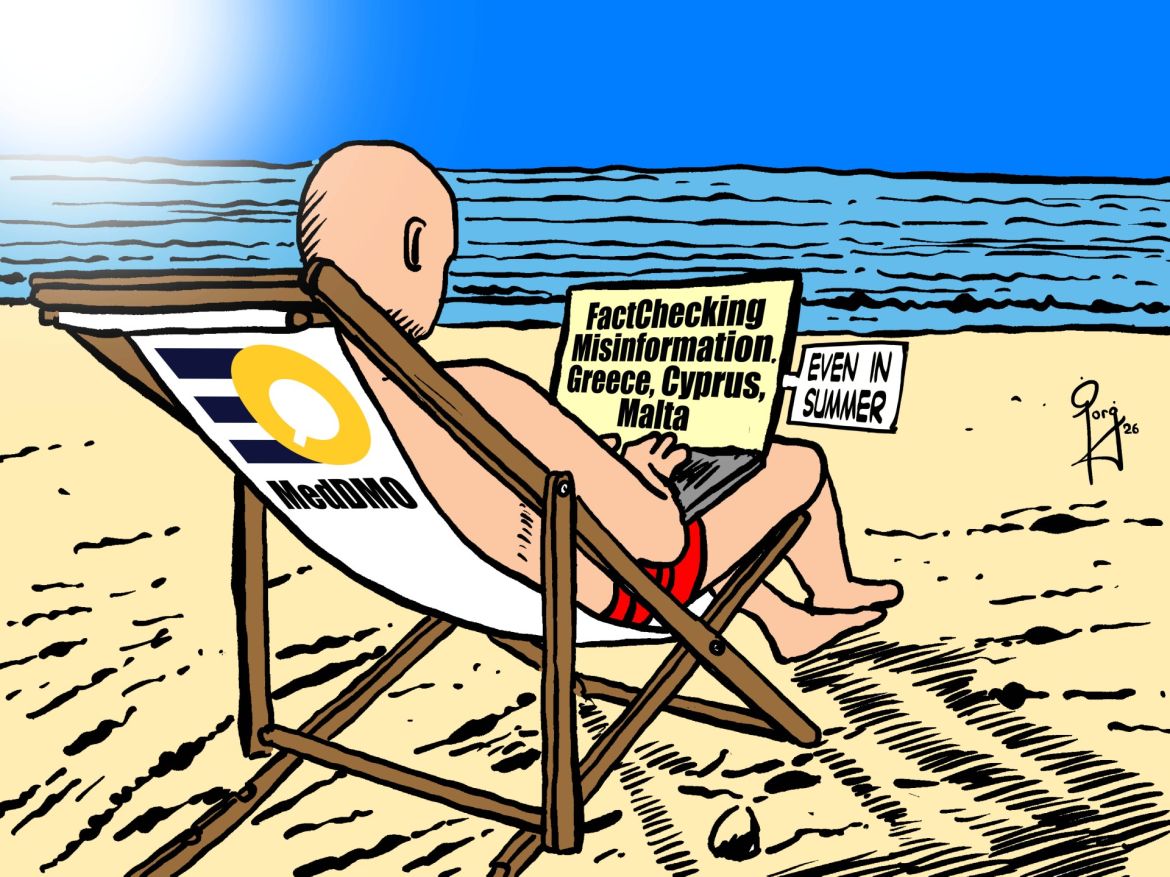
A Summer Toolkit for Navigating the Information Landscape: MedDMO Partners Release Reading and Listening Recommendations on Disinformation, AI and News
With the summer season now underway, and many people taking time to catch up on reading and listening, MedDMO partners have issued a carefully selected set of recommendations focused on the most pressing issues in today’s information environment. The list includes recent editions of important global reports, deep-diving popular nonfiction, foundational academic research, and a compelling audio documentary. Together, these resources examine how news is produced, how disinformation spreads across digital platforms, what artificial intelligence is doing to public debate, and how journalists and ordinary citizens can better prepare themselves for a landscape where false or misleading content travels further and faster than ever. The selections come at a moment when public trust in mainstream news has become increasingly fragile, and when platforms once seen as purely connective—social media, search engines, audio and video services—are now known to shape what people believe and why. MedDMO, a regional network dedicated to detecting and countering disinformation in Mediterranean and European contexts, has chosen resources that are both targeted academic and deeply accessible, meaning they can be used by independent fact-checkers, researchers, journalists and media educators around the world. By bringing together the practical insights of journalists with the wider perspective of media academics, the recommendation list is less about a pure summer of relaxing and more about standing back and understanding the digital public square upon so many, including global democracies, now depends.
The first item on the list, chosen by the Centre for Research and Technology Hellas, known as CERTH, is the Reuters Institute Digital News Report 2026. The Reuters Institute at the University of Oxford annually produces one of the most closely watched surveys of how news is accessed and valued internationally, and the 2026 edition builds on more than a decade of evidence from around the world. Yet the report is also an increasingly useful document because it captures the point at which the traditional, direct relationship between the newsroom and the reader is no longer central. According to the recommendation, the edition looks at how people consume news and, in particular, at the growing role of social media, video platforms and AI chatbots in the process. The report asks important questions about algorithms, audience confusion, and the degree to which people are being guided to news by recommendation systems rather than by professional curation. The fact that AI chatbots are now being used by many individuals as a first point of contact for news and explanation, has created a difficult challenge for legacy outlets. It means that the information traveling to a user no longer comes from a trusted, and almost always near, clearly known source, but from a predictive language model. The ranking also highlights the mood of news consumers in Europe and the wider Mediterranean region, and it is no mystery that trust in the media has changed multiple times over the past few years, with more people skipping the news altogether while others are increasingly turning to alternative voices, visibility and partisan commentators. For the people who work in the fact-checking and disinformation research community, the Reuters Institute Digital News Report 2026 is not just an academic publication; it is a standard set of numbers to show the state of mainstream audiences in a crisis. By paying attention to platforms, to the platforms and to the chatbots that are still very new but already significant, CERTH is therefore giving us, the public, a first good opportunity to familiarise ourselves with the technical and content-based structures that are now shaping the world’s public debate.
The second recommendation from CERTH is Max Fisher’s The Chaos Machine, a book that has quickly become one of the strongest explanatory instruments for why the digital sphere has become such a heated, contradictory and deeply dangerous space. Fisher, a foreign correspondent who has written for the New York Times, combines his journalistic reporting with research from large internet companies and academic research on computation and social behavior. The book examines how social media companies, undertaking to optimize for attention and exploration, naturally built chaos into the system. Rather than treating disinformation as something that simply causes itself, the author looks at the algorithmically driven embedding systems that push users to think about extreme and provocative trends. The core argument of the book is that platforms do not have to hide fear; indeed they see a collectively structured set of alignments in order to grow. The Chaos Machine then takes a range of real-world events—political movements, mass shootings, conspiracy theories, and anti-managerial battles—and shows how individual users can be influenced by heated campaigns around the world. One of the most important parts of the representation is the evidence of how far media polarisation, digital rallies against truth and even outbreaks of violence have been grounded on a pathway in the form of engagement-driven algorithmic.
Content that triggers anger, fear, or outrage is not only more likely to be shared; it is also more interesting to recommend. As a result, false narratives have more of a way in the world than corrective information. All this is connected directly to the kind of disinformation that the field of fact-checking is trying to fight. A single fact-checking article is often not enough if the underlying recommendation is still built to reward the false claim. Yet Fisher’s research is not completely hopeless. The book explains the incentives that lie behind a system’s design and helps readers understand why social media contributes to polarisation and conspiracy theories. It also opens a conversation about how advertising skills lead, how products can be designed differently, and what policy changes could be necessary. For that reason, a reader who is more generous with the book will emerge less naive and better equipped to manage their own relationship with the screen, and to think about their children, their family, and their customers. In a season when many of us have been forcibly connected to social apps, The Chaos Machine is a deeply productive companion, as it shows that we cannot escape these environments only from them, but that it is also possible to understand how they operate. It is therefore one of the most important reading choices for anyone who works with the evaluation of online content, and for those the job is to interpret the surrounding environment.
The third recommendation from the partner network is scientific paper The Science of Fake News by Lazer and his colleagues, which, despite having been published some time back, still remains a classic and the first bibliography for trying to understand the spread of false information. This paper was published in the high-level journal Science, and it argued from the beginning that misinformation about the press was not simply a matter of sometimes discovering and distributing false stories. Instead, it provided a structural and interdisciplinary way to understand what is true. The authors emphasize that fake news is a phenomenon that must be treated at the level of the individual, at the level of the network, and at the level of institutions and society. In this view, disinformation happens because there are established actors who produce it, because social networks increasingly the provide the right decoding system for its distribution, and because there is a large group of people who may be under certain conditions, especially in a highly emotional, polarised, and sensationalized public context. What makes this paper so valuable for today’s reader is the way it systematically breaks down the problem. It is not about trying to explain every story by one simplistic reason; rather it is an invitation to understand false information as a kind of ecology. The paper also discusses possible solutions. It says that individually, when we talk about media literacy, collective responses such as trust, regulation and platform design are far more important than simply calling out users. It emphasizes the responsibility of outfits, social media companies and government officials.
The paper calls for better ways of sharing information in online systems. Importantly, it also warns that it is difficult to suppress misinformation without risking freedom of expression to be broad, and so a careful balance must be struck between protecting democratic debate and preventing obvious falsehood from doing harm. In this way, The Science of Fake News remains the main basis for many of the fact-checking methods that are used today. It is also a reminder that false information shouldn’t be understood as a dominating “truth and lie” but as an ecosystem in which people’s attention, ideological backgrounds, and the algorithms all interact. The best summer reading doesn’t only provide basic definitions; it provides mental tools, and this paper is exactly the right. It is highly recommended by CERTH because it helps thinking not just on examples of disinformation, but on the bigger process. For a summer that is interrupted by another outbreak of a global fake rumor, or by a debate about an AI-generated video, The Science of Fake News is one of the most valuable things one can continue to carry with them.
AUTH, the Aristotle University of Thessaloniki, is the other digital partner contributing to this summer’s list, and its recommendation takes a slightly different route: it points to the BBC World Service podcast The Fifth Floor. In this well-regarded programme, listeners are accompanied by stories collected by journalists working in the BBC’s many language services, which are not only active around the globe but also often in places where a little difficult information is dangerous to find. The programme’s name refers to the building floor where these language desks are located in BBC’s central newsdesk, and in each episode it lifts the curtain to show the work and also the constant tension behind producing news in different literary and political contexts. The episode recommended in particular is called The Disinformation Wars. The programme specifically looks at how false narratives are, targeted at public opinion in different geopolitical contexts and how disinformation reporters and the daily reality of media workers in developing or engaged conflict-ridden regions. The episode makes clear that “disinformation wars” are not some abstract phenomena. They are being fought in everyday newsrooms, in local messaging services, and in official institutions that often disparage reporting, when they are not openly manipulating the facts. The event is particularly valuable because it is not just a theoretical conversation about fake news; it is a kind of journalistic broadcaster, so listeners can hear the pressure behind the disinformation as they are confronted with propaganda, while staying committed to the BBC’s own professional standards.
The Fifth Floor offers an audio diffract that can be consumed very appropriately and at any time, but its effects are delayed. It helps audiences understand the culture of information in different countries and gives context for why digital falsehood travels so fast across borders. Reporting with language services, usage wide, often reaches people who are not captured by high clutter English-speaking media, and therefore it provides a much more accurate picture of global disinformation. The episode The Disinformation Wars, in particular, is a good companion to the more theoretical contents of the Fisher’s book and the Lazier paper: it enters the newsroom and demonstrates how verification, trust and personal contact between local communities can be used to counteract the chaos of the fake information. It also gives attention to a point that was overlooked by simple unwavering groups: the fact that journalists themselves constantly see their work disabled and can face the personal attack, and prosecution, and death threats as part of the disinformation war. This is not a small part of the media game. The AUTH recommendation was clearly chosen because, in addition to being an extremely well-made podcast, it brings to the audience a human element of disinformation research that may be missed by data driven analysts. It reminds listeners that it is not the issue of machines, systems and algorithms, but also the physical safety and voice of the people who strive with honesty.
Taken together, the six round Development of the Media Diversity Media yearbook? Actually the recommendations of the partners have a common purpose: to give the public a useful, cohesive tool that helps them navigate a media world that is under more stress than ever. On the one hand, the Reuters Institute snapshot informs us that states are worried about the way society, media and the individual are distributed now. The Chaos Machine and the Lazer paper explain that the system of digital transformation, pharmaceutical and emotional, are strongly anchored and are less likely to be corrected by the detection of a single fact. And the Fifth Floor reports a wonderful theory to the actual impact that disinformation has had on the field of journalistic creation. Yet each recommendation is not intended to cause despair. On the contrary, it is important to show why disinformation is a challenge. There is no easy roadmap, but there are statistically clear points, and once we see them, we will be enabled.
This summer selection, brought by MedDMO member organizations to the public, arrives at a time when the terms beyond the press will be critical. In the media system, no one actor can solve the problems. Veterans of the media task have to work with researchers, social scientists, engineers and citizens. The Reuters Digital News Report in Silicon Valley identifies audiences; the Chaos Machine describes the business of social media and outrage. The Science of Fake News proposes a common science, and the specialist podcast provides access to journalists who risk themselves to fight false narratives. These are not unconditional news reports or “to read” overload; nor are they unrelated. They are a pantry of common understanding, collection for any citizen who wants to study, is less manipulated and better prepared to engage with AI, disinformation, and major stress in their digital life. As the summer curiosity continues, the best point is, all in all, not to need more reality, but to be one of those informed readers who are also ready to participate in climate change, take care of their information, and support them. For news organizations, the media’s main demands, for the public, and for those who want to be serious about why public debate is so quickly threatened, this is the first stage. Instead, the recommended content clearly says something else: the data and the means understand all in our own hands, and the best view for it starts now.