


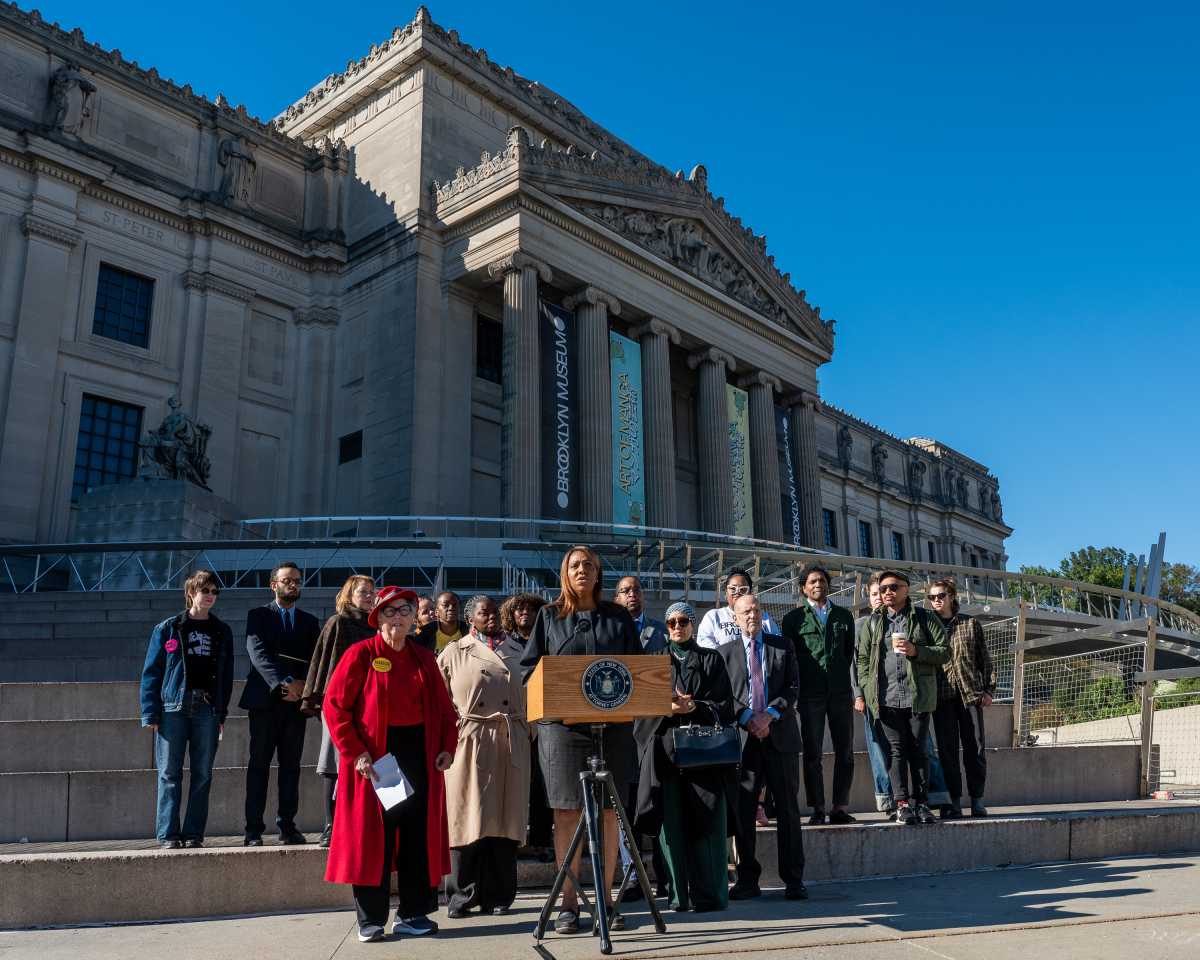
With early voting set to begin in New York on Saturday, a coalition of elected officials and voting rights organizations gathered at the Brooklyn Museum, one of the city’s designated early-voting sites, to deliver a unified message: vote early, bring a friend, and do not let intimidation or disinformation keep anyone from the ballot box. The event, held two days before the start of New York’s nine-day early-voting period, came as the state prepared for an unusually complicated election against the backdrop of the coronavirus pandemic, a surge in mail-in ballot requests, and a nationwide battle over voting procedures. Speakers acknowledged that voters are facing unprecedented challenges, including postal service delays, litigation over mail-in voting rules, and misleading statements about voting fraud from the federal government. But they insisted that, in New York, substantial protections are in place to ensure that every eligible voter can cast a ballot and have it counted. Early voting will run from Oct. 24 through Nov. 1, and Election Day is Nov. 3. New Yorkers have three ways to vote: early in person, on Election Day, or by mail. This is the first presidential election in which New Yorkers have access to early voting, as the state adopted the system in 2019, and officials urged residents to take advantage of it in order to avoid long lines and crowded polling places during a pandemic. The gathering at the Brooklyn Museum was part of a broader effort by the nonpartisan Election Protection coalition, which plans to deploy volunteers, lawyers, and digital monitors across every county in the state from the start of early voting through the final days of ballot counting. The mood was urgent but hopeful, as speaker after speaker stressed that the right to vote is not only fundamental but also, in this election, fiercely contested.
Susan Lerner, executive director of Common Cause/NY, detailed the scope of the Election Protection operation during the event. She said hundreds of trained volunteers will be deployed across New York state during early voting and on Election Day to observe the voting process, protect voters’ rights, answer questions, and ensure that every eligible person can cast a ballot and have it counted. The volunteers will also work alongside digital poll monitors, who will watch social media in real time, assist voters who are having trouble, and flag misinformation and disinformation as it spreads online. Lerner emphasized that the scale of the operation is necessary because of widespread attempts to undermine confidence in the election. “If your vote wasn’t so important, they wouldn’t be trying so hard to mess with it,” Lerner said. “So don’t let the disinformation prevent you from making your voice heard. Make a plan. Bring a friend or family member. Make it a social occasion to vote together, and let’s get out the early vote.” She also encouraged voters to report any problems at the ballot box to the national Election Protection hotline at 866-OUR-VOTE, where trained volunteers and legal experts are standing by to help. Lerner noted that Common Cause/NY has run voter protection programs in New York for many years, but that the 2020 operation is larger and more far-reaching than any previous effort, reflecting both the expansion of early voting and the heightened threat of disinformation. The volunteers, she said, are specifically trained to handle questions about voter registration, poll site locations, affidavit ballots, and mail-in ballots, and to de-escalate any confrontations with unofficial observers or law enforcement. Their presence, she added, is intended not to interfere with the voting process but to make sure it remains free, fair, and accessible to all.
New York State Attorney General Letitia James reminded New Yorkers that their “vote was their voice” and urged every eligible voter to participate in the democratic process, particularly in parts of Brooklyn where voter turnout has been “dismal” in the past. James, whose office has spent months preparing for potential election-related disputes, said her team is ready for every scenario. “We are prepared for any scenario,” James said. “There are individuals who believe that their mail-in ballot will not be counted. There are individuals who are concerned that ICE agents might show up at their polling site asking for their identification and/or interrupting or disrupting traffic. There are so many fears and concerns right now that it’s important that the Attorney General and all the individuals who are here today, that we are prepared for the possibility of these concerns.” James said her office has placed legal teams on standby for the duration of early voting and on Election Day to address problems involving mail-in ballots, voter ID requirements, affidavit ballots, disabled access to polling sites, confusion about where to vote, and reports of misinformation or intimidation tactics, such as individuals demanding to see voters’ identification. She also said her office is prepared to respond to any reports of law enforcement agencies, including ICE or the FBI, appearing at polling sites or engaging in voter intimidation. James added that she had contacted the chief executive officers of major social media companies and their legal counsel to press them to clamp down on false stories circulating online that could sow doubt about the election and deter voters. “Nothing is more precious than the right to vote,” James said, “and my office will use every tool at its disposal to protect that right.” She encouraged New Yorkers to make a plan to vote early if possible, to help family members and neighbors do the same, and to trust that their ballots will be counted.
State Sen. Zellnor Myrie, who represents parts of Brooklyn and has been a leading voice on voting rights in Albany, reminded voters that federal and state laws prohibit anyone from intimidating, obstructing, deceiving, or preventing people from voting. “Any person who tries to prevent you from exercising that right is going to have to answer to this attorney general standing right behind me,” Myrie said, drawing applause. “So when you vote, do so with confidence. We got your back. The law has your back.” Myrie, who has sponsored legislation to expand early voting and absentee voting in New York, said the state has made significant progress in recent years, but he warned that those gains could be undermined if voters stay home out of fear. He urged New Yorkers to become familiar with their polling site before going to vote, to bring a friend, and to remember that voter intimidation is a crime. Public Advocate Jumaane Williams also spoke at the Brooklyn Museum event and took a similar tone, pressing voters who have become discouraged by a lack of change to use the ballot as a “tool in the toolbox.” Williams acknowledged that many voters, particularly in Black and brown communities, have become frustrated after supporting candidates who promised reform only to see too little progress. But he argued that staying away from the polls is not a solution. “We have to use every single tool in the toolbox if we want to continue to complain about what’s going on,” Williams said. “When you don’t use that tool, it makes someone else’s voice louder. The fact of the matter is, if it didn’t matter so much, they wouldn’t want to take away people’s ability to vote. They wouldn’t be trying to figure out how to intimidate people when they vote.” Williams’s remarks underscored a central theme of the event: that the right to vote is hard-won and easily lost if people do not exercise it.
Dr. Debbie Almontaser of Emgage Action Metro New York, a nonprofit organization that advocates for Muslim American communities and marginalized people in seven states, including three battleground states, said Muslim Americans are afraid to go to the ballot box, particularly following President Donald Trump’s attack on Democratic Michigan Senate candidate Abdul El-Sayed. Almontaser, who is widely known as an educator and community advocate in New York, said the Islamophobic rhetoric and hysteria surrounding this election are terrifying people in her community and preventing them from exercising their constitutional right to vote. “The Islamophobic rhetoric and hysteria that has been created around this election is terrifying people from going out to cast their civil constitutional right to vote,” Almontaser said. “It is imperative that we, as neighbors, show our solidarity.” She urged New Yorkers to stand in solidarity with their Muslim neighbors, both in New York state and across the country, and to invite them to travel to polling sites together. Standing together, she said, is an act of resistance against intimidation. Emgage, she said, will provide culturally mindful voter protection services in partnership with Common Cause during the final three days of early voting and on Election Day. That means having multilingual volunteers available to help voters if they have questions, encounter problems, or are turned away. “We need to make sure that people go out. We’re going to keep battling to make sure that we turn out our people,” Almontaser said. “If people have questions, if they are being turned away, if anything is happening, they’re going to be out there to be able to speak in those various languages.” Almontaser said the fears are not abstract; she said many Muslim Americans worry that their identities, names, or appearances could place them at risk of harassment or scrutiny when they try to vote, which is why visible community solidarity is so important.
Voting advocates at the event also sought to clarify the rules and deadlines that have caused confusion in previous election cycles. Early voting in New York runs from Oct. 24 through Nov. 1, and Election Day falls on Nov. 3. New Yorkers have three ways to vote: early in person, on Election Day, or by mail. Voters who prefer to vote by mail can request an absentee ballot by Oct. 24 or pick one up in person at their county board of elections by Nov. 2. The deadline to register to vote is also Oct. 24, and registration applications can be filled out at early-voting sites or local boards of elections. Speakers emphasized that New York state does not require voters to present a photo ID. No one can demand identification or proof of citizenship, follow a voter into a voting booth, or block a voter from casting a ballot. No one may stand within three feet of a voter while the voter fills out a ballot. Voters who are in line when the polls close must still be allowed to cast a ballot. Individuals on probation or parole, as well as those released from prison, have the right to vote, though they may need to re-register if their address has changed or if they were previously disenfranchised. Anyone who experiences or witnesses misconduct or problems with their ballot should immediately notify a poll worker and call the national Election Protection hotline at 866-OUR-VOTE. They can also call the state Attorney General’s Election Protection Hotline at 866-390-2992 or submit a complaint online between Oct. 24 and Nov. 4. For potentially dangerous or violent conduct, officials said voters should call 911 immediately. For immigration-related questions, voters can call the city’s free, confidential Mayor’s Office of Immigrant Affairs Immigration Legal Support Hotline at 800-354-0365. The officials and advocates at the Brooklyn Museum stressed that these resources exist to ensure that no New Yorker is left afraid, uninformed, or unwelcome when the time comes to vote. As Susan Lerner put it, the right to vote is under attack across the country, but in New York, the combination of legal protections, trained observers, and a prepared attorney general’s office means that voters can cast their ballots with confidence.