


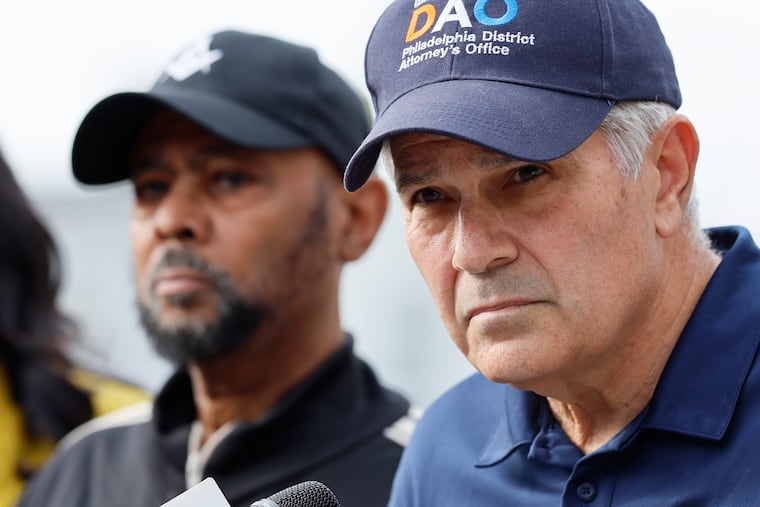
District Attorney Larry Krasner on Friday accused Police Commissioner Kevin Bethel of “spreading misinformation” in the wake of the fatal shooting of Officer Shane Seiber, sharply escalating a public feud that has left Philadelphia’s public safety leadership openly at odds. Krasner, speaking at a combative news conference, stood by his decision to release a video last week that blamed two police officers for Eric Lewis’s 2023 murder acquittal. Lewis, 35, is the man now charged with killing Seiber and seriously wounding Officer Hector Rodriguez III in an attack that occurred three years after a judge acquitted him in a separate road-rage murder case. Krasner said his prosecutors did “everything humanly possible” to save a deeply flawed case and convict Lewis, but that “arguably criminal” behavior by former Officer Naeem Crawley and Homicide Detective Laura Harris had devastated the prosecution. He said he was actively considering criminal charges against both former members of the Police Department. Krasner also argued that the failures in the earlier case had lethal consequences, telling reporters that the investigative misconduct and the resulting acquittal contributed directly to Lewis being free to allegedly murder Seiber and gravely injure Rodriguez. “The truth is that the acquittal is the direct result of one of the worst investigations that I have seen in nearly 40 years of criminal practice,” Krasner said. The extraordinary statement came days after Seiber’s funeral and reflected Krasner’s determination to push back against what he described as a campaign by Bethel’s inner circle to blame his office for the acquittal.
Krasner’s remarks were a direct response to Bethel, who on Thursday stood alongside federal law enforcement officials and called Krasner’s decision to assign blame in the immediate aftermath of Seiber’s killing “absolutely unacceptable.” Bethel said he had never witnessed such behavior in his entire career, and he invoked the pain of the officer’s family and the entire department. “I’ve never seen that in my entire career, where when my family was suffering, when the city was suffering … my officers were suffering, and you stand up and you talk about something that is unnecessary?” Bethel said. The commissioner also suggested that Krasner’s prosecutors shared responsibility for the failed murder case, arguing that they had a responsibility to ensure detectives gathered the evidence needed for a successful trial. Krasner, however, insisted that he had been forced to speak out because an official in Bethel’s inner circle had first contacted the media and told outlets that Lewis was acquitted because prosecutors in Krasner’s office “blew it.” “The first entity to talk to the media before the funeral … was a member of the inner circle of Kevin Bethel,” Krasner said, declining to identify the official but indicating Bethel knew who it was. He said the leaked narrative, combined with mounting criticism of his office and the two prosecutors who handled the case, left him no alternative. “I had no choice but to correct this communication initiated by the inner circle of Police Commissioner Bethel, and to tell Philadelphians the truth. And so I did.” He added that the truth was that the acquittal resulted from one of the worst investigations he had seen in his nearly four decades of criminal practice.
The conflict is not limited to Krasner and Bethel. Krasner also took aim at Mayor Cherelle L. Parker, saying there has been a lack of communication between her office, the police commissioner, and the district attorney. “Sadly, ‘One Philly, a City United,’ is not what is happening,” he said, invoking Parker’s signature slogan. When asked why he had again chosen to address the matter in another news conference rather than directly with Bethel, Krasner said there were “consequences” to the commissioner’s Thursday comments. “There might have to be consequences for spreading misinformation. And if I have to go to the people for [there to] be a consequence, then that’s what I’ll do,” he said. Police spokesperson Sgt. Eric Gripp issued a statement saying Bethel stands by his comments and that the department’s focus remains on supporting Seiber’s grieving family and Rodriguez as he recovers. “These families have endured enough, and we will not prolong their pain through a public back-and-forth. We will continue supporting them and focusing on the work ahead,” Gripp said. The statement did not directly address Krasner’s accusations but made clear that the commissioner would not retreat from his criticism. The escalating public battle has exposed deep fractures in the city’s public safety leadership and raised questions about whether Krasner and Bethel can work together in the aftermath of an officer’s killing. It also left the families of Seiber and Rodriguez in the middle of an extraordinary political fight, with the police department saying it would continue to prioritize their needs while declining to join the back-and-forth.
At the center of the dispute is the failed murder case against Lewis, who was charged in the 2019 road-rage killing of 32-year-old Christopher Williams in West Philadelphia. Police records show that Homicide Detective Laura Harris first identified Lewis as a suspect after then-Officer Naeem Crawley brought her a tip that Lewis was the gunman. A woman who was riding in Williams’s car when he was shot and killed identified Lewis as the gunman in a photo array. But Krasner said Crawley, who was engaged to Lewis’s sister, lied to prosecutors about an alternative suspect, failed to appear for court, and sought to “torpedo” his testimony before the April 2023 trial. Harris, the lead detective, also failed to secure investigative records, including Lewis’s cell phone location data. According to case records, she said prosecutors lost the records she obtained from Lewis’s Facebook account but she could not reproduce them. Common Pleas Court Judge J. Scott O’Keefe, who presided over the trial and acquitted Lewis, later criticized Harris for not investigating how the eyewitness account did not line up with physical evidence. In a rare move, O’Keefe reported Harris to the Police Department’s Internal Affairs Unit. According to Krasner, Harris was subsequently disciplined, and Crawley was fired. Harris declined to comment last week and could not be reached Friday; Crawley did not respond to requests for comment. The details of the case have become central to Krasner’s argument that his office was handed an unsalvageable case by police failures, not by prosecutorial mistakes. The judge’s referral and the internal discipline, Krasner says, provide independent confirmation that his prosecutors were not the ones who wrecked the case.
Krasner went further on Friday in defending Assistant District Attorney Erica Rebstock, who inherited the case in October 2022 and led the trial. Because Harris’s records said she had taken investigative steps that she actually had not, Krasner said, it was difficult for his prosecutors to know how they might strengthen the case before trial. His prosecutors, he said, should not be expected to do the “job of detectives who wrecked a case.” Krasner’s video, released last week, was an effort to counter what he called a false narrative that his office had “blew it.” In the video, he said the actions of Crawley and Harris were “arguably criminal” and that those actions had directly contributed to the tragedy that followed. On Friday, he said he was considering criminal charges against both former law enforcement members, though he offered no timeline and declined to provide additional details. He also said the decision to record the video was not made lightly, but was necessary because officials within the police commissioner’s orbit had already spoken to the media before Seiber’s funeral. Krasner pointed to Judge O’Keefe’s referral of Harris to Internal Affairs and the subsequent discipline of both Harris and Crawley as evidence that his office had not fabricated its criticisms. He framed the dispute as a matter of professional integrity, insisting that prosecutors cannot be blamed for police failures and that no amount of criticism would change the underlying facts of the case. He also repeated that his office had done everything possible with what police had given them, and said the public deserved to know the truth about how the Lewis case unraveled.
The fallout comes at a painful moment for Philadelphia, where the killing of Seiber and the wounding of Rodriguez have intensified scrutiny of the criminal justice system. Lewis is now facing murder and attempted murder charges in connection with the recent shooting, although the legal process has not yet determined his guilt in that case. For Krasner, the tragedy has become a case study in how police misconduct and investigative failures can have lethal consequences, while his critics argue that the district attorney’s office should have done more to ensure Lewis was convicted the first time and not left free to commit another violent act. The commissioner’s office, for its part, has said it will not allow the political fight to distract from its duty to care for the families of the fallen officers. “We will continue supporting them and focusing on the work ahead,” Gripp said. But the unprecedented public split between Krasner and Bethel — and the pointed criticism from the district attorney aimed at Mayor Parker’s lack of communication — suggests that the city’s promise of unity will be difficult to uphold. The dispute also raises urgent questions about how the district attorney’s office and the Police Department can continue to work together on investigations and prosecutions while their leaders are at war. For the families of Seiber and Rodriguez, the political conflict adds another layer of pain to an already devastating tragedy, and the city now faces the difficult task of pursuing justice in both cases while trying to heal a widening institutional rift. With no sign of de-escalation from either side, Philadelphia appears headed for an extended period of conflict between the people responsible for keeping the city safe and the people responsible for prosecuting those charged with violence.