


The Rise of Social Media and the Spread of Fake News
Over the past decade, online social networks (OSNs) like Twitter, Facebook, and Instagram have fundamentally altered the way we consume news. Once primarily platforms for social interaction, these platforms have become dominant sources of information, eclipsing traditional print media. This shift has been accelerated by events like the COVID-19 pandemic, which heightened the need for real-time updates and information sharing. However, the democratization of news dissemination has also brought about a significant challenge: the proliferation of fake news. From misinformation to deliberate disinformation campaigns, OSNs are now battlegrounds for truth and falsehood, impacting public discourse and potentially influencing real-world events.
The Challenges of Fake News Detection
Detecting fake news is a complex endeavor. Traditional methods of verification, relying on expert analysis and fact-checking, are often too slow and resource-intensive to keep pace with the rapid spread of information online. Furthermore, these methods can be subjective and prone to bias. While automated systems employing machine learning (ML) and artificial intelligence (AI) offer a promising alternative, they face their own set of hurdles. Most existing systems rely on pre-labeled datasets, limiting their ability to adapt to evolving tactics of misinformation. Computational resources also restrict the use of larger datasets, hindering the effectiveness of these models. Furthermore, many existing studies focus on specific types of fake news, such as propaganda or satire, lacking a comprehensive approach to categorization.
A New Approach: The FANDC System
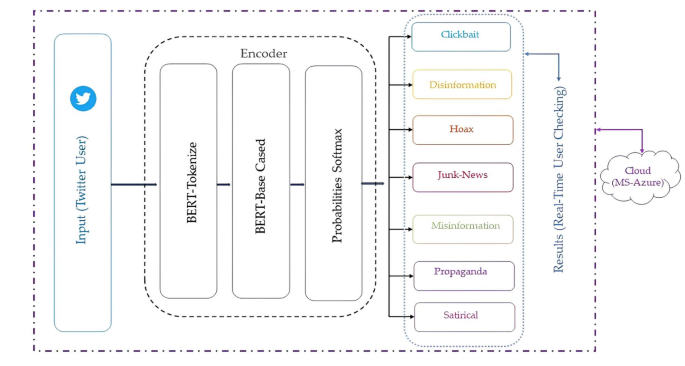
Addressing the limitations of current fake news detection methods, a new system called Fake News Detection on Cloud (FANDC) has been developed. This cloud-based system utilizes the Bidirectional Encoder Representations from Transformers (BERT) algorithm, a powerful NLP tool, to analyze and categorize fake news in real time. Unlike previous approaches, FANDC distinguishes itself by categorizing fake news into seven distinct subcategories: clickbait, disinformation, hoaxes, junk news, misinformation, propaganda, and satire. This granular approach provides OSN users with more detailed insights into the nature of potentially false information they encounter. The system’s cloud-based architecture also offers enhanced security against cyber threats, a crucial aspect often overlooked in previous research.
The FANDC System: Methodology and Innovation
The FANDC system was developed using the Cross-Industry Standard Process for Data Mining (CRISP-DM) methodology. This structured approach ensured a comprehensive and rigorous development process, encompassing data collection, pre-processing, categorization, and system design. A key innovation of FANDC lies in its utilization of a large, system-specific corpus. This departure from reliance on pre-labeled datasets allows for greater adaptability and accuracy in identifying and classifying fake news. The use of distributed and containerized cloud computing infrastructure further enhances the system’s resilience and scalability. This allows the system to handle the vast volume of data generated by OSNs while also mitigating the risk of cyberattacks.
The FANDC System: Addressing the Gap in the Literature
FANDC directly addresses a significant gap in existing research by providing a real-time, online fake news detection system with comprehensive categorization capabilities. Previous studies often focused on either offline analysis or limited categorization schemes. FANDC’s ability to analyze and categorize fake news in real-time empowers OSN users to critically evaluate information as they encounter it. This empowers users to make informed decisions about the information they consume and share, thereby reducing the spread of misinformation. The cloud-based infrastructure ensures the system’s accessibility and scalability, making it a viable solution for widespread adoption.
The FANDC System: Future Directions
The FANDC system represents a significant advance in the fight against fake news. Its ability to categorize fake news in real time, coupled with its robust cloud-based architecture, offers a promising solution for empowering OSN users to navigate the complex information landscape. Further research could explore the integration of FANDC with existing social media platforms to provide real-time feedback to users directly within their browsing experience. Expanding the system’s language support and refining its categorization algorithms are additional areas for future development. The ongoing evolution of fake news tactics will require continuous adaptation and improvement of detection systems, and FANDC provides a strong foundation for these future endeavors.