


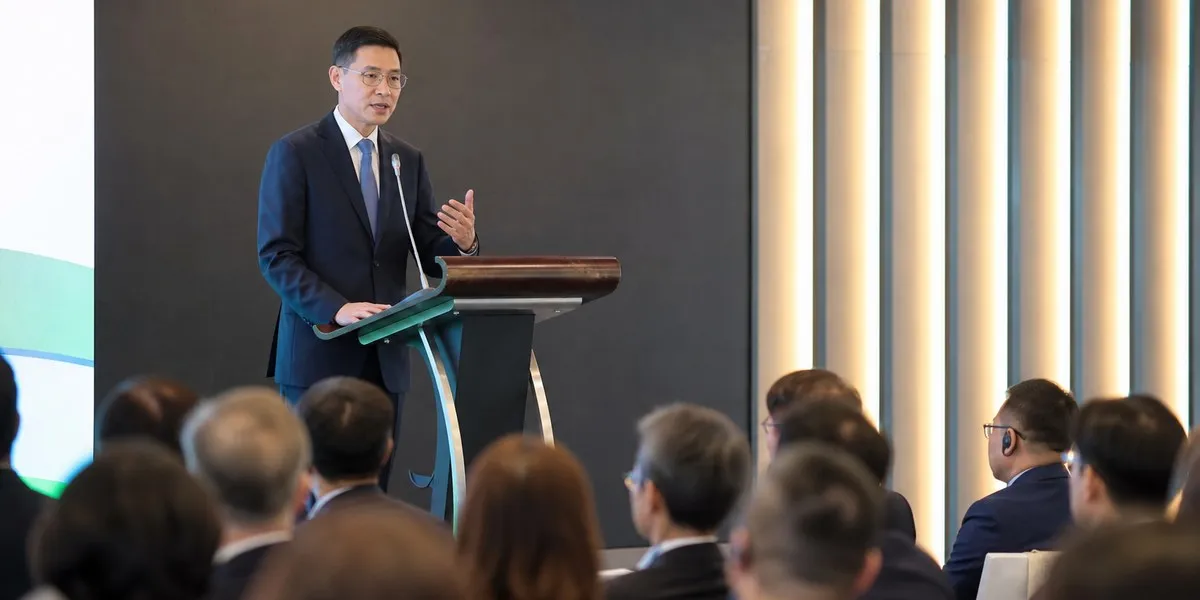
TAIPEI, Taiwan — Former U.S. deputy national security adviser Matt Pottinger urged Taiwanese people to direct their skepticism toward the promises of the Chinese Communist Party rather than toward the United States or Taiwan’s own democratic resilience, according to a report by the Taipei Times. Pottinger delivered a keynote speech at the Resilient Taiwan for Sustainable Democracy 2026 international forum, an event organized by Taiwan’s Presidential Office. Now head of the research and consulting firm Garnut Global, Pottinger said skepticism toward the United States and skepticism toward Taiwan itself are myths that distract attention from the more pressing question of whether Beijing can be trusted to honor its commitments. He argued that the Chinese Communist Party has made sweeping assurances about peaceful coexistence and democratic freedoms while engaging in actions that contradict those assurances. The speech came at a time of heightened cross-strait tensions, with Beijing increasing military, political and economic pressure on the democratic island. Pottinger’s presence at the forum underscored the continued engagement of former senior U.S. officials with Taiwan’s defense needs and democratic institutions. His remarks were designed to counter narratives that the United States is an unreliable partner and that Taiwan is too weak or divided to defend itself. Instead, he said, Taiwanese people should focus their critical attention on the credibility of the Chinese Communist Party, whose promises he suggested have repeatedly proven hollow. The forum itself was conceived as a platform for discussing how a robust democracy can survive in a contested region, and Pottinger’s address set the tone for conversations about defense, technology, disinformation and civil preparedness.
Pottinger is no stranger to Taiwan or to the policy debates surrounding the Indo-Pacific. He served as a deputy national security adviser in the administration of U.S. President Donald Trump and was known for a hawkish approach to China. After leaving government, he founded Garnut Global, a firm focused on geopolitical risk and strategic competition. In his keynote, he drew on years of engagement with Taiwanese officials, military planners and civil society groups. He recalled that during previous visits to Taiwan, he had repeatedly urged authorities to urgently strengthen defense capabilities and social resilience. In his assessment, Taiwan’s current administration is heeding these recommendations, a point he offered as a sign of progress. The Resilient Taiwan for Sustainable Democracy 2026 forum, organized under the auspices of Taiwan’s Presidential Office, was intended to bring together government officials, scholars, business leaders and representatives from allied countries to discuss how a democracy can withstand external pressure. The title of the event suggests a medium-term planning horizon, reflecting concern that pressure on Taiwan could intensify in the coming years. Pottinger’s message was aimed at reinforcing confidence in Taiwan’s ability to adapt and resist coercion. He maintained that while external support is important, Taiwan’s ultimate resilience depends on the willingness of its people and institutions to prepare for crises. By placing the Chinese Communist Party’s promises at the center of public skepticism, he sought to reframe the debate: rather than asking whether Taiwan can trust the United States, Taiwanese voters and policymakers should ask whether China can be trusted to keep its word. That question, he suggested, is answered by Beijing’s behavior in Hong Kong, Macau and elsewhere. Pottinger also stressed the importance of international alliances, but he was clear that Taiwan should not let doubts about its partners become an excuse for inaction. Allowing such doubts to grow, he said, would only play into the hands of those seeking to weaken Taiwan’s will to defend itself.
On the specific question of defense, Pottinger said Taiwan has begun making tangible changes. He cited the updated format of the annual Han Kuang military exercises as evidence that Taiwan’s armed forces are adapting to real-world challenges. The Han Kuang exercises, held for decades as Taiwan’s largest military drills, have been revised in recent years to include more realistic scenarios, including live-fire training, urban warfare, civilian evacuation and coordination with local governments. Pottinger also pointed to urban resilience drills as another indicator of progress. These exercises are designed to prepare residents and municipal authorities for possible emergencies, including natural disasters and military contingencies. He argued that such preparations are essential for deterrence because they demonstrate to any potential adversary that Taiwan is ready to respond. Perhaps the most striking evidence of progress, in Pottinger’s view, is the rapid expansion of Taiwan’s drone industry. He said Taiwan exported 3,000 drones in 2024, and he expects this figure to increase one hundredfold by the end of 2026. If realized, that would mean hundreds of thousands of drones produced and exported in a very short period, a dramatic leap for a sector that was relatively small only a few years ago. Taiwan, he said, has laid the groundwork to become a significant player in the unmanned systems industry, an area of growing importance for modern militaries around the world. Drones have become central to contemporary warfare, as demonstrated by conflicts in Ukraine and elsewhere, and Taiwan’s investment in drone manufacturing and innovation is therefore not just an economic opportunity but a strategic necessity. Pottinger’s remarks suggest that Taiwan’s government has taken seriously the warnings he and other former officials have issued about the need for urgent defense improvements. The combination of more realistic military training, community-level preparedness and a booming drone industry points to a broader shift in Taiwan’s approach to resilience. Rather than relying solely on conventional deterrence, Taiwan is building a layered defense that includes technology, civilian participation and international cooperation. Pottinger’s endorsement of these efforts may carry particular weight because of his experience in the U.S. national security establishment and his long-standing focus on China. He made clear that more remains to be done, but he offered the current trajectory as a reason for confidence.
Pottinger also drew attention to what he described as a coordinated disinformation campaign by Beijing and Moscow. According to his remarks, the two governments are cooperating on social media operations that are amplified by platform algorithms. The goal, he said, is to spread skepticism toward Taiwan and the United States and undermine confidence in both. This is not a new theme in discussions of information warfare, but Pottinger gave it a prominent place in his keynote, warning that such campaigns can erode public trust and weaken democratic cohesion. He argued that foreign adversaries exploit existing divisions and uncertainties, using automated accounts, fake news sites, manipulated videos and algorithm-driven recommendation systems to push narratives that cast doubt on Taiwan’s viability and America’s reliability. In his telling, the disinformation campaign is designed to make Taiwanese people question whether their democracy is worth defending and whether the United States will actually come to their aid in a crisis. These doubts, once planted, can be as damaging as military pressure because they undermine the will to resist. Pottinger called on Taiwanese people to be alert to these tactics and to treat information from untrusted sources with suspicion. But he also suggested that the most effective response to disinformation is not merely debunking individual false claims but building a resilient information environment grounded in free press, civic education and social trust. The mention of Beijing and Moscow together reflects the deepening alignment between China and Russia, particularly since Russia’s full-scale invasion of Ukraine. Both governments have frequently been accused of using information operations to advance their foreign policy objectives. Pottinger’s warning implied that Taiwan is not merely a target of Chinese pressure but part of a broader struggle between authoritarian and democratic models of governance. By exposing the disinformation campaign, he hoped to inoculate Taiwanese society against it. He said critical thinking should be directed toward the source of the problem, which in his view is the Chinese Communist Party and its false promises, rather than toward the United States or Taiwan’s own institutions. His message was a call to action: recognize the threat, prepare for it and do not allow manufactured doubts to take root.
In explaining why Taiwanese people should focus their skepticism on the Chinese Communist Party, Pottinger pointed to Beijing’s record of broken promises. He cited the suppression of freedoms in Hong Kong and the imprisonment of media freedom advocate Jimmy Lai and activist Joshua Wong. When Hong Kong was handed over to Chinese rule in 1997, Beijing promised that Hong Kong’s democratic system and way of life would remain unchanged for 50 years. Pottinger argued that recent events, including the imposition of the national security law and the arrest of pro-democracy figures, demonstrate that this promise has not been honored. Jimmy Lai, the founder of Apple Daily, has been held in detention while facing national security charges. Joshua Wong, a prominent activist in Hong Kong’s democracy movement, has been imprisoned for his political activities. Pottinger presented these cases as evidence that Beijing’s commitments to freedom and democracy are unreliable. He also mentioned former pro-democracy Macau lawmaker Au Kam San, who was imprisoned following what Pottinger described as a secret trial. The case of Au Kam San, less well-known internationally than Lai or Wong, was cited to show that Beijing’s pattern of suppressing dissent extends beyond Hong Kong to Macau as well. For Taiwanese audiences, these examples carry a direct message: if China cannot be trusted to keep its promises in Hong Kong and Macau, there is little reason to trust assurances about Taiwan’s future autonomy. Beijing has repeatedly stated that it seeks peaceful reunification and that Taiwan could maintain a high degree of autonomy under a “one country, two systems” framework. But Pottinger suggested that the experience of Hong Kong casts serious doubt on such assurances. He urged Taiwanese people to critically assess China’s ability and willingness to fulfill its own promises rather than accepting them at face value. His remarks were particularly pointed because they came at a forum dedicated to democracy and resilience. The message was not simply that Taiwan should be skeptical of Beijing, but that this skepticism should be grounded in observable facts and historical experience. Pottinger offered the fate of Hong Kong and Macau as a cautionary tale, urging Taiwan to learn from the experience of other territories that have come under Chinese rule.
Pottinger closed his keynote by invoking a historical figure: former U.S. President Franklin Roosevelt, whom he called an ally of the Republic of China in the fight against tyranny. Roosevelt led the United States through much of World War II and supported China in its war against Japanese invasion. By invoking Roosevelt, Pottinger sought to remind his audience that the United States and Taiwan share a long history of cooperation in defending freedom and democracy. He urged people not to allow doubts to weaken Taiwan’s confidence in its own achievements, defense and resilience. This final appeal was intended to rally the audience around a positive vision: Taiwan has a strong democracy, a capable military, a vibrant civil society and international support. Pottinger argued that these assets, combined with a clear-eyed view of the threats Taiwan faces, are enough to sustain hope. He acknowledged that the challenges are real, but he insisted that Taiwan is not alone and not powerless. The forum, Resilient Taiwan for Sustainable Democracy 2026, is part of a broader effort to prepare the island for the challenges ahead. Pottinger’s speech, with its mixture of warning and encouragement, fit squarely within that mission. He left the audience with a simple but pointed conclusion: the most important question is not whether Taiwan can trust the United States, but whether it can trust the Chinese Communist Party. Based on the evidence he cited, his answer was clear. He called on Taiwanese people to preserve their skepticism for Beijing, to strengthen their defenses, to guard against disinformation and to take confidence in their own democratic achievements. Whether those appeals will be heeded remains to be seen, but Pottinger’s speech added a prominent voice to the ongoing debate about Taiwan’s future. As Taiwan continues to face military pressure, diplomatic isolation and information warfare from Beijing, the message of resilience is likely to grow even more important. Pottinger’s presence at the forum, and his forceful defense of Taiwan’s right to exist as a free society, reflected the continuing engagement of former U.S. officials in the region. The event ended with a renewed call for vigilance, unity and confidence.