


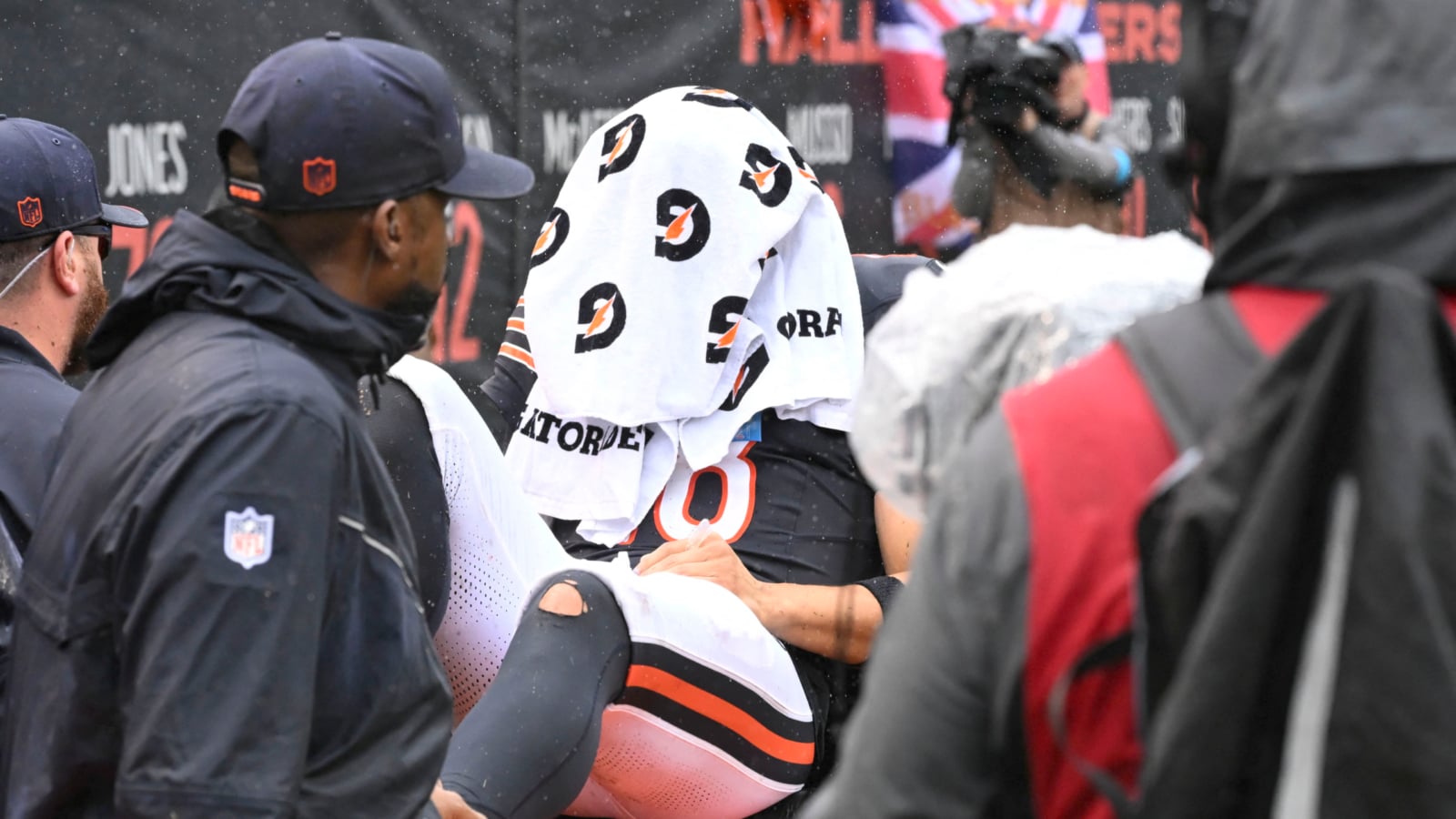
Dave Portnoy, the outspoken founder of Barstool Sports, has accused Chicago Bears quarterback Caleb Williams of spreading false information about him after Williams amplified another user’s post instead of directly responding to criticism of his theatrical reaction to a relatively minor hamstring injury. Portnoy said he woke up Tuesday morning to find the Bears signal-caller “spreading disinformation” about him, and quickly laid out his own version of an older confrontation that the retweet had twisted into a misleading narrative. The episode began when Williams, the No. 1 overall pick and the presumed face of the Bears franchise, left Sunday’s game against the Minnesota Vikings with a hamstring injury. What drew Portnoy’s attention was not the injury itself but the way Williams reacted—being carted off, flashing a thumbs up as if his season were over, and making enough noise that many viewers assumed he had suffered a catastrophic tear. Portnoy, never shy about voicing an opinion, mocked Williams for the melodrama, especially after later evaluation showed the injury to be a strain rather than a season-ending ailment. Williams did not quote-tweet Portnoy, nor did he write his own reply. Instead, he chose to repost someone else—a decision Portnoy dismissed as “weak sauce.” The Barstool Sports account piled on with a meme, tweeting “Legs fell asleep on the toilet this morning” alongside a pointed joke aimed at the quarterback’s over-the-top exit. The entire episode has become a cultural flashpoint, pitting a brash media personality against one of the NFL’s most promising young quarterbacks and raising questions about whether Williams is prepared for the relentless scrutiny that comes with leading a franchise in a city like Chicago.
The controversy did not emerge from nowhere. Williams left the game against Minnesota after injuring his hamstring, and his exit was dramatic by any standard. Television cameras captured him grabbing the back of his leg, collapsing to the turf, and then being loaded onto a cart. The thumbs-up he gave as he was driven off the field was interpreted by many as a signal that his day was over, but the gesture also carried an undeniable theatrical flair. On the sideline, Williams was visibly upset, and the audible frustration only increased the perception that he had suffered a devastating injury. When the Bears announced it was a hamstring strain, and when Williams was seen moving around the facility with relative ease, the mockery began. Portnoy was among the loudest voices, suggesting that the quarterback had turned a minor injury into a dramatic production. The “Legs fell asleep on the toilet” meme from Barstool Sports was aimed directly at Williams, mocking the exaggerated reaction. What made Williams’s response notable was the choice of weapon. Rather than addressing Portnoy directly, or brushing off the criticism, he went to social media and shared a post from a user with a relatively small following. The post in question claimed that Portnoy had once had a kid arrested and expelled from school for throwing pennies at him, then used that story to laugh at Portnoy for calling anyone else soft. The implication was that Portnoy, who criticized Williams for being overly sensitive, had himself been overly sensitive when confronted with coin-throwing. It was a classic attempt to turn the tables, but the facts did not support it. Portnoy, upon seeing the retweet, immediately pushed back. “I didn’t get anybody arrested or kicked outta school,” he posted. “That moron threw s— at me on camera in the middle of a pizza review, and it went viral. Play stupid games, win stupid prizes.” The response was vintage Portnoy—blunt, confrontational, and unapologetic. But it also exposed a key problem with Williams’s strategy: by sharing a post with factual problems, the quarterback handed Portnoy an easy counterpunch. Instead of changing the conversation, Williams extended it and made himself look like someone who relies on others to fight his battles.
At the center of the dispute is a 2025 pizza review Portnoy filmed in Starkville, Mississippi. Portnoy has become famous for his “One Bite” pizza reviews, traveling to pizzerias across the country and rating slices with a simple, often brutally honest formula. During this particular review, he was not just evaluating pizza; he became the target of a disturbance. According to the account Portnoy outlined, a Mississippi State student threw coins at him while he was on camera and also directed antisemitic remarks at him. The incident was caught on video and quickly went viral. The student was subsequently arrested and later left the school. Portnoy’s version of events is starkly different from the one shared by Williams. The post Williams amplified claimed Portnoy had a kid arrested and expelled for throwing pennies at him, framing it as an overreaction and casting Portnoy as someone who could dish out criticism but could not take it. Portnoy rejected that framing, emphasizing that the incident was not a harmless prank. The use of the word “s—” in his response was deliberate; he wanted to make clear that what was thrown at him and what was said were not simple childish antics. “I didn’t get anybody arrested or kicked outta school,” he insisted. “That moron threw s— at me on camera in the middle of a pizza review, and it went viral. Play stupid games, win stupid prizes.” By sharing the compressed and misleading version of the story, Williams gave it a massive audience. The original post had a tiny following, likely a few hundred or thousand accounts. After Williams retweeted it, the post ballooned to tens of thousands of likes and more than a million views. That kind of amplification is not neutral. In the age of social media, a retweet from a star athlete can turn a fringe narrative into a mainstream story. Williams may not have written the post himself, but by sharing it he effectively endorsed it. And when the post contained false or misleading claims, Williams became responsible for spreading them. Portnoy, for his part, seemed to understand the stakes immediately. His response was designed to correct the record, but also to put the pressure back on Williams. “When they go low, I go high! Go Bears!” he wrote, while also taking a jab at the quarterback’s injury.
Perhaps the most surprising part of Portnoy’s response was his willingness to let the incident go. “Regardless, I will not hold this against Caleb,” he wrote. “He’s an emotional guy and in his feelings after tweaking his hammy. I am rooting for him and all of Chicago. I can’t wait to see 18 back on the field this week after that season-ending injury.” The statement was a mix of generosity and sarcasm. Portnoy was saying, in effect, that he understood Williams was upset and acting out of emotion, but he could not resist pointing out the absurdity of calling a hamstring strain a season-ending injury. The phrase “season-ending injury” was clearly a jab, referencing the dramatic way Williams reacted to the injury. Portnoy also included the phrase “when they go low, I go high,” a line borrowed from Michelle Obama, to signal that he was taking the high road—at least by his own standards. The “Go Bears” at the end was another layer of mockery. Portnoy may genuinely want the Bears to do well, but including that phrase in a post that also accused Williams of spreading disinformation was not a simple expression of fandom. It was a way of saying that he was above the petty feud, even as he continued to needle Williams. The response was carefully constructed to make Portnoy look reasonable and Williams look like someone who was in his feelings. Whether Williams intended it or not, the quarterback’s decision to share the misinformation gave Portnoy an opportunity to cast himself as the victim of a false attack. Portnoy has built a career out of turning controversy into content, and this exchange was no exception. By responding quickly with receipts and a clear narrative, Portnoy managed to control the conversation. Williams, by contrast, remained largely silent, letting the posts speak for him. That silence, combined with the factual problems in the shared post, left Williams looking like he had not thought through the consequences. In the court of public opinion, the first clear and coherent story often wins. Portnoy delivered that story within hours. Williams had not, at least as of the time of the report, offered a correction or an explanation. That asymmetry is significant for a player who is supposed to be a leader on and off the field.
The larger problem with Williams’s handling of the situation, according to the report, is not just the cart-off, the thumbs-up, or the screeching on the field. It is how he chose to answer the pile-on. In addition to sharing the post about Portnoy having a kid arrested, Williams also amplified another post that argued people trying to emasculate him may not be honest about why. “The constant need to emasculate the dude is so strange,” the post read. “Starting to think the people who do it are actually attracted to him and won’t be honest with themselves.” This line of argument is not new; athletes and public figures often respond to criticism by questioning the motives of their critics. But in this context, it came across as an attempt to deflect. Williams did not address Portnoy by name. He did not correct the arrest claim. He did not explain why he had shared a post with clear factual problems. Instead, he let smaller accounts make the case for him and then hit “repost.” The report described this as “keyboard warrior” behavior, noting that a quarterback already being called soft chose an indirect clapback. The decision to share a post suggesting that critics are secretly attracted to him was unlikely to change anyone’s mind. It may have energized his supporters, but it also gave his detractors more ammunition. “He’s doing a pretty good job of it himself,” the report concluded, referring to the emasculation critique. That line captures the irony of Williams’s strategy. By hiding behind reposts and anonymous accounts, he reinforced the very narrative he was trying to combat: that he was not tough enough to handle criticism directly. Portnoy, for all his bombast, responded directly, named the accusation, refuted it, and moved on. Williams, by contrast, seemed to be circling the wagons, relying on third-party posts to make his case. In a media environment that rewards direct engagement and punishes evasion, that approach rarely works. For a young quarterback in a demanding football market, it could be especially damaging. The Bears selected Williams to be the face of the franchise, someone who could handle the pressure of playing in Chicago. This episode raised legitimate questions about whether he is ready for that kind of scrutiny.
Ultimately, this episode is about more than a social media spat between a media mogul and a quarterback. It is about accountability, information, and the pressure of being an NFL star in the digital age. Williams, who was the No. 1 overall pick and has been hailed as the potential savior of the Bears, is under intense scrutiny. Every move he makes, on and off the field, is analyzed and critiqued. His decision to leave Sunday’s game with a hamstring injury was not just a football story; it became a character story. Portnoy, a polarizing figure with a massive following, turned the injury into a running joke. Williams’s response—amplifying a misleading post about Portnoy—was an attempt to change the narrative, but it backfired. Instead of exposing Portnoy as a hypocrite, Williams opened himself up to charges of spreading disinformation. That is a significant misstep for any public figure, but especially for a quarterback whose job requires leadership, poise, and judgment. The Bears cannot be happy with the distraction. They have a young franchise quarterback who is supposed to be focused on improving and leading the team, not engaging in social media battles with a barstool personality. While Portnoy said he is rooting for Williams and cannot wait to see him back on the field, the underlying tension is unlikely to disappear. Portnoy is not known for letting things go easily, and Williams has shown that he is sensitive to criticism. If the Bears struggle, this story could resurface. If Williams plays well, it will fade into the background. But the lesson from this week is clear: in the modern NFL, a quarterback’s judgment is not limited to the field. Every post, every retweet, every reaction is part of the public record. Williams chose to share a false story instead of confronting his critic directly. That choice says something about who he is and how he handles pressure. Whether he can learn from it and grow remains to be seen. But for now, Portnoy got the last word. And in the world of sports media, that is often the only word that matters.